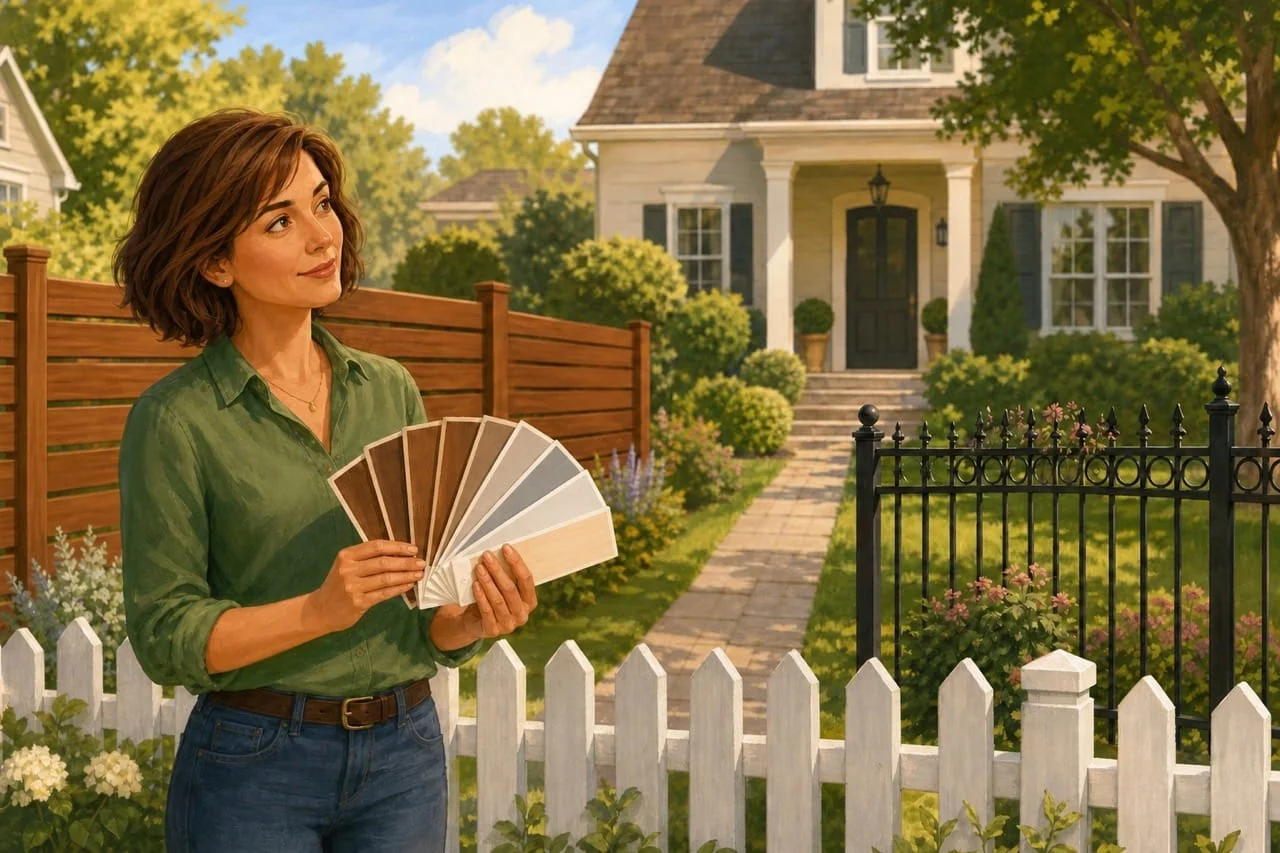
We didn’t start our fence project thinking about curb appeal. We started it thinking about the dog. But somewhere between measuring the property line and pricing materials, something shifted. We started noticing every fence on our street — which ones made a house look polished, which ones looked like afterthoughts. That’s when we realized: a fence isn’t just a boundary. It’s a design choice that affects how your whole property reads.
Here’s what we learned.
The Front Yard: Modern Black Aluminum Makes a Statement
When we started researching front yard fence options, we kept coming back to black aluminum. It shows up everywhere on newer homes and craftsman-style houses, and there’s a reason for that — it does a lot with very little.
The open-picket design lets your landscaping breathe. You’re not blocking the view of the house; you’re framing it. A well-planted front yard behind a clean black aluminum fence looks intentional in a way that a solid privacy fence never could from the street.
Bob was immediately interested from a maintenance standpoint. Aluminum doesn’t rust, doesn’t need painting, and holds its color for years without refinishing. “If we’re spending this much, I want something that lasts without me out here every spring with a brush,” he said. That’s basically aluminum’s pitch, and it delivers.
Style-wise, black aluminum pairs well with:
- Modern and contemporary homes — the clean lines match
- Craftsman and bungalow styles — black picks up window trim and porch details
- Colonial homes — especially with a classic flat-top or spear-top picket profile
If you’re picturing before and after: imagine a front yard with no fence, just a lawn that bleeds into the sidewalk. Then add a 3-foot black aluminum fence with a matching gate, some boxwoods inside the line, and suddenly the house has presence. That’s the upgrade.
The Backyard: Classic Wood Dog-Ear for Privacy and Warmth
The backyard is a different job. We wanted privacy, not a view. And we wanted it to feel like an actual outdoor room, not a containment zone.
Wood was the obvious choice, and after a lot of back-and-forth we landed on a classic dog-ear board-on-board style at 6 feet. The dog-ear profile — that angled cut at the top of each picket — is traditional without being fussy. It works on almost any house.
What surprised us was how much the finish decision mattered. Staining versus painting is a real fork in the road:
Staining keeps the natural grain visible, ages more gracefully, and when it’s time to redo it, you’re refreshing rather than stripping. Alice preferred this from the start — “It just feels warmer. Like it belongs in a backyard.”
Painting gives a crisper, more finished look and lets you match your house trim exactly. It’s a stronger visual statement, but repainting eventually means prep work and the risk of peeling if moisture gets in.
We went with a semi-transparent cedar stain, and two years later it still looks good. The maintenance reality: plan to re-stain every 3–5 years depending on sun exposure. Not a huge ask for how much the space changed.
On height: 6 feet is the privacy standard, but some municipalities require permits above 6 feet. Check local rules before you order. We almost didn’t.
Mixing Styles: Front Showpiece, Private Backyard
This is the part most fence guides skip, but it’s where a lot of homeowners get stuck. How do you use two completely different fence styles on the same property without it looking like an accident?
The answer is transition points and shared elements.
Where your front yard fence meets your backyard fence — usually at the side of the house — that connection point needs to look intentional. A few things that help:
Match your gate hardware. We used the same matte black hardware on both the aluminum gate and the wood side gate. Small thing, huge difference.
Keep your post caps consistent. If your aluminum posts have flat black caps, use flat black post caps on your wood fence posts too. It reads as a system instead of two separate projects.
Use color to bridge the gap. We stained our wood fence a warm brown that picks up the cedar tones in our siding. The black aluminum out front matches the black shutters. Neither fence looks random because both are reacting to the house.
Alice’s take: “I was worried it would look mismatched. But because both fences are clearly doing different jobs — one’s decorative, one’s for privacy — it actually makes sense that they’re different materials.”
Quick Guide: Matching Fence Style to Home Exterior
| Home Style | Front Yard | Backyard | Colors That Work |
|---|---|---|---|
| Colonial | Aluminum spear-top or classic picket | Wood privacy, painted white or black | White, black, dark green |
| Ranch | Low horizontal aluminum or split-rail | Wood privacy, stained natural | Natural wood tones, black |
| Modern/Contemporary | Flat-top black aluminum | Horizontal wood slat or composite | Black, dark gray, warm brown |
| Farmhouse | White vinyl picket or wood board-and-batten | Wood privacy, painted white | White, gray, natural |
| Craftsman | Black aluminum with classic picket profile | Wood privacy, stained warm tone | Black, cedar, olive |
This isn’t a rigid formula. But if you find your home style in that list, it’s a useful starting point when you’re standing at the showroom trying to decide between five options that all look fine in isolation.
The Upgrade Is Real
We kept going back and forth on whether a fence was really worth the investment. Then we finished it. The front yard looks like a different property — defined, planted, cared for. The backyard finally feels like a room. Neighbors have commented. Our kids use the yard more because it feels enclosed and comfortable.
The fence didn’t just mark the property line. It changed how the whole place feels.
If you’re thinking about making the same move, Fence Deck Supply carries aluminum, vinyl, and wood fence systems — the same materials we’ve been researching. Worth a look before you commit to anything.