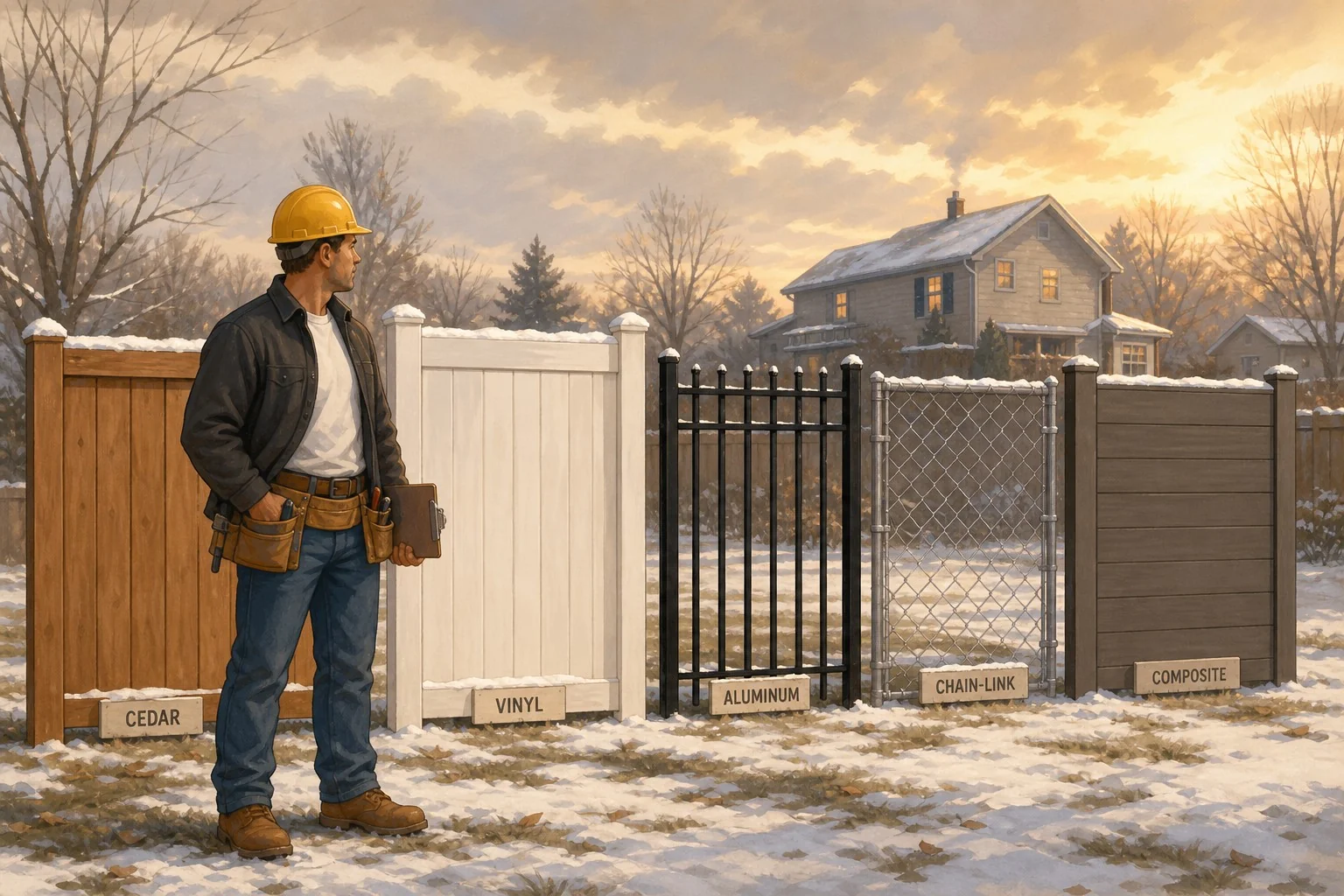
Pennsylvania winters don’t give you a clean break. You get freezing rain on top of snow on top of mud. Temperatures drop below zero, bounce back to 45 degrees, then drop again. The ground heaves. Posts shift. And come March, you find out whether your fence was built to handle any of that — or just built to look good in the listing photos.
I’ve pulled out more rotted fence posts and re-plumbed more leaning panels than I can count. Most of those jobs were preventable. The fence wasn’t wrong — the material choice was wrong, or the install was done without thinking about what Pennsylvania ground does from November through April.
Here’s what actually holds up, and why.
1. Aluminum
This is my first recommendation for most homeowners. Aluminum doesn’t rust, it doesn’t absorb moisture, and it doesn’t care about freeze-thaw cycles. The posts aren’t going to rot out in five years, and the panels aren’t going to warp when the temperature swings 40 degrees in a weekend.
It’s not a cheap option, but it’s a long-term one. If you’re putting up a fence around a yard that sees real Pennsylvania weather, aluminum is the material you’re not going to regret.
The one caveat: aluminum is not a privacy fence. It’s ornamental — open picket style. If you’re looking for a solid barrier, this isn’t it.
2. Vinyl
Vinyl gets a bad reputation it mostly doesn’t deserve. Good-quality vinyl installed correctly will outlast wood in this climate by a wide margin. It doesn’t rot, it doesn’t need staining or sealing, and it doesn’t absorb water that then freezes and cracks it apart.
The keyword is “installed correctly.” Vinyl posts need to be set deep — deeper than you think — and in most Pennsylvania yards, that means getting past the frost line, which sits around 36 inches. Set a post shallow and the ground will heave it right out of the ground by February. I’ve seen whole fence lines tilted like dominoes because a crew went cheap on post depth and backfill.
Good vinyl is also thick-walled vinyl. The thin stuff yellows, cracks in cold weather, and looks terrible inside of ten years. You get what you pay for.
3. Pressure-Treated Wood
Wood gets a harder time than it deserves when it comes to winter performance — if it’s the right wood handled the right way. Pressure-treated pine, set on concrete footings below the frost line, will last decades in Pennsylvania.
The problems people run into are usually: untreated or minimally treated wood, posts set in dirt instead of concrete, and wood that sits in pooled water at ground level. Fix all three of those, and wood performs well.
You do have to maintain it. Stain or seal it every few years. Let it go, and moisture gets in, and then winter does the rest. But a homeowner willing to do some basic maintenance can have a wood fence that looks good for 20 or 30 years.
One job I remember off the top of my head — pulled out a 6-year-old wood privacy fence in Northeast Philly that looked like it had been there since the ’70s. Owner had no idea the posts were sitting in water every spring. The bases had completely rotted while the top half of the fence looked fine. You’d never have known until you grabbed a post and it moved in your hand. Below-grade drainage matters as much as the wood choice.
4. Steel (Chain Link and Welded Panel)
Chain link gets no respect, but it’s one of the most durable fencing options available for Pennsylvania conditions. Galvanized steel doesn’t care about frost heave the way wood does. The posts flex slightly rather than cracking, and the mesh itself isn’t fighting freeze-thaw at every joint.
Neither of these is a beauty contest winner. Chain link is utilitarian, but if function is your priority and aesthetics are secondary, steel holds up better than almost anything else through a hard winter.
What Pennsylvania Winters Actually Do to Your Fence
Before you pick a material, understand what you’re up against.
Frost heave is the big one. When water in the soil freezes, it expands — and it pushes everything upward. Posts set above the frost line will move. Sometimes an inch. Sometimes six inches. A post that’s heaved out of position doesn’t go back down neatly when the ground thaws. It stays crooked, and now your panels don’t hang right, and now you’ve got a fence that looks like it survived something it almost didn’t.
Set posts below the frost line. In Pennsylvania, that’s generally 36 inches minimum. In colder pockets of the state, go deeper. This applies to every material on this list.
Freeze-thaw cycles are what kills the materials themselves. Water gets into any crack, gap, or pore — then it freezes, expands, and makes the crack bigger. Next thaw, more water gets in. Repeat this 40 or 50 times over a winter and spring, and you’ve got a fence that’s been attacked from the inside all season.
Wood is most vulnerable to this. Untreated or poorly sealed wood soaks up water aggressively. Vinyl and composite are largely immune if they’re good quality. Metal doesn’t absorb water, so freeze-thaw cycles affect metal mostly at fasteners and cut ends — which is why you seal cut ends of aluminum or steel.
Snow load and ice weight can bend or break panels if your fence isn’t built for it. A heavy wet snow sitting on a top rail for three days is real weight. Aluminum and steel handle it fine. Cheap vinyl can crack under load. Wood usually flexes enough to survive unless there’s significant rot already present.
The Bottom Line
If you want low maintenance and long life: aluminum. If you want privacy and don’t mind maintaining it: treated wood done right. If you want privacy without the maintenance: vinyl, but pay for quality and set the posts deep. If you want pure durability and don’t care how it looks: steel.
Any of these will hold up in Pennsylvania if they’re installed properly. None of them will hold up if they’re not. The fence doesn’t fail — the install does.
Get your post depth right. Get your footings in concrete. Make sure water drains away from your post bases. Do those three things and whichever material you choose will still be standing when your neighbor’s rotted wood fence is kindling.