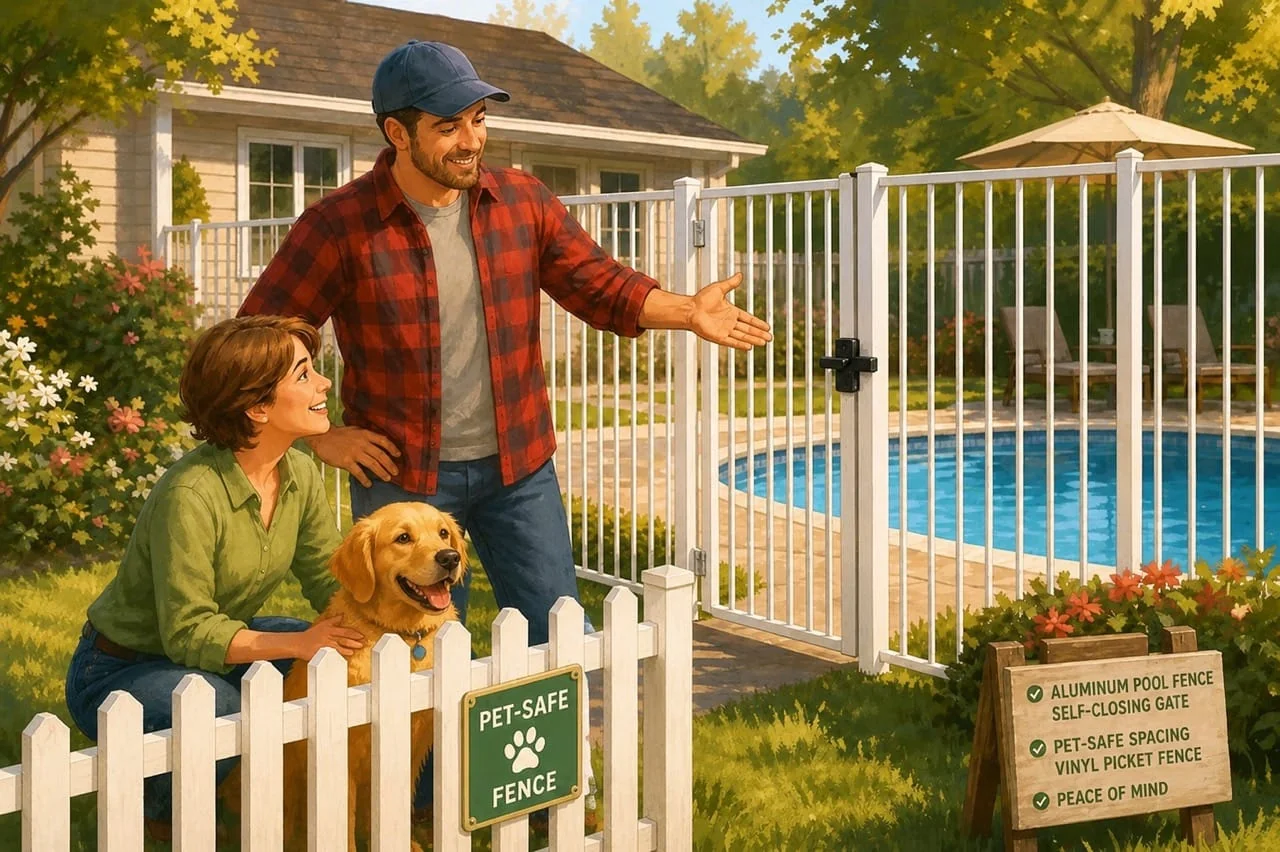
When we started talking about redoing our backyard fence, we thought it was mostly an aesthetic decision. New fence, fresh look, done. Then we started actually thinking about why we needed one — and the list got real fast. We have a dog. We have kids who visit. And we live on a corner lot with more foot traffic than we’d like. Suddenly “something that looks nice” became “something that actually works.”
Here’s what we learned about fencing built for safety — not just curb appeal.
Fencing for Dogs: It’s More Complicated Than Height
The first thing Bob researched was how high the fence needed to be for our dog, a border collie mix who has cleared a 4-foot fence before. (Yes. Cleared it. We know.)
What surprised us: it’s not just about height. It’s height plus spacing plus what’s happening at the ground line.
Height by breed:
- Small dogs (beagles, corgis, terriers): 4 feet is usually fine, but watch for diggers
- Medium and athletic breeds (labs, huskies, border collies): 5–6 feet minimum — and sometimes that’s still not enough for determined jumpers
- Large working or guard breeds: 6 feet, no question
For jumpers, Alice found a useful tip: solid panels are actually better than picket or lattice styles because the dog can’t see through to get excited and launch. Less visual stimulus, less motivation.
Spacing matters too. If you have a small dog, standard 3.5-inch picket spacing can be an escape route. Look for closer spacing — some vinyl and aluminum panels come in 1.5 to 2-inch spacing for exactly this reason.
The no-dig problem. This was the one we hadn’t thought about at all. Some breeds — terriers especially, but also huskies and any dog that gets bored — will dig under a fence. Solutions we looked at:
- L-footer: a strip of wire mesh bent flat along the ground extending outward, buried a few inches. Dogs hit the mesh before they can dig deep enough to get under.
- Concrete apron: more permanent, more expensive, but very effective along the fence line.
- Concrete footings that go deeper than standard (18–24 inches instead of the typical 12) help too, especially with wood posts.
Our dog is a jumper, not a digger, so we went with 6-foot vinyl privacy panels and breathed easier.
Pool Fences: The Codes Are Specific for a Reason
When Bob’s sister mentioned she was getting a pool, we got deep into this research alongside her. Pool fencing codes are not just suggestions — most municipalities require them, and they’re written the way they are because of drowning statistics.
The baseline most inspectors use (often based on the International Residential Code or local equivalents):
- Minimum 48 inches (4 feet) tall — many jurisdictions require 5 feet
- No openings larger than 4 inches (so small children can’t squeeze through or get footholds)
- Self-closing, self-latching gate that opens away from the pool
- Latch must be at the top of the gate, or on the pool side, out of a child’s reach
The self-closing gate was one we almost overlooked. If someone leaves the gate propped open — which happens constantly at parties — the whole system fails. A self-closing gate with a spring mechanism means it closes behind every single person. It’s the most important feature on the list and easy to add.
Aluminum vs. vinyl for pool enclosures:
We looked at both. Here’s how Bob broke it down:
Aluminum is the industry standard for pool fencing. It doesn’t rot, doesn’t warp in humidity, and can be powder-coated in any color. The typical 4-inch spacing between pickets meets most codes, and it looks clean and unobtrusive — you can see the pool from the house, which is actually a safety feature (easy supervision). It’s low maintenance and holds up to pool chemicals splashing on it.
Vinyl offers more privacy and is solid enough to block sightlines — which some people prefer. It’s also zero-maintenance. The tradeoff: you can’t see through it, so you lose the visual supervision angle. Some pool enclosure codes also require the fence to be “non-climbable,” and solid vinyl panels can actually be easier to climb than aluminum pickets because there’s no footing problem but more surface to push off from.
For most pool setups, aluminum is the right call. It’s what code was basically written around.
One thing her inspector specifically checked: the spacing between the bottom of the fence and the ground. No more than 4 inches there either. We had to make sure the grade was consistent all the way around.
Serious Perimeter Fencing: When You Need More Than a Property Line
This one came out of our own situation. We’re on a corner lot on a moderately busy street. We also know a few neighbors who run small home businesses — a dog groomer, someone who does auto detailing — and their perimeter needs are different from a standard residential yard.
A few scenarios where “standard” fence thinking doesn’t cut it:
Corner lots: You have more linear footage, more exposure, and foot traffic from two streets. We ended up running our fence slightly inside the property line (check with your municipality — there are often setback requirements) and used a heavier-gauge post at the corner itself. Corner posts take more lateral stress than line posts; undersizing them is a common mistake.
Busy streets or cut-through traffic: We added a solid privacy panel section along the street-facing side specifically to discourage people from using our yard as a path. It worked.
Home businesses: If you have clients coming and going, deliveries, equipment, or liability concerns, you’re essentially thinking about commercial-grade perimeter logic on a residential property. That often means:
- Heavier post spacing (8 feet vs. 10 feet on center)
- Gate hardware rated for higher cycles (residential gates are usually rated for home use, not 30 opens per day)
- Possibly a double-wide drive gate if equipment or vehicles need access
The thing Alice kept pointing out during all of this: the fence has to match the reason you’re building it. A beautiful cedar privacy fence means nothing if the dog can dig under it, or if the gate doesn’t latch automatically, or if the posts aren’t deep enough to handle a corner.
The Part We Wish Someone Had Told Us First
Before you buy anything, pull your local fence permit requirements and your HOA rules (if applicable). Then find out whether your municipality has adopted pool fence codes, and if so, which version. These details change what you can and can’t install — and it’s a lot easier to know that before you purchase.
We also learned to look at fence systems rather than individual components. A fence rated for pool safety, with code-compliant picket spacing and a self-closing gate package, is worth the slightly higher price over piecing it together yourself and hoping it passes inspection.
Fence Deck Supply carries pool-rated and pet-safe fence systems — aluminum pool fence packages, vinyl options with tight spacing for dogs, and the gate hardware that makes everything work together. If you’re building for safety, it’s worth talking to someone who knows which systems are inspection-ready in your area.
We spent three weekends researching this before we touched a post hole digger. You don’t have to.