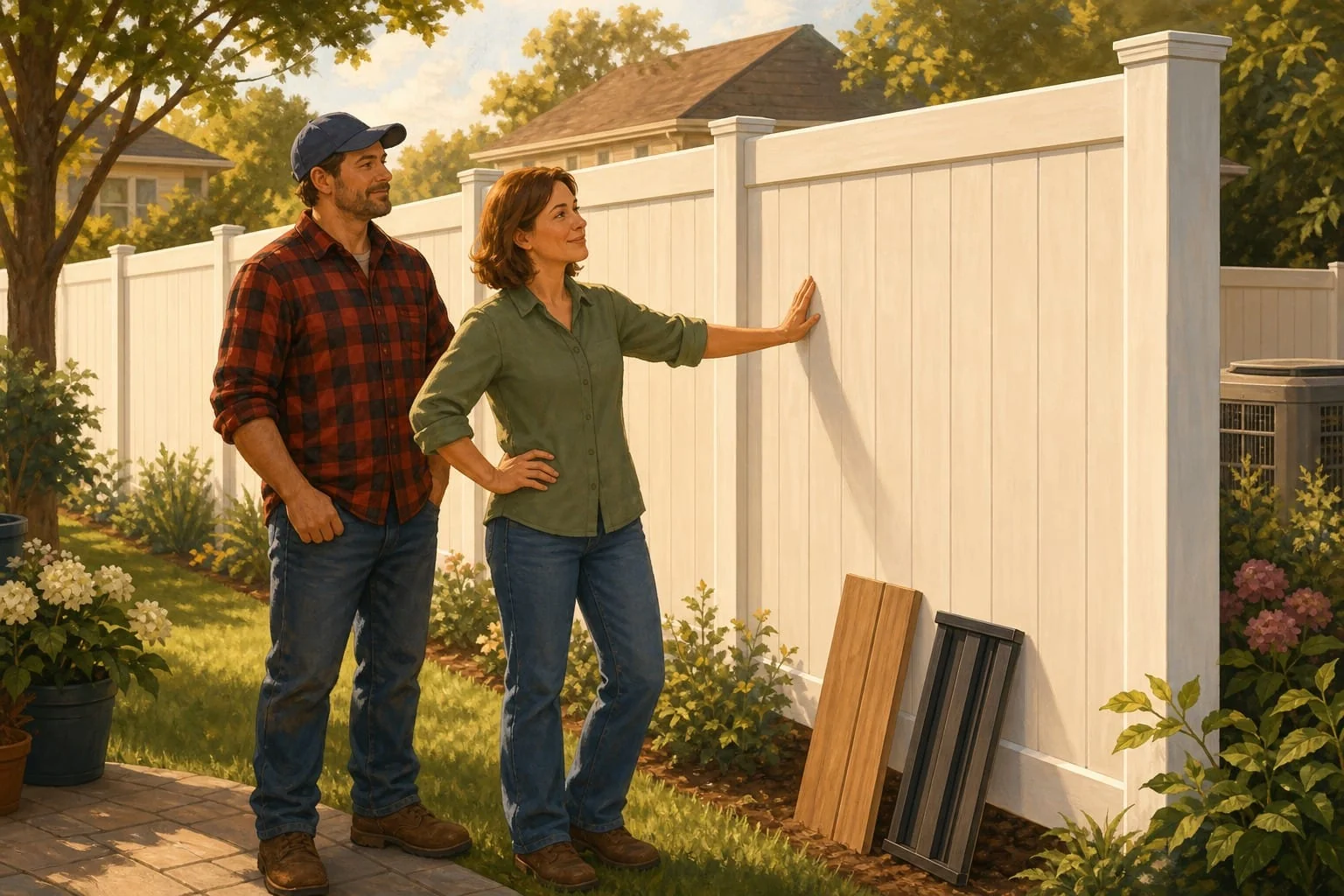
We’d been putting off the backyard privacy project for two summers. Not because we didn’t want it — we really did — but because every time we started researching, the options multiplied and we’d get stuck. Wood or vinyl? Full panels or lattice on top? What about the side yard where there’s barely four feet between our fence and the neighbors’?
This past spring we finally committed. And what we learned along the way was more useful than anything we’d read online before starting.
Choosing a Privacy Fence for Your Patio
The patio was our starting point. We wanted to sit outside in the evening without feeling like we were in a fishbowl.
Most privacy fences come in three materials: wood, vinyl, and aluminum. We ruled out aluminum quickly — it’s great for decorative or semi-private looks, but full privacy panels in aluminum aren’t common and the cost didn’t make sense for what we needed. That left wood and vinyl.
Wood has that warm, natural look we both like. The downside Bob kept coming back to: maintenance. Staining, sealing, watching for rot at the base posts. “If we’re spending this much, I want something that lasts without a yearly project,” he said. He wasn’t wrong.
Vinyl felt like the practical choice. No painting, no staining, holds up in rain and freeze-thaw cycles. The quality has improved enough that it doesn’t look cheap anymore — especially the thicker-walled panels. We ended up going with a 6-foot privacy vinyl fence for the patio perimeter, and we haven’t regretted it.
On height: 6 feet is the standard for backyard privacy and usually the max your municipality allows without a permit variance. If you’re on a slope or have neighbors with a raised deck, you might look into whether 7-foot or stepped panels are an option. We’re on a flat lot, so 6 feet worked perfectly.
Style-wise, a full tongue-and-groove privacy panel gives you zero sight lines. If you want some light and airflow, a board-on-board style leaves small gaps while still blocking direct views. We went tongue-and-groove for the patio side, board-on-board for the back property line where we wanted a little more breeze.
The Side Yard Problem: Narrow Spaces and Neighbor Separation
Our side yard is tight — maybe five feet wide between the house and the property line. This was honestly the trickiest part of the project.
A few things we figured out:
First, measure before you buy anything. A 4-foot-wide gate panel doesn’t work in a 3.5-foot opening. Sounds obvious until you’re standing in a lumber yard holding a tape measure you should have brought three weeks ago (that was us).
Second, narrow side yards usually don’t need the same 6-foot height as the back. We did 4-foot white vinyl panels along the side to mark the property line cleanly without making the passage feel like a tunnel. It solved the neighbor-separation issue — no one’s accidentally walking through each other’s space anymore — without closing things off completely.
White vinyl in particular was Alice’s call for the side yard. “It makes the narrow space feel lighter,” she said. She was right. Darker or natural wood tones would have made that corridor feel smaller.
If your side yard serves as an actual walkway to the back, consider gate placement carefully. We added a simple swinging gate at the front of the side yard so the space is accessible but defined.
Screening Eyesores: Trash Cans, AC Units, Pool Equipment
Here’s the part nobody writes about enough: hiding the stuff you don’t want to look at.
Our AC condenser sits right outside the back door. We have a trash and recycling area against the garage. And our neighbor has pool equipment that hums on their side of the shared fence line. None of these problems needed a full 6-foot privacy fence — they just needed thoughtful screening.
For trash and recycling, we built a small enclosure using three short fence panels (about 4 feet tall) arranged in a U shape, with a gap at the front wide enough to roll bins in and out. Lattice panels on top let air circulate, which matters more than you’d think — a fully enclosed bin area in summer gets unpleasant. Decorative lattice also softens the look so it doesn’t feel like a utility box.
For the AC unit, we used two fence panels set at an angle to create an L-shaped screen. The key is leaving 12–18 inches of clearance on all sides so airflow isn’t restricted — your HVAC tech will thank you. Some people use slatted screens or decorative metal panels for this; we kept it consistent with the rest of the fence.
Pool equipment enclosures work similarly. The goal is blocking the visual without trapping heat or blocking service access. A three-sided panel enclosure with an open or lattice top is usually the right call.
Fence + Landscaping: When the Two Work Together
We didn’t want the fence to be the only thing doing the work. A fence by itself can look stark, especially when it’s new. Landscaping along the fence line changes everything.
A few combinations we either used or seriously considered:
Climbing plants on lattice tops. We added a 1-foot lattice extension to the top of our patio fence panels and planted climbing hydrangea on one corner. It’ll take a couple seasons to fill in, but it already softens the look. Clematis and wisteria are faster growers if you want quicker results — just know wisteria gets aggressive.
Garden beds along the fence line. We put a narrow raised bed along the back fence — about 18 inches deep — planted with ornamental grasses and black-eyed Susans. The plants don’t replace the privacy the fence provides, but they create a layered look that feels intentional rather than institutional.
Hedge and fence pairings. If you’re willing to play the long game, planting arborvitae or boxwood in front of a fence gives you living privacy that grows taller over time. We saw this in our neighbors’ yard and it looks great. The fence provides immediate privacy; the hedge eventually takes over the job and adds texture.
The combination approach also helps with noise. A solid fence reflects some sound, but a dense planting in front absorbs it. We’re right off a busy road in the back, and the fence-plus-grasses combo made a noticeable difference.