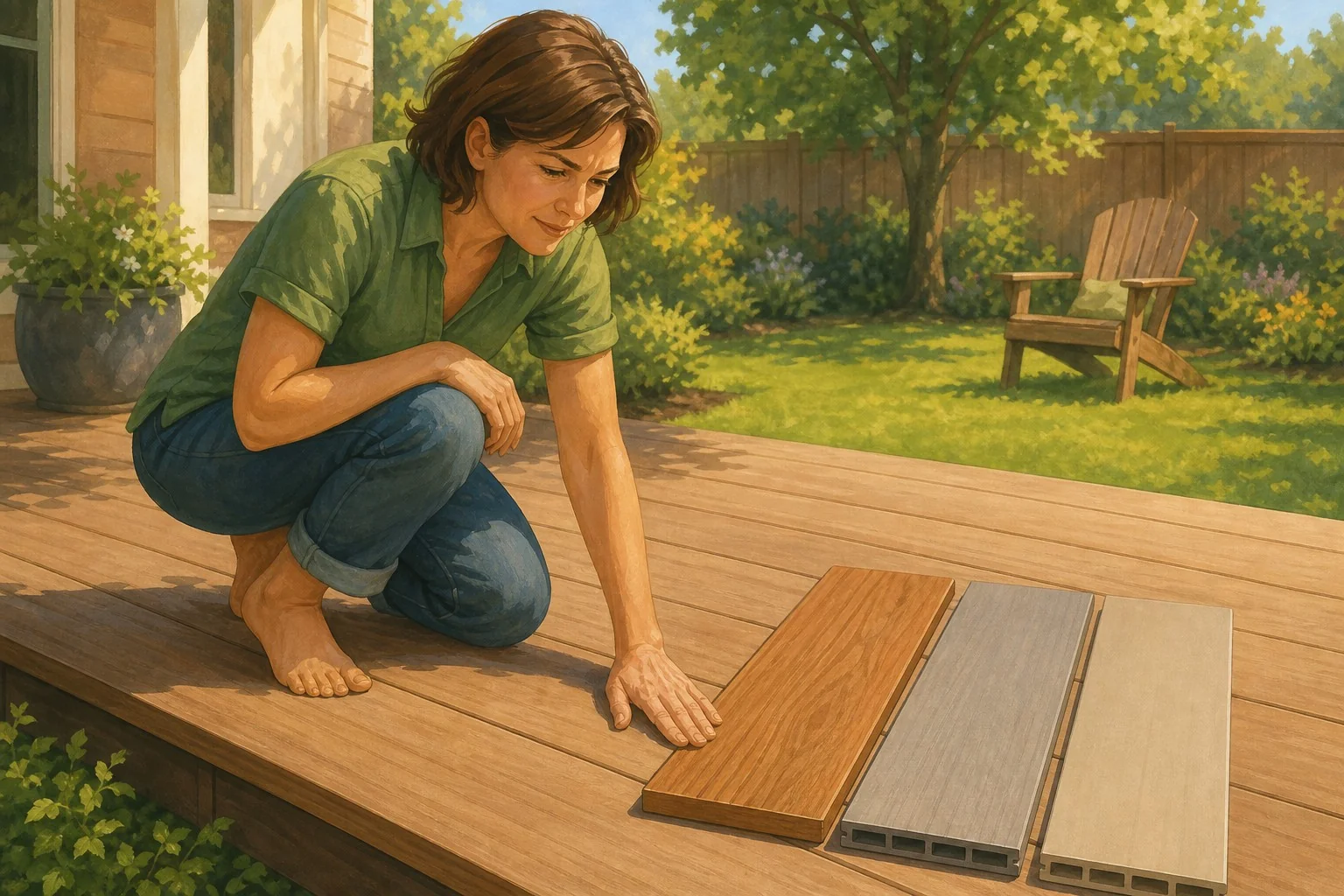
Every July I get the same call. Somebody built a fancy new deck last year, spent good money on it, and now their kids won’t walk on it without shoes. It’s 92 degrees, the deck’s baking, and the boards are hot enough to fry an egg. They want to know why nobody told them this was coming.
Well, I’m telling you now. Before you drop fifteen grand on a new deck this summer — or before you write off the one you already have — here’s what actually matters.
The Temperature Reality Between Materials
Here’s the honest ranking on a 90-degree day in full sun, hottest to coolest:
- Dark composite (Trex, TimberTech in charcoal or espresso): 160°F and up. That is not a typo. That is blister territory.
- PVC decking (Azek and similar): Usually 10 to 20 degrees cooler than composite of the same color, but still brutal in dark shades. Light-colored PVC can stay under 130°F, which is livable.
- Pressure-treated pine: Runs hot but not crazy. Maybe 125 to 140°F in dark stain, cooler if it’s weathered gray.
- Cedar or redwood: The winners on temperature. Natural wood breathes and doesn’t hold heat like plastic does. You’re looking at 115 to 125°F even on a hot Philly afternoon.
- Ipe and other tropical hardwoods: Similar to cedar. Warm to the touch, but not scorching.
The takeaway: plastic-based decks bake. Wood decks don’t. That’s just physics. Composite and PVC are solid material with nowhere for heat to go. Wood has grain, moisture, and air pockets that keep it cooler.
If you love the look of composite and hate maintenance, fine — plenty of good reasons to buy it. Just go in with your eyes open about summer.
Color Matters More Than You Think
I had a client in Fishtown a few years back who insisted on charcoal composite because “it looks modern.” I told her straight up: you’re building a griddle in your backyard. She went with it anyway. Three weeks after we finished, she called and asked if we could swap the boards for a lighter color. I said sure. For another eight grand.
Dark colors absorb heat. Light colors reflect it. That’s the whole science lesson.
If you want composite or PVC and you actually plan to use the deck barefoot, pick a light gray, a sandy tan, or a driftwood tone. Skip the black, the espresso, the “midnight walnut.” Whatever the salesperson is pushing because it’s on trend — if it’s dark, it’s going to burn feet. Every good manufacturer has a light color line. Use it.
Shade Is the Cheapest Fix
If you already have a hot deck and can’t replace it, shade is your friend. A few options that actually work:
- Shade sails. Anchor them to the house, a fence, or posts you sink into the ground. A single 12x12 sail can drop surface temps 30 degrees in the shaded area. Cheap, easy to take down in the fall, and they don’t look like something your grandparents had on the porch.
- A large market umbrella with a heavy base. Not the flimsy ones from a discount store. Get a real cantilever arm and 50 pounds or more of base weight so it doesn’t take flight in the next thunderstorm.
- A pergola with slats or a canvas top. More permanent, more money, but if you’re staying in the house long-term it’s the best-looking solution and it adds real value.
Skip the retractable house-mounted awnings unless you’re ready to spend two grand and up. They work, but they’re overkill for most decks.
Rugs, Runners, and What to Skip
Outdoor rugs help. Not fancy, not glamorous, but they do the job. Put one where you walk most — near the door, under the table, at the top of the stairs. Barefoot traffic stays comfortable.
A few rules:
- Get a rug rated for outdoor use. Indoor rugs mold in a week outside and start smelling like a wet basement.
- Lift and dry them after heavy rain. Trapped moisture rots wood and stains composite. Do not let a “temporary” rug sit there for six months.
- Skip the rubber-backed ones. They trap water and heat. Get a woven polypropylene rug that lets water pass through.
When to Bite the Bullet and Replace
Sometimes the deck is just wrong for how you actually want to live. Dark composite installed by the previous owner. West-facing yard with zero shade. Kids and grandkids running around barefoot every weekend. You’re not going to fix that with a rug and an umbrella.
If you’re miserable every summer and you plan to stay in the house another five years or more, tearing off the boards and swapping to a lighter composite or a real wood surface pays off in usability. The framing usually stays — just the boards and hardware get replaced. It’s not cheap, but it’s not a full rebuild either. Get two or three quotes and don’t let a contractor talk you into re-doing what doesn’t need re-doing.
Bottom Line
Don’t buy a deck based on what looks good in the showroom under fluorescent lights. Buy it based on what your feet are going to feel on a 92-degree Sunday in July.
Light colors. Real wood if you can swing it. Shade where you sit. A decent outdoor rug where you walk. That’s the whole formula.
Nothing fancy. Just what actually works.