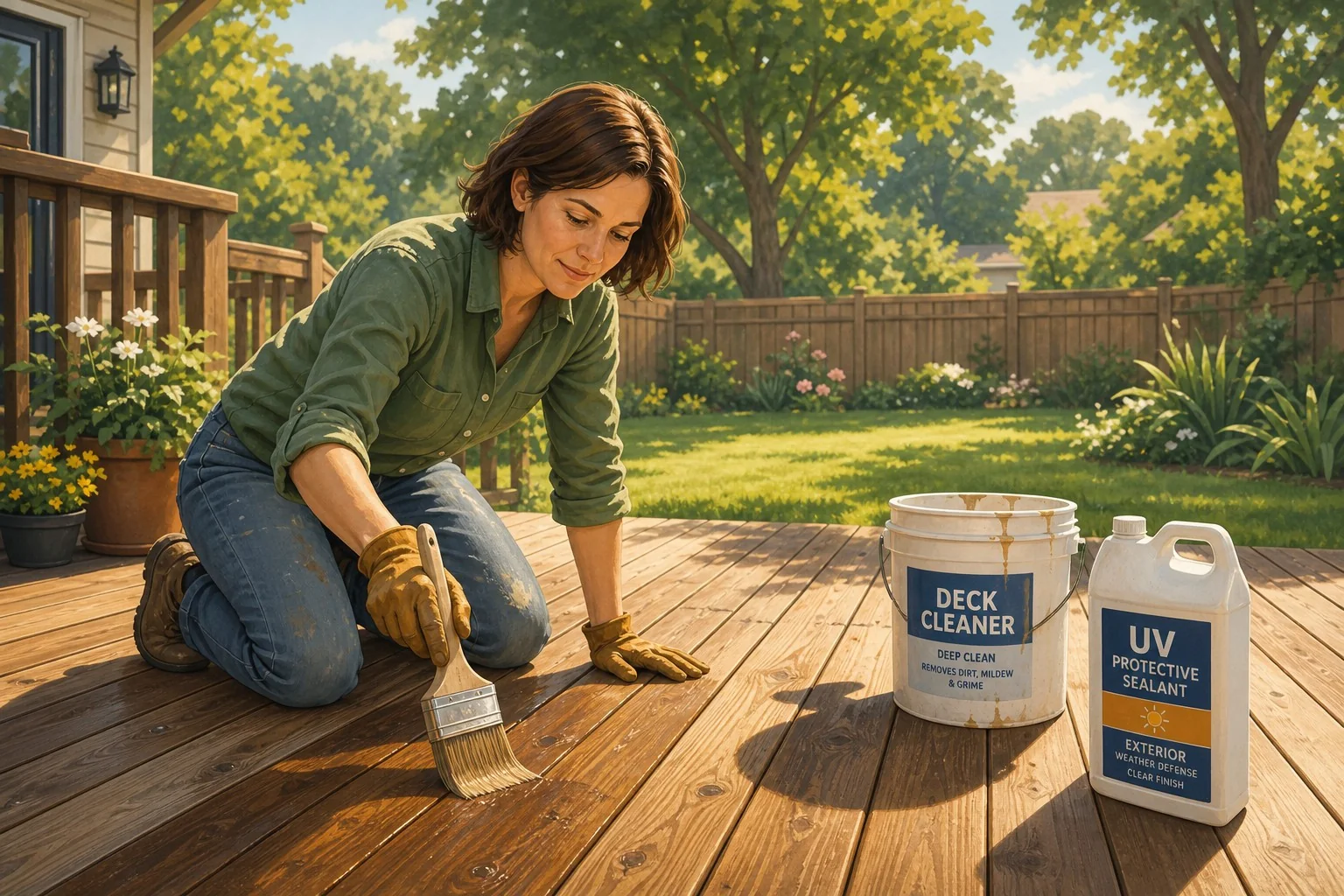
Pennsylvania summers are not friendly to your deck. Between the July humidity that makes the air feel like a wet blanket and stretches where the sun cooks everything from Scranton to Chester County, your deck is taking a beating whether you notice or not. Wood expands. Fasteners work loose. Stain that looked fine in June starts flaking by August. Composite gets hot enough to burn a dog’s paws.
Most homeowners either ignore the deck all summer or they do the wrong thing at the wrong time and make it worse. Here’s how to actually take care of it during the ugliest weeks of the year.
Don’t stain or seal when it’s 90 degrees out
I don’t care what the can says. I don’t care that you finally have a free Saturday. If it’s ninety-plus and the sun is hammering the boards, you are not staining your deck today.
Here’s why. Stain needs to soak in. When the wood surface is 130 degrees — and yes, a dark deck in direct July sun hits that easily — the carrier flashes off before the pigment and resin can penetrate. You end up with a film sitting on top of the boards. That film peels. Then you’re stripping it off next spring and starting over.
Best window in a PA summer is early morning, on a day the high tops out somewhere in the low 80s, with a couple dry days on either side. If we’re in a stretch of 90s and thunderstorms every afternoon, wait it out. The deck isn’t going anywhere.
If the wood is dry and gray and you’re worried about it, a light coat of water-based penetrating sealer in the early morning is fine. But full staining? Wait for a break in the weather.
Clean it, but time it right
Summer is actually a decent time to clean a deck, because everything dries fast. But there’s a right way and a wrong way, and I’ve seen plenty of the wrong way.
A homeowner in Roxborough called me a few years back because his boards were fuzzy and splintering after he “cleaned” his deck. Turned out he rented a pressure washer, cranked it to twenty-five hundred PSI, and held the tip about four inches off the wood in the middle of the afternoon. He didn’t clean the deck. He sandblasted it. Half the top layer of every board was chewed up, and the sun baked what was left into a warped mess within a month.
Here’s the right way:
- Sweep it first. Get the leaves, pollen, and grit out of the gaps between boards. That stuff holds moisture and rots the joists underneath.
- Use a proper deck cleaner — oxygenated bleach based, not chlorine. Chlorine wrecks the wood fibers and kills your landscaping.
- If you pressure wash, keep it under 1500 PSI, use a wide fan tip, and stay at least a foot off the boards. Move with the grain, not across it.
- Clean in the morning or evening, not when the sun’s directly on it. Cleaner that dries on the wood before you rinse leaves streaks.
If you have composite decking, follow the manufacturer’s cleaning instructions. Most composites hate certain chemicals and warranties get voided fast. Soap, water, soft brush. Done.
Watch for movement — wood and composite both do it
Heat and humidity make deck boards move. This is not a defect. This is physics.
Pressure-treated pine is the worst offender. If it was installed even a little too tight, you’re going to see boards cup, crown, or push against each other in July. Look for boards that are riding up at the ends, gaps that have closed completely, or any board that suddenly feels spongy underfoot. Cupped boards can sometimes be pulled back down with a couple screws. Boards that have bowed hard enough to pop nails need to be replaced, and honestly if you’ve got a lot of them, the deck was built too tight to begin with.
Composite decking moves too. It expands lengthwise in the heat — a lot more than most people realize. If your installer didn’t leave proper gaps at the butt ends and against the house, you’ll see it buckle in the middle of a heat wave. That’s not a defect in the material. That’s a bad install. Get on the phone with whoever built it.
Go easy on the foot traffic during heat waves
Two things people don’t think about:
First, hot decks burn. A dark composite deck in the sun can hit 160 degrees on the surface. That’s hot enough to blister bare feet in seconds. If you’ve got kids or dogs, put down an outdoor rug in the main traffic area or make people wear shoes. This is not being dramatic — I’ve seen the ER bills.
Second, wood decks that are bone dry from a heat spell are more brittle than you think. That’s when you notice the popped nail heads, the loose railings, and the wobbly step. Walk the whole deck once during a hot stretch. Push on every railing baluster. Bounce lightly on the steps. Anything that gives you a bad feeling gets fixed before somebody puts a beer in one hand and a plate of ribs in the other and finds out the hard way.
The summer maintenance checklist
Do these once, mid-July, and you’ll save yourself a headache in the fall:
- Sweep gaps between boards. Clear leaves and debris from where the deck meets the house.
- Check for popped nails or screws. Reset or replace them.
- Look under the deck if you can get under there. Any joist that looks black, soft, or has white fuzz is rotting. Poke it with a screwdriver — if it goes in easy, you’ve got a real problem.
- Tighten every railing post at the base. Loose railings kill people. Not being dramatic.
- Check flashing where the deck meets the house. If water is getting behind the ledger board, that’s how decks fall off houses. Look for rust stains, gaps, or missing caulk.
Take care of the deck now and it’ll still be there when you want to sit on it in October. Ignore it, and you’ll pay for a full rebuild in a few years. That’s how it works.