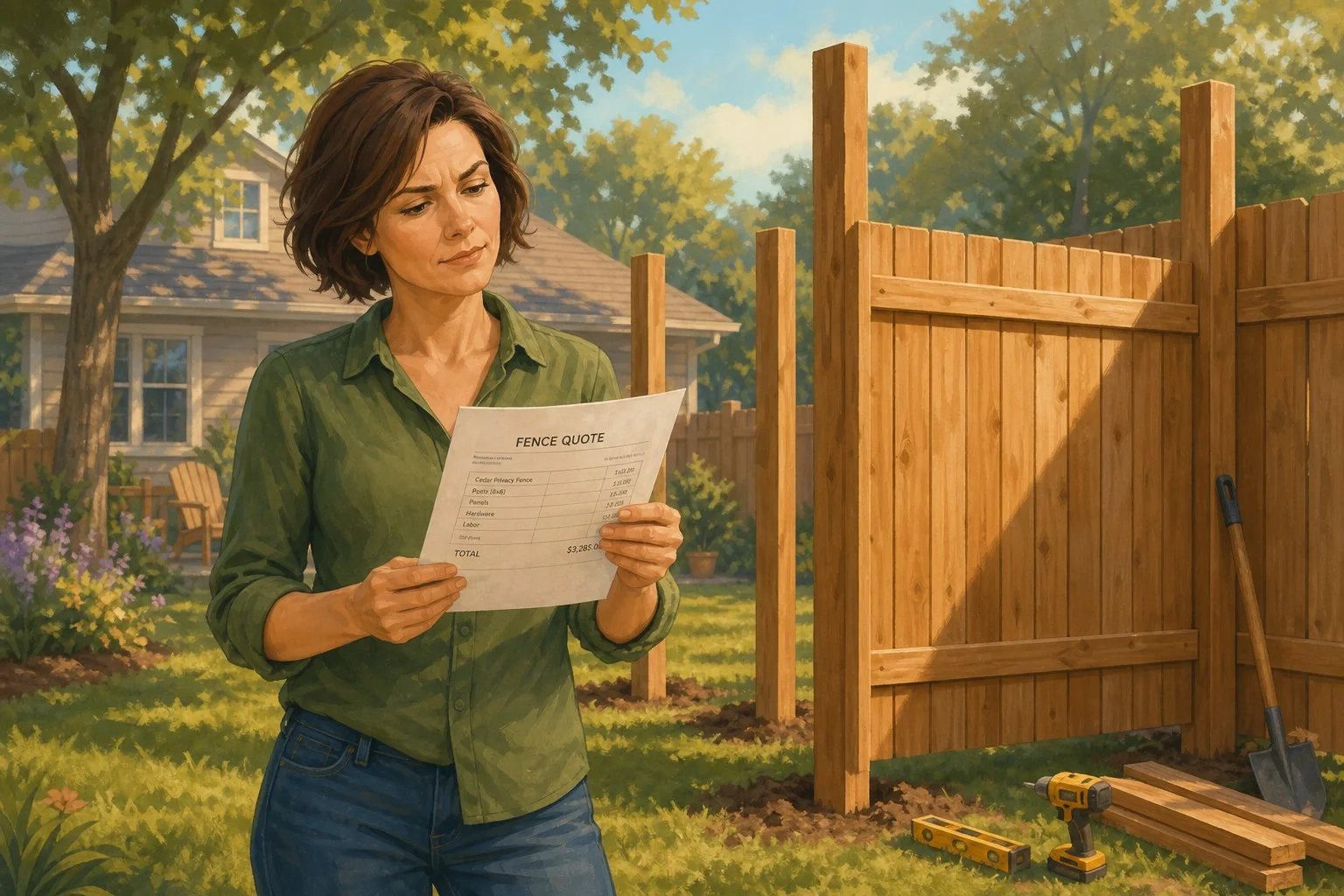
A fence quote looks simple. Three numbers, maybe four, a total at the bottom. Sign here, thanks for your business.
That’s exactly how homeowners get taken.
I’ve been on job sites for thirty-plus years and I’ve read more fence quotes than I care to count. The good ones are boring — every line item spelled out, every material listed, every number defensible. The bad ones are short, vague, and land you a change order the day the truck shows up.
Before you approve a fence quote — any fence quote, six-foot cedar privacy, aluminum ornamental, chain link, doesn’t matter — you check three things. Do that and you’ll dodge most of the garbage.
1. Does the scope actually match the job?
Read the quote like you’re going to build the fence yourself. Because if the guy quoting you doesn’t spell it out, he’ll build whatever’s cheapest and hand you the invoice.
Here’s what should be on the paper, in ink:
- Linear footage. Not “your yard.” A number. If it says 187 feet, walk the line with a tape and see if that matches. Salesmen eyeball from the driveway all the time, and their eyeballs are usually short.
- Post count. Fence posts should sit every 6 to 8 feet depending on style and code. If the quote says “posts as needed,” that’s not a spec — that’s a coin flip. Ask for a number.
- Post depth and setting method. Are they digging 36 inches? Setting in concrete or gravel? Around here we’re going below the frost line or the fence lifts the first hard winter. If it isn’t written, assume they’re going shallow.
- Removal and disposal of the old fence. This one hides constantly. If they don’t say “haul away included,” you’re paying to get rid of the pile they leave in your driveway.
- Delivery, permit, and tax. All three should be listed as line items or explicitly rolled in. “Plus applicable fees” is a phrase that means “we’ll tell you at the end.”
A real quote reads like a materials list plus a labor description. If yours reads like a receipt from a diner, you don’t have enough information to sign anything.
2. What does the gate really include?
Gates are where fences fail. And gates are where quotes hide money.
The panel section of a fence is the easy part. Straight boards, straight posts, done. A gate has to swing, latch, stay square, and survive a hundred slams a week from a kid and a dog. So when a quote says “one 4-foot gate — $350,” you stop and ask questions.
What kind of hinges? Heavy-duty strap hinges, or the flimsy stamped ones that come in a hardware store clamshell? Is there a proper gate frame with a diagonal brace, or is it just picket boards nailed together into a rectangle? Because a rectangle isn’t a gate — it’s a parallelogram waiting to happen. Six months in, it sags, drags the ground, and the latch stops meeting the post.
Is there a stiffener on the swinging side? A cane bolt for double gates? A drop rod? These aren’t luxuries. These are the parts that keep a gate a gate. If they’re not on the quote, they’re not going in.
Ask specifically: hinge type, frame construction, latch model, and whether the gate posts are larger or set deeper than the line posts. They should be. A gate post carries load a line post doesn’t. If the quote treats every post the same, that gate’s on borrowed time.
3. Are there any vague allowances?
This is where the sharp guys get you.
An allowance is a placeholder dollar amount for something they haven’t fully priced — “stone allowance: $500,” “hardware allowance: $200,” that kind of thing. Sometimes allowances are legitimate. Most of the time they’re a runway for a change order.
I had a homeowner in South Philly hand me a fence quote from another outfit and ask me to look it over. Right there on the paper: “Grading allowance — $400.” The yard had a two-foot drop across sixty feet. There was no world where $400 covered that grading. The contractor knew it. The number was there so the total looked competitive. On job day, the homeowner would’ve been staring down another $1,800 to make the fence sit right, and by then he’d already signed and cashed his enthusiasm.
If you see the word “allowance” anywhere on the quote, ask three questions: What exactly does it cover? What’s the ceiling? And what happens if the actual cost blows past it? Get the answer in writing before you sign. If the contractor gets squirrelly about pinning it down, that’s your answer — walk.
Same goes for phrases like “as needed,” “if required,” “subject to site conditions,” and my personal favorite, “additional materials billed separately.” Every one of those is a door someone’s going to walk through at your expense.
The bottom line
A fence isn’t a mystery. It’s posts, panels, gates, and dirt. Any contractor worth hiring can put every part of the job on a piece of paper before you sign.
If the quote you’re holding is one page with three lines and a total, you don’t have a quote. You have a hint. Send it back and ask for the real one. If the guy won’t give it to you, you already know everything you need to know about how the job’s going to go.