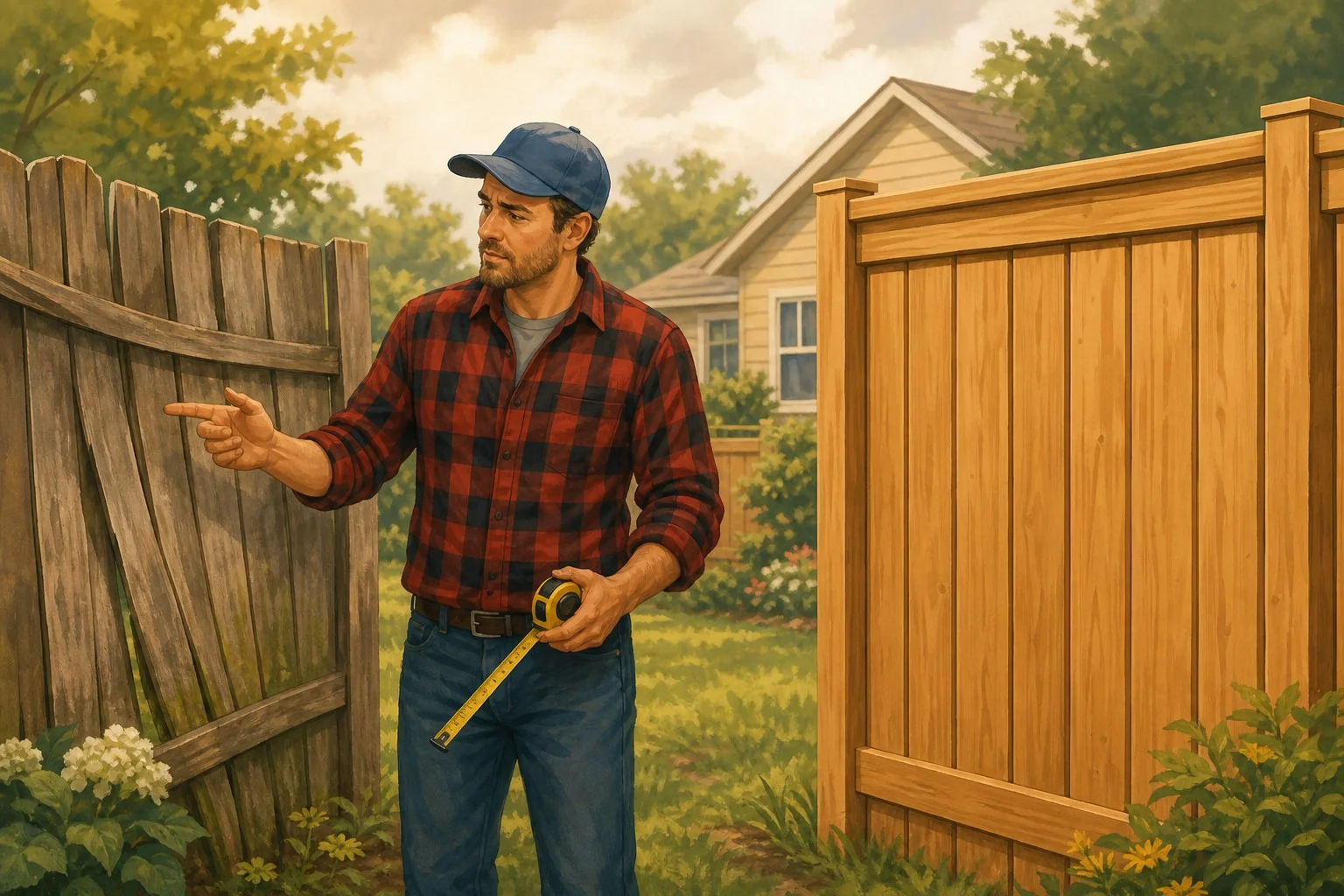
Every spring I get the same phone calls. Somebody’s fence is leaning, sagging, or falling into the neighbor’s yard, and they want to know if I can come look at it. Nine times out of ten, the fence isn’t the problem. The problem is how they bought it.
Fences look simple. That’s the trap. It’s four posts, some pickets, a gate. How hard can it be? Hard enough that half the fences I see in this city are already dying five years in. And it almost always traces back to the same handful of mistakes homeowners make before a single post goes in the ground.
Here’s what to watch for.
Mistake #1: Signing a vague quote
This is the big one. This is the mistake.
A good fence quote is boring to read. It lists post size, post depth, concrete type, rail count, picket spacing, gate hardware brand, and how the ends are treated. A bad quote says “6-foot wood privacy fence, 120 linear feet, $4,200.” That’s it. That’s not a contract. That’s a wish.
When the quote is vague, you have no idea what you’re getting. Are the posts 4x4 or 6x6? Are they set 24 inches deep or 36? Is that pressure-treated pine or cedar? Are the rails nailed or screwed? Every one of those decisions changes the price by hundreds of dollars, and if it’s not written down, the guy building it gets to make the cheap choice every time. And he will. That’s not villainy, that’s math.
A few years back, a homeowner in Roxborough called me out because her brand-new fence was already tilting after one winter. I pulled a post. Concrete footing was maybe a foot deep, and the “pressure-treated” post was standard lumber with a green tint. She’d paid full price for a fence built out of half the materials. Her contract? One line. “Install privacy fence, rear yard.” That’s what she got. A fence. Technically.
If the quote fits on a Post-it, walk away.
Mistake #2: Under-speccing the gate
Ask any fence guy which part fails first, and the answer is always the same. The gate.
Gates get used every day. They swing, they slam, they sit in the sun, they take the wind. And most homeowners spend zero time thinking about them. They pick out the fence style, sign the paper, and assume the gate will be “the same as the fence.” It’s not. Or at least, it shouldn’t be.
A gate needs heavier hinges than the fence panels. It needs a diagonal brace or a steel frame — otherwise it sags into a parallelogram inside two years. It needs a latch that actually works when the wood swells in July. And if you’ve got a driveway gate wider than four feet, you need a drop rod or a wheel, not just prayer.
When you’re getting quotes, ask specifically what hardware they use on the gates. Ask about the brace. Ask what happens when the gate sags — is that on you or on them? A contractor who’s built real gates will have real answers. A guy who’s about to hand you a sagging piece of junk will get vague fast.
Mistake #3: Assuming your yard is square and flat
It’s not. I promise you.
Half the fence disputes I’ve seen come from homeowners who eyeballed the property line and told the contractor “run it along there.” Then the neighbor comes out with a survey, and now the fence is three inches onto their side, and everyone’s a lawyer.
Before you sign anything:
- Know your actual property line. If you don’t have a recent survey, pay for one. It costs a few hundred bucks and saves you thousands.
- Check for slope. A yard that looks flat almost never is. Slope changes whether you’re stepping the fence down in sections or racking each panel to follow the grade. Those look completely different and cost different money.
- Call before you dig. In PA that’s 811. Gas lines and fence posts don’t mix. This is not optional.
- Check your HOA and your township. Height limits, setback rules, and materials rules vary wildly. Some places require a permit. Some don’t. Find out before, not after.
If a contractor tells you none of that matters, that’s a red flag the size of a barn door.
Mistake #4: Choosing on price alone
The cheapest bid is cheap for a reason. It’s always for a reason.
Maybe he’s using lumber from the bottom of the pile. Maybe he’s skipping concrete on half the posts. Maybe he’s not licensed or insured, which means if his guy falls off your porch, that’s your homeowner’s insurance getting the phone call. Maybe he’s just planning to disappear the day after the check clears.
I’m not saying pay the highest bid. I’m saying get three quotes, read them line by line, and pick the one that makes sense — not the one with the smallest number at the bottom. When two quotes come in $2,000 apart, that difference is bought and paid for somewhere. Your job is to figure out where.
Bottom line
A fence is not a fence. It’s posts, footings, framing, hardware, layout, and a hundred small decisions that either get made right or get made cheap. If your contractor won’t put those decisions in writing, he’s not the guy.
Do the homework up front. Get the survey. Read the quote. Ask about the gate. Then hire the person who talks to you like you’re smart, not the one who’s rushing to close the sale.
Your fence should outlive your dog. Twice. Anything less and somebody cut corners on the front end.