Cut the crap: “buy in winter” isn’t the whole story
Every home improvement blog tells you to buy fence material in the winter. That’s about as useful as telling somebody to eat vegetables. Technically true, missing all the important parts.
The reality is that fence suppliers run on cycles — real ones tied to manufacturing, distribution, and cash flow — and if you understand them, you can save serious money. If you don’t, you’ll walk into a yard in February thinking you’re getting a deal and pay the same price your neighbor paid in April.
When suppliers actually discount
Fence season runs hard from about mid-March to late June. Everyone wants their yard done before the barbecue, the graduation party, the pool opening. Suppliers know this. Their entire year revolves around it.
Here’s what most homeowners don’t get: the discount windows aren’t just “winter.” They’re specific.
Late October through late November is the first sweet spot. Yards are looking at what didn’t sell during the summer and they’re staring at the cost of storing it through a cold, wet winter. Pressure-treated pickets, in particular, get marked down because the mills don’t like their material sitting outside through freeze-thaw cycles. If a yard has a stack that’s been out since July, they’ll deal.
Early January through mid-February is the second window, and honestly, it’s the better one for a homeowner who can plan ahead. This is when suppliers do their real fiscal year cleanup and manufacturers start pushing spring inventory into the pipeline. The old stuff has to move to make room. Yards will run truckload specials, clearance rows, and package deals you won’t see in April.
After mid-February, forget it. Contractors start pulling material and prices creep back up before the general public even notices.
Not every material moves the same
This is where the “buy in winter” advice falls apart. Different materials have completely different cycles.
Pressure-treated wood is the most volatile. Prices swing 15–25% depending on the season and the mill’s mood. Best discounts happen when yards have material that’s been sitting — but be careful, because PT that’s been outside a full year has usually shrunk, checked, and cupped. You want stock that came in a few months ago and needs to go, not stock that’s been rotting in the back row since last spring. I had a customer in Fishtown who thought he’d scored a deal on “clearance” 4x4 posts back in November. By June the fence looked like it was staggering home from a bar. The wood was already twisted before it went in the ground, and no amount of cross-bracing was going to save it.
Cedar discounts less. It sits well outdoors and dealers know it holds value. If you see cedar marked down hard, ask questions.
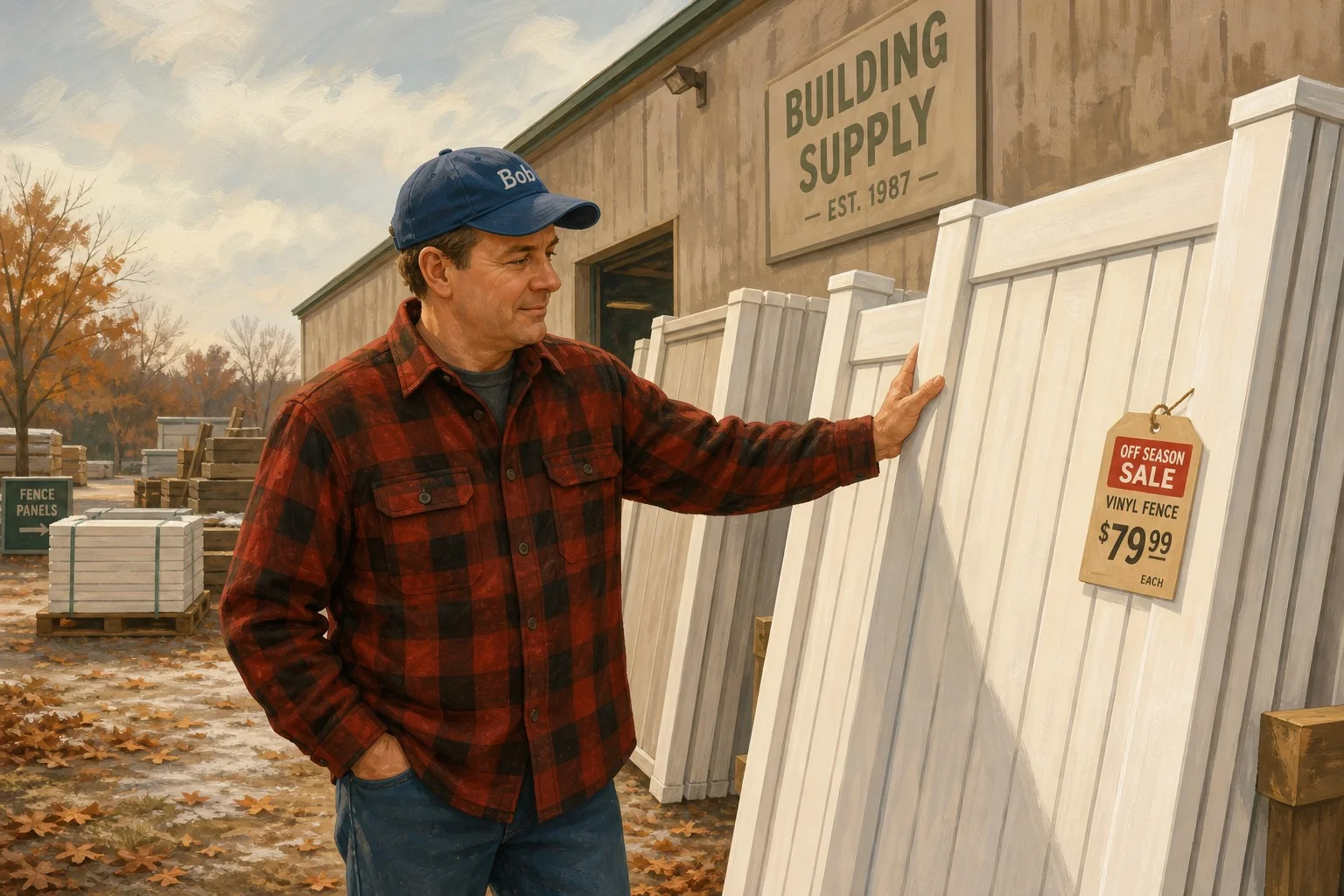
Vinyl is a different animal. It’s manufactured year-round in factories that don’t care about the weather. The discounts on vinyl come from dealer incentive programs — manufacturers push distributors to pre-buy for spring, and retailers get quarterly volume bonuses. That means late Q4 (November–December) and the end of Q1 (March) are when you’ll see the best vinyl pricing. Not the same rhythm as wood at all.
Chain link barely moves. It’s a commodity. Prices are tied to steel and zinc markets, not the calendar. You might save 5% if a yard needs to clear roll stock. That’s it. Don’t wait around thinking chain link is going to get cheap.
Aluminum panels are the worst for off-season deals. High margin, low volume, and dealers don’t budge much. If somebody offers you a serious aluminum discount off-season, look at the finish carefully — usually it’s a discontinued color or a damaged batch.
How to actually get the deal
Walking into a big box store in December and asking about “off-season pricing” gets you a blank stare from a kid who was stocking mulch last week. That’s not where you find real markdowns on real quantities.
Go to a dedicated fence supply yard. Ask for the yard manager or the counter guy who’s been there ten years. Skip the sales floor.
A few things to say — and mean:
- “What have you got that needs to move?”
- “I’m buying, not browsing. Cash today if the number’s right.”
- “What’s your minimum on damaged or oddball stock?”
Damaged and oddball stock is where the real savings live. A pallet of vinyl panels in a discontinued color. A bundle of PT 6-footers that got wet and grew a little green (which washes off, by the way, it’s not rot). Aluminum sections with minor scratches that face the ground anyway. This is the stuff a yard will practically give away in January because they don’t want to feed it another month of yard space.
Ask about delivery too. Off-season, yards have trucks and drivers sitting idle. A delivery that costs $150 in April might be $50 in January if the driver’s already going in your direction.
What NOT to buy off-season
Two things I’d steer you away from, no matter how good the price looks.
Bagged concrete mix. Bags absorb moisture in cold storage. By March, you’ll have half-solid, half-powder bags that mix inconsistent and set weak. Buy your concrete when you’re ready to pour, not before.
And posts that are going to sit outside your house all winter. If you’re not installing until April, don’t buy your 4x4s in November and lean them against the garage. They’ll twist. Even good stock will move if it’s not stickered, stacked flat, and covered right. Buy your posts as close to install day as you can — that’s true whether the price looks good or not.
The realistic play
If you’re a homeowner planning a spring or early-summer fence project, here’s the honest approach:
Scout in October or November. Get pricing, walk a couple yards, see what’s around. Then buy your bulk pickets, rails, and panels in the second window — January through early February — from a real fence yard, not a big box. Order your posts and concrete a week or two before install day.
That timeline gets you the best pricing on the material that actually discounts, without giving cheap wood four months to warp in your driveway.
Anybody who tells you it’s simpler than that is selling something.