Callbacks Are Cheaper When Your Supplier Stocks the Full System
Here’s something most homeowners don’t think about until they’re staring at a bent gate six months after installation: where do the replacement parts come from?
Not a fun thing to wonder about in February when your fence cap blew off in a storm and the contractor you hired is telling you the supplier needs two to three weeks to ship a replacement. Meanwhile your yard is wide open, your dog is gone, and nobody’s happy.
This isn’t a rare situation. It happens all the time. And it’s avoidable.
The Hidden Cost of a Patchwork System
When a contractor puts up a fence, they’re working with a system — panels, rails, post caps, gates, hardware. Those pieces are supposed to work together. They’re engineered to fit, match, and hold up as a unit.
Problem is, not every contractor sources from a supplier who actually keeps the full system on the shelf. Some guys buy the panels locally but get the gates from a catalog. The caps come from one vendor, the rails from another. It’s cheaper upfront, sometimes. But you’ve just created a parts-sourcing nightmare for every repair that comes after.
When something breaks — and something always breaks eventually — your contractor is now calling three different vendors to find matching components. Maybe one of them is backordered. Maybe the product line got discontinued. Maybe the new version is slightly different and doesn’t fit the old hardware. Now a one-hour fix turns into a week of phone calls and a callback that costs everybody money.
Why Local Stock Is Worth More Than You Think
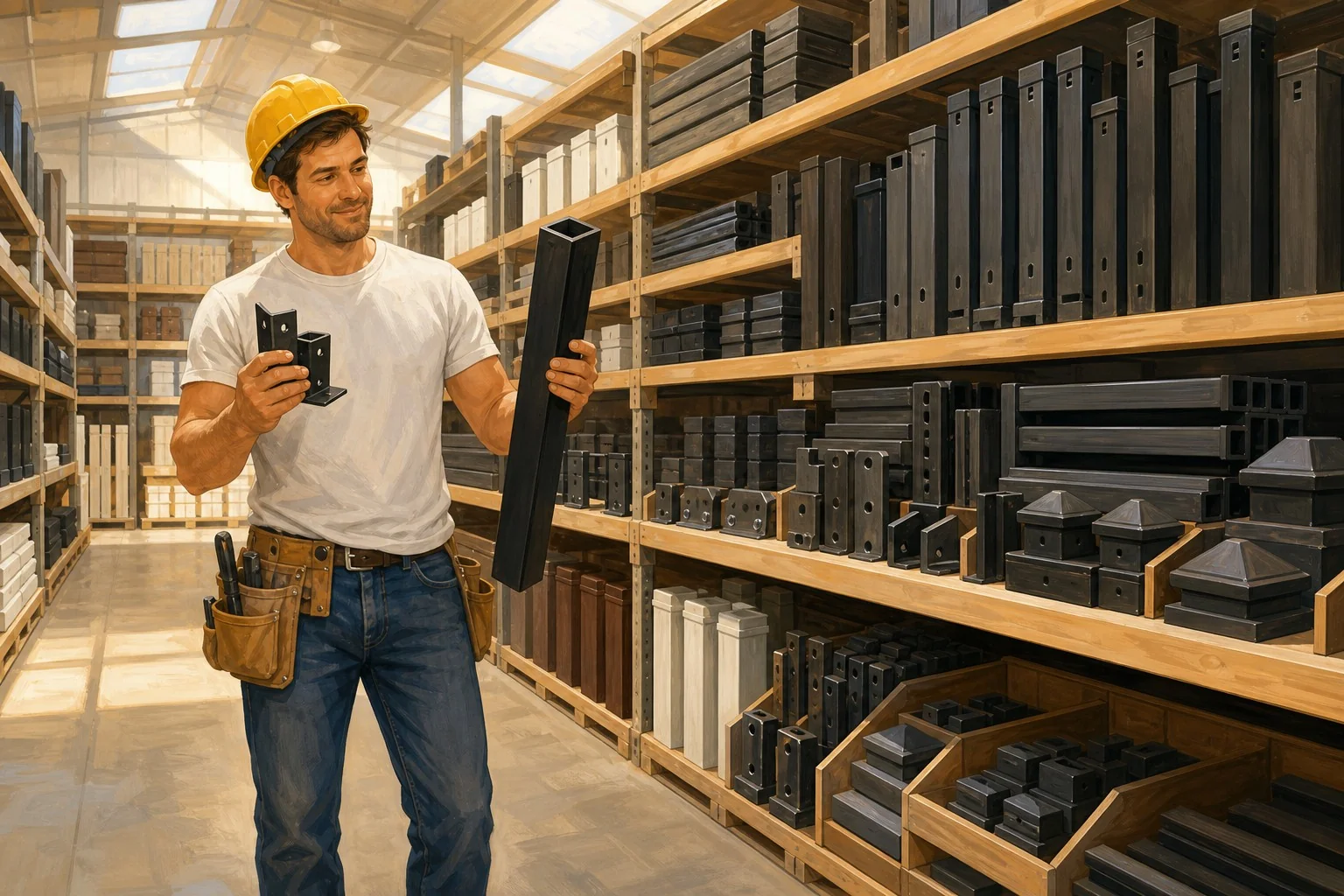
A supplier who keeps panels, rails, caps, and gates in stock locally isn’t just more convenient. They’re reducing your callback risk.
Think about what local stock actually means. If something needs to be repaired or replaced, a contractor can pull parts the same day. No freight. No lead time. No waiting on a warehouse in another state to process an order. A repair that should take half a day stays a half-day repair.
That saves you money two ways. First, the labor is less — the contractor isn’t billing you for three trips when one should’ve done it. Second, you’re not living with a half-finished fix while you wait on a part to show up. The job gets closed out properly.
I had a customer in Northeast Philly a few years back, ornamental aluminum fence along the whole perimeter of her property — not a small job. Six months after we installed it, a truck clipped the gate post. Bent the gate frame, damaged the latch hardware. Because I source from a supplier that stocks the full line, I had a matching gate frame and hardware the next morning. One trip. Done by noon. That’s what it should look like.
What to Ask Before You Sign Anything
Before you hire someone to put up a fence, ask these questions. They’re not complicated, but most homeowners never think to raise them.
1. Does your supplier stock the full system locally?
You want panels, rails, post caps, and gates all available from the same source, without a long lead time. If the answer is vague — “we can order it” or “usually within a few weeks” — that’s your answer right there.
2. What’s your process when a part needs to be replaced?
A contractor who’s thought about this will give you a straight answer. They’ll tell you where the parts come from and roughly how long it takes. If they’ve never considered the question, that tells you something about how they handle problems after the job is done.
3. Are the components you’re using proprietary or standard?
Proprietary systems — where every piece only works with other pieces from the same manufacturer — can be fine as long as that manufacturer is reliable and your contractor has access to the full product line. Standard components give you more flexibility but can still be a mess if nobody keeps them in stock locally.
The Contractor Side of This
Here’s the part homeowners don’t see: callbacks cost contractors money too. When something fails and a contractor has to go back to fix it, that’s labor they’re not billing for on a new job. The faster they can close out a callback, the better for everyone.
A contractor who doesn’t think about their supply chain is a contractor who’s going to be dragging out callbacks — whether they mean to or not. Parts delay equals schedule delay equals a unhappy customer who’s going to tell five other people about the experience.
Good contractors pick suppliers who stock the full system because it protects their reputation, not just their schedule. A two-hour repair shouldn’t become a two-week ordeal because nobody has a matching rail in stock.
Bottom Line
When you’re getting a fence installed, you’re not just buying what goes up on day one. You’re buying into a system that needs to be maintainable for years. The contractor matters. The materials matter. But so does where those materials come from and whether anybody can get them fast when something needs fixing.
Ask the question before you sign the contract. A good contractor will have a real answer. And a supplier who keeps the full system in stock locally isn’t a nice-to-have — it’s what keeps a callback from turning into a headache that stretches across weeks.
Parts are either on a shelf or they’re not. Make sure they’re on a shelf.