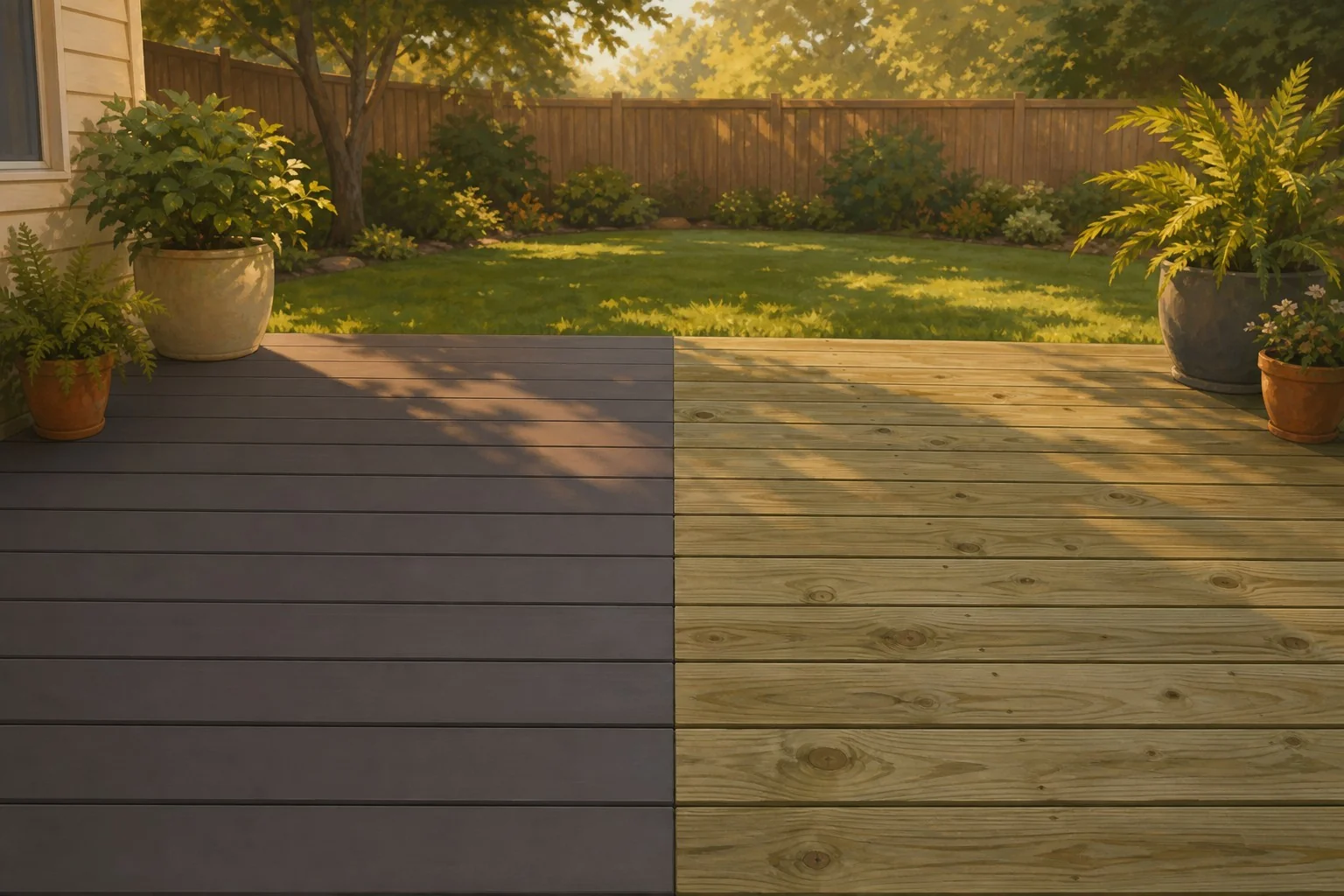
Every spring I get the same call. Somebody pulled a quote for a new deck, choked on the composite number, and wants me to tell them pressure-treated is the smart move because it’s half the price.
It’s not half the price. Not when you actually do the math.
A deck is a 10-year decision, minimum. If you’re only looking at what gets loaded onto the lumberyard truck, you’re looking at a fraction of what this thing is going to cost you. So let’s run the real numbers.
The Sticker Price Lie
For a standard 200 square foot deck — your typical 16-by-12, ground-level or low — here’s what you’re looking at, installed, in 2026:
- Pressure-treated: $4,000 to $6,000
- Composite (Trex, TimberTech, Deckorators): $7,000 to $10,000
Yeah, PT comes in around half. That’s the only part of this comparison where it wins. Keep reading.
What PT Wood Actually Costs You
Pressure-treated lumber comes out of the mill soaking wet. Loaded with chemicals, full of moisture, heavy as a body bag. You cannot stain it the day it gets installed. Not the next week. Not the next month.
You wait. Six months minimum, twelve is better. The wood needs to dry out and let that moisture work its way to the surface, or your stain just beads up and sits there like water on a waxed car. Then it peels off in sheets the next summer and you’re sanding back to bare wood.
I had a guy in Fishtown — nice deck, did it myself, beautiful PT job — and his wife wanted it stained the following weekend because they had people coming over. I told him no. He hired a kid off the internet to do it anyway. By August the whole thing looked like a leopard. Twelve hundred bucks to strip it, another six hundred to redo it right. So now he’s into the deck for the price of a low-end composite anyway.
Once you’re past the drying-out period, here’s the maintenance cycle for the next decade:
- Annual cleaning: $50–$100 in supplies, half a day of your weekend
- Stain or seal every 2 years: 3–4 gallons of decent stain at $50–$70 a gallon, so $150–$280 a pop, plus a full weekend of labor
- Board replacement: Figure 4–8 warped, split, or popped boards over 10 years. About $20 a board in materials plus your time. Call it $200–$400.
Over 10 years, that’s roughly $1,200 to $2,000 in materials alone, and somewhere around 12 to 15 weekends spent on your hands and knees with a paintbrush. If you hate that idea and hire it out, you’re paying a pro $600–$1,200 every other year. That alone runs you $3,000 to $6,000 over a decade.
Real 10-year PT total: $5,200 to $12,000 depending on whether you DIY the maintenance.
What Composite Actually Costs You
Composite is more upfront. Nobody’s arguing that. Where it pays you back is everything that comes after the install.
- Annual cleaning: A garden hose, a soft brush, maybe some Dawn. Twenty bucks a year if you’re being generous. An hour of your time.
- Stain or seal: None. You don’t stain composite. Anyone who tells you to is selling you something.
- Board replacement: If you drop a propane tank on it or take a sledgehammer to it, sure. Otherwise the boards are warranted against rot, warp, and splitting for 25 years.
Over 10 years, composite maintenance runs you about $200 in cleaning supplies and a handful of Saturday mornings.
Real 10-year composite total: $7,200 to $10,200.
Side by Side
Here’s where the math gets uncomfortable for the PT crowd:
- PT, DIY maintenance: $5,200–$8,000 over 10 years, plus 60–80 hours of your labor
- PT, hired maintenance: $7,000–$12,000 over 10 years
- Composite: $7,200–$10,200 over 10 years, with maybe 10 hours of your labor total
If you genuinely enjoy deck maintenance — and some people do, no shame in it — PT can save you a couple grand. If you’re paying anyone to do that work, composite is either equal or cheaper, and you get your weekends back.
When PT Still Makes Sense
I’m not anti-PT. It’s good lumber when you use it right. PT still wins in a few situations:
- You’re selling in 3–5 years. No point eating composite costs you’ll never recoup at closing.
- It’s a small deck, low to the ground. Easy to maintain, cheap to replace boards on.
- You actually like the look of real stained wood. Composite has come a long way, but it’s still not lumber. If that matters to you, that matters to you.
- The cash isn’t there right now. Sometimes you need the cheap option because that’s what the budget allows. Honest answer.
If You’re Going PT, Do It Right
Three things, and I mean this:
- Wait the full year before you stain. I don’t care what your brother-in-law says. Wet wood and stain don’t mix. Sprinkle some water on the boards — if it beads up, the wood’s not ready.
- Use a real penetrating stain, not the bargain-bin film-former. Penetrating stains soak in and wear off evenly. Film stains peel, and once they peel, you’re sanding.
- Stay on schedule. Every two years, like clockwork. The minute you skip a cycle, you’re not maintaining anymore — you’re restoring. Restoration costs three times as much.
The Bottom Line
If you’re staying in the house and you don’t want to spend your retirement sanding a deck, composite is the better buy. The upfront gap closes faster than people expect, and it closes entirely if you’re hiring out maintenance.
If you’re going PT, go in with your eyes open. Budget for the labor — yours or somebody else’s — because it’s coming whether you planned for it or not.
A deck isn’t the lumber. A deck is the next ten years of weekends. Price it that way.