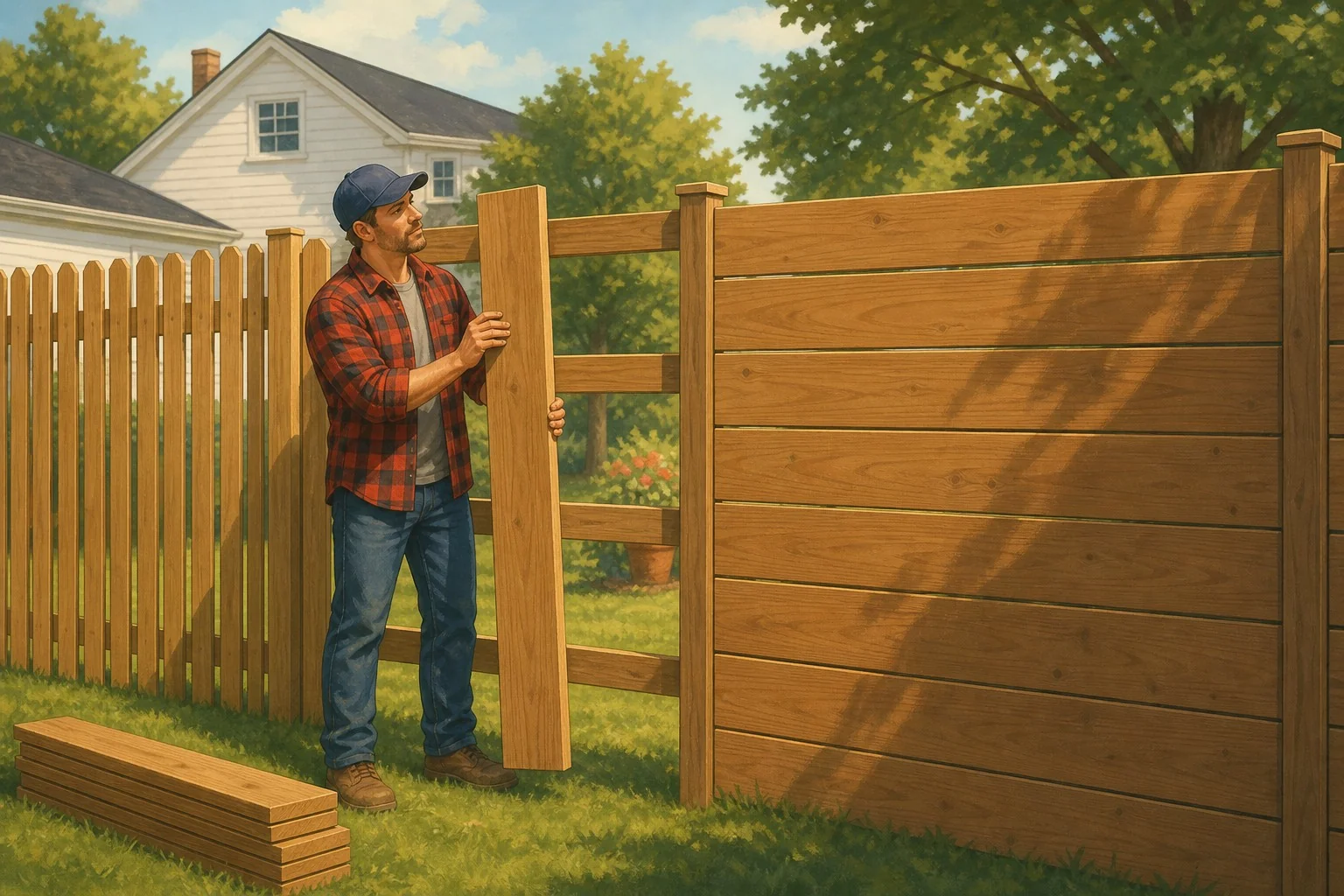
Short answer: yes, you can. Should you? Most of the time, no. And I’ll tell you why.
I get this question every couple years, usually from a homeowner who just tore down an old wood fence and is standing in the aisle at the box store staring at composite deck boards thinking, “These look nice. I could screw these to some posts.” I understand the logic. But you’re solving one problem and creating three others.
Let me break it down honestly.
Why homeowners even consider it
The appeal is real. Composite and PVC deck boards look uniform. Same color, same texture, no knots, no warping the day you buy them. You’ve probably already got a composite deck, and you want the fence to match. Or you’re tired of restaining a wood fence every three years and figured, hey, composite is supposed to be maintenance-free — why not use it for the fence too?
That thinking isn’t crazy. It’s just incomplete.
What actually works about it
Let’s give credit where it’s due.
- The look is consistent. No knot pockets, no one board turning gray faster than the one next to it. If you care how a fence looks from the street, this is a real win.
- Maintenance is basically nothing. You’re not staining or sealing composite. Hose it off once a year, done.
- Color options. You can get grays, browns, dark charcoals, tans — colors you’d never get out of a stain that stays that way for more than a season.
- Rot resistance. The bottom boards on a wood fence rot out first from ground contact and splashback. Composite doesn’t care. Neither does PVC.
That’s the good column. It’s not nothing.
Where it falls apart
Now the ugly part.
Deck boards aren’t engineered for vertical loads. They’re designed to lay flat, supported every 12 to 16 inches by joists, with gravity holding them in place. A fence board has to fight wind. A 6-foot fence catches a lot of it. Composite deck boards are heavier than cedar and don’t flex the same way. You’re asking a product to do a job it wasn’t built for.
Fastener issues. Deck boards are usually installed with hidden clip systems that grip the grooves on the sides. Try screwing a grooved composite board face-on to a fence rail and the screws want to blow through the surface cap because there isn’t much material under it. Overdrive them and you get mushroomed heads or cracked boards within a year. Underdrive them and wind pulls them loose.
Grooved edges look stupid on a fence. Nobody talks about this, but it’s real. Grooved boards installed vertically show a little dark channel down each side. Up close, it looks unfinished. Some homeowners don’t care. Others hate it the second they see it in daylight.
It voids the warranty. Every composite manufacturer I’ve dealt with — Trex, TimberTech, Fiberon, all of them — writes their warranty around use as a deck surface. Slap those boards on a fence and if something goes wrong down the road, they’ll point at the fine print and walk away. I’ve watched it happen more than once.
The cost. A composite deck board runs you two to four times what a cedar or pressure-treated fence picket costs. You’re paying a premium for a product being misused.
The job that made me stop humoring the request
Had a homeowner in Manayunk about eight years ago who insisted on composite deck boards for a 100-foot backyard fence. Wanted it to match his new deck. Fine. We built it beefy — extra rails, more posts than code required, stainless fasteners, the works. Two winters in, half the boards had cupped or bowed. The sun hit one side and not the other, there was no joist system holding them flat, and the material moved. He spent more fixing that fence than he would’ve spent doing cedar and staining it every four years.
That’s when I stopped playing along.
When it actually makes sense
There’s a scenario where I’d say go for it: short sections, low fences, wind-protected spots. A 3-foot decorative fence around a patio? Sure. A privacy screen tucked between two buildings where wind isn’t a factor? Fine. A small gate section that has to match a nearby deck? Reasonable.
A six-foot privacy fence out in an open yard? Don’t do it. You’re setting money on fire.
What to do instead
If you want the composite look without the composite problems, look at actual composite or vinyl fence systems. CertainTeed, Bufftech, Trex Fencing — these are engineered for the job. The boards are the right thickness, the posts are reinforced, the whole system is designed to handle wind and vertical load. It costs more than wood, less than misusing deck boards, and it’s built for what you’re doing.
If you want low maintenance on a budget, cedar with a solid semi-transparent stain still holds up better than most people give it credit for. Six to eight years between stains if you do it right — proper prep, a real stain, not the cheapest can on the shelf.
If you already own a bunch of leftover deck boards from a previous job and you’re trying to use them up, build a planter box or a bench. Don’t build a fence.
Bottom line
Can you use deck boards for a fence? Technically, yeah. Should you? Only in small, protected sections where the look matters more than the engineering. For a real fence — the kind that has to stand up to weather, wind, and time — buy the product built for the job.
Your future self will thank you when you’re not out there in February re-screwing warped boards while your neighbor’s cedar fence is doing just fine.