How to Care for Your Deck After a Humid Pennsylvania Summer: A Late-Summer Maintenance Checklist
August in Pennsylvania is brutal on wood. You get weeks of 90-degree days, thunderstorms that dump an inch of rain in twenty minutes, and humidity that never really drops even at night. Your deck sits out there and takes all of it. The boards swell, the fasteners work themselves loose, and moisture gets trapped in places you can’t see.
Late August into early September is when you want to walk your deck and figure out what’s going on before the leaves fall and the freeze-thaw cycle starts kicking your teeth in. Small problems now are cheap. Small problems in April are joist replacements.
Here’s what to actually do. Not what a Home Depot flyer tells you. What I’d do if it were my deck.
1. Look for mold and mildew — and be honest about what you see
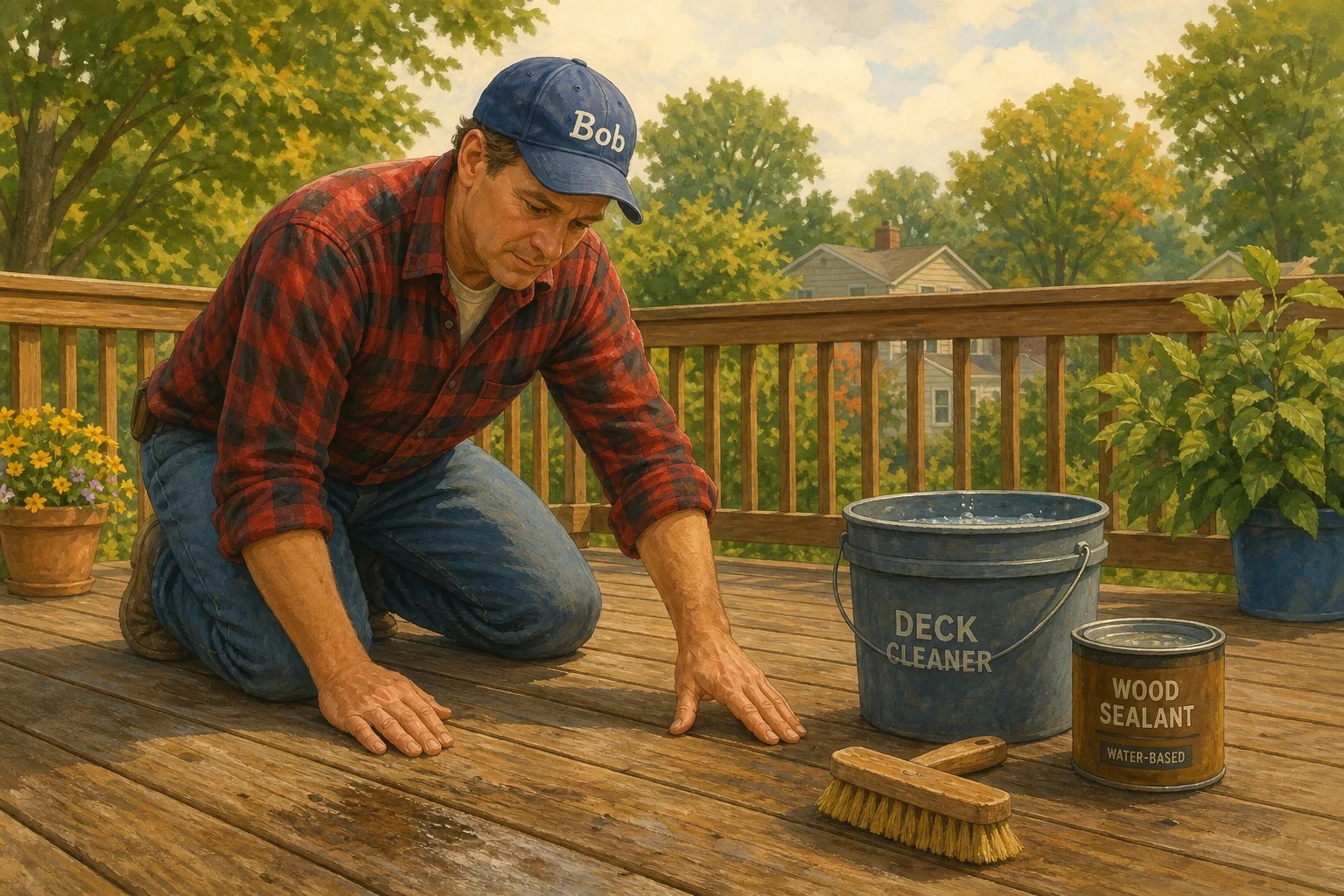
Get down on your knees. I mean it. Standing up and glancing at your deck tells you nothing. You’re looking for dark blotches, green fuzz, and black streaks — especially along the north side, under railings, around planters, and anywhere a grill or a piece of furniture sat all summer.
Mildew is the light stuff — surface-level, wipes off with a deck cleaner and a stiff brush. Mold is deeper. If you scrub and the discoloration is still there, it’s in the wood. That’s a bigger conversation and probably means the board is holding moisture underneath.
I had a homeowner up in Roxborough call me a couple summers back because his deck felt “spongy” near the house. Guy had a beautiful outdoor rug he left down all June and July. Pulled it up in September — the boards underneath were black, soft, and half the fasteners had rusted through. Rug trapped every bit of humidity against the wood for two months. Cost him about $1,800 to fix what would’ve been a $40 cleaning if he’d rotated the rug or pulled it up between rains.
Clean with a proper deck cleaner — sodium percarbonate-based stuff, not bleach. Bleach kills the mildew on top but wrecks the wood fibers and corrodes the fasteners underneath. Scrub with the grain. Rinse thoroughly. Let it dry for at least 48 hours before you do anything else.
2. Check every board for warping, cupping, and cracks
Walk the whole deck. Look for boards that are cupped (edges higher than the middle), crowned (middle higher than the edges), or twisting at the ends. Humidity swelling in summer plus drying out in fall is what causes this. Some movement is normal. A lot of movement means the board is done.
Pay attention to any board where water is pooling instead of running off. Standing water is your enemy. If a board is cupped bad enough to hold a puddle, replace it. Don’t try to plane it flat, don’t try to screw it down harder — the fibers are shot and it’s just going to rot from the top down.
Check for splits at the ends of boards, especially near the fasteners. End grain drinks water like a sponge. If you see splits opening up, that’s where rot starts.
3. Get under the deck if you can
This is the part everyone skips. And it’s the most important part.
Grab a flashlight and get under there. You’re looking at the joists, the beams, the ledger board (where the deck attaches to the house), and the posts where they meet the ground or the concrete footings. Poke suspect wood with a screwdriver. If it goes in easy, that’s rot. Firm wood pushes back.
The ledger board is the one that’ll kill somebody. That’s the board bolted to your house that holds the whole deck up. If the flashing above it is bad, water’s been running behind it all summer, and the wood behind your siding could be soft. Look for rust stains on the siding, staining on the ledger itself, or any gap between the ledger and the house. If something looks off, get a contractor out. Ledger failures are how decks collapse at graduation parties. I’m not being dramatic — that’s how it happens.
4. Tighten every fastener you can reach
Wood swells and shrinks. Screws back out. Nails pop. Lag bolts loosen. Walk the deck with a drill and a socket set and tighten anything that’s moved.
Pay special attention to:
- Railing posts. Grab the top of each post and give it a real shake. If it wiggles more than a hair, the bolts underneath need attention. A loose railing is a lawsuit waiting to happen.
- Stair stringers. Check where they meet the deck frame and where they meet the ground. Wobbly stairs are the number one injury on residential decks.
- Joist hangers. Every nail should be seated. If you see any backed out, drive them home or replace with proper joist hanger nails (not roofing nails, not drywall screws — I’ve seen both and it makes me want to scream).
If you find rusted fasteners, replace them. Don’t just tighten rust and hope. Rusted hardware means water’s been sitting there, and it’s only going to get worse.
5. Clear the gaps between boards
Those gaps between deck boards are there for drainage. When they fill up with leaves, pine needles, and general summer crud, water sits on top of the boards instead of falling through. Then it rots the boards from underneath.
Take a putty knife or a plastic paint scraper and run it down every gap. You’ll be shocked what comes out. Then rinse the deck with a garden hose — not a pressure washer on max, you’ll tear up the wood — and make sure water actually flows through the gaps.
6. Decide about staining or sealing — but don’t rush it
Late summer is a decent time to reseal if the wood is dry and the weather cooperates. But here’s the thing everyone gets wrong: the wood has to be actually dry. Not “it hasn’t rained today” dry. Dry all the way through. After a humid August, that can take a week of sunny weather with low humidity.
Do the water test. Sprinkle some water on the boards. If it beads up, your existing seal is still working — don’t recoat, you’re just wasting money and making a sticky mess. If it soaks in within a few seconds, it’s time.
Pick a stretch of 3-4 dry days with temps between 50 and 85. Don’t stain in direct blazing sun (dries too fast, doesn’t penetrate) and don’t stain if rain is coming within 24 hours. Use a real deck stain — oil-based penetrating stain for older wood, quality water-based for newer composite-friendly applications. Skip the film-forming products that sit on top. They peel in two years and then you’re sanding.
7. Look at what’s touching your deck
Planters sitting directly on boards. Grills against the railing. That patio umbrella base you never move. Anywhere something’s been sitting all summer, water’s been trapped underneath. Move everything, inspect what’s under it, clean it, and when you put stuff back, put a small spacer under it — a couple of cedar shims, a rubber mat with drainage, whatever. Air circulation is the whole game with a wood deck.
The bottom line
A deck is a big flat piece of wood sitting outside getting hammered by weather. If you ignore it, it dies. If you spend an afternoon on it once a year — really on it, not just a quick sweep — you’ll get 25-30 years out of a pressure-treated deck instead of 12.
Late summer is the right time to do this in Pennsylvania. The humidity is starting to break, you can still get sealer to cure properly, and you’ll head into winter knowing nothing’s actively rotting.
Do the walk-through. Fix what you can. Call somebody for the stuff you can’t. And for the love of God, keep an eye on that ledger board.