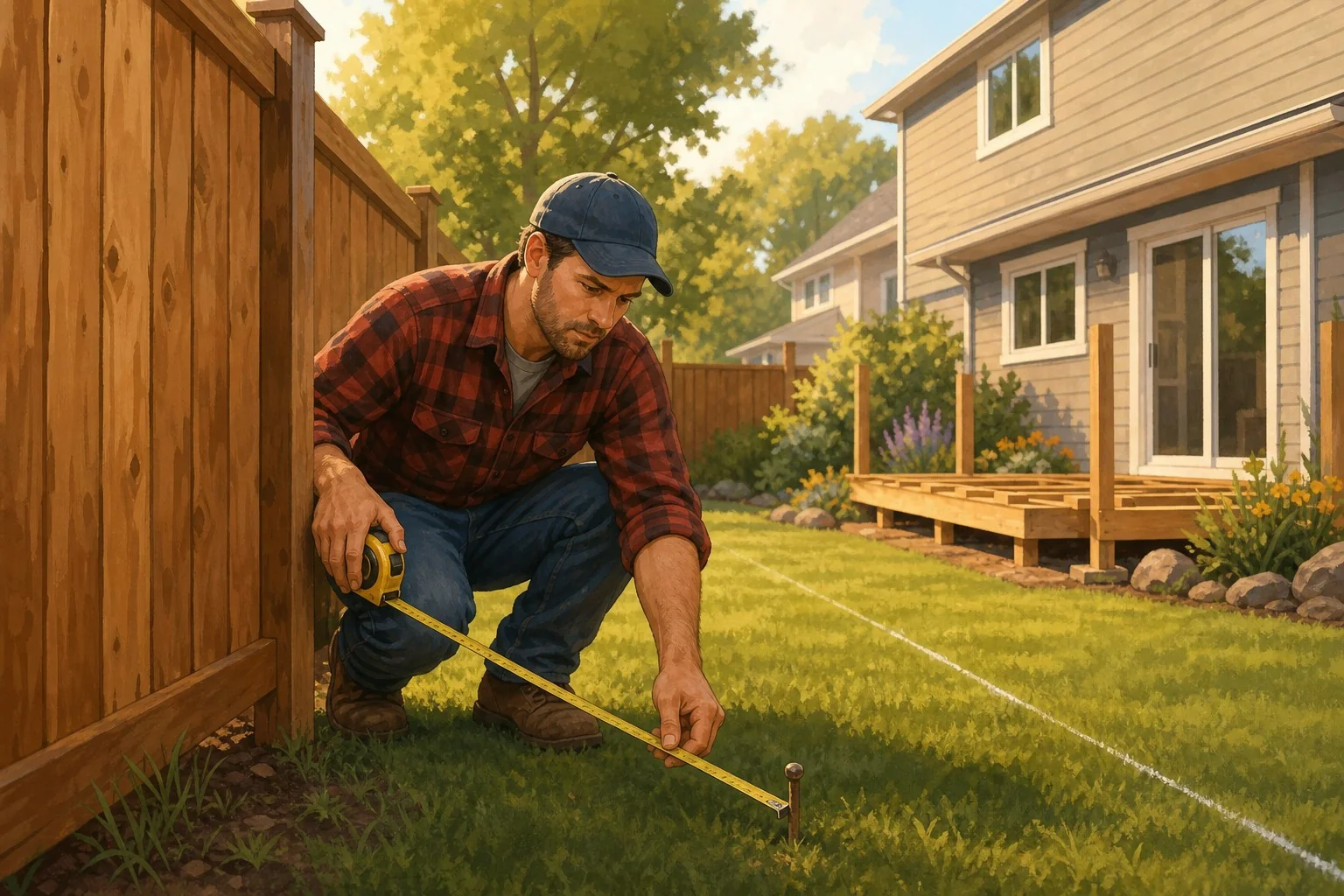
Here’s the short answer most homeowners don’t want to hear: you probably can’t build where you think you can.
Every town has its own rules. Most of them treat fences one way and decks another. And almost nobody bothers to check before they break ground. Then the neighbor calls the township, and suddenly that beautiful cedar fence is coming back down — at your expense.
Let me walk you through what you actually need to know before you put a post in the dirt.
The Setback Basics
Setbacks are the minimum distance a structure has to sit off your property line. They exist so houses aren’t pressed up against each other, so fire trucks can get through, and so you don’t end up with rainwater dumping from your roof onto somebody else’s foundation.
For fences, most municipalities let you go right up to the property line, or within a foot or two of it. Some are stricter on corner lots because of “sight triangles” — the township doesn’t want your six-foot privacy fence blinding a driver pulling out of the side street.
Decks are a different animal. Because a deck is considered a structure, not a yard feature, the rules tighten up fast. You’re usually looking at a side-yard setback of 5 to 10 feet and a rear-yard setback of 10 to 20 feet, depending on where you live. Attached decks often follow the same setback as the house itself, which can be even more restrictive.
Don’t guess. Don’t go by what your neighbor did ten years ago. The rules change, and half the time the neighbor didn’t pull a permit anyway.
How to Find Your Actual Rules
Three places to look, in this order:
1. Your municipal zoning office. Call them. Tell them your address and ask for the setback requirements for an accessory structure or a fence in your zoning district. Most townships will tell you over the phone in under five minutes. Some have it on their website under “zoning ordinance” — search the PDF for “setback” and “accessory structure.”
2. Your deed and plot plan. When you bought the house, you got a stack of paperwork. Somewhere in there is a survey or plot plan that shows your property boundaries and any existing easements. Easements matter. If the utility company has a ten-foot easement along the back of your lot, you cannot put a deck on it. Period. They will dig it up if they need to, and they don’t owe you a dime.
3. Your HOA, if you have one. This is where people get burned. The township might say a six-foot fence is fine. The HOA says four-foot max, white vinyl only, no exceptions. The HOA rules sit on top of the municipal rules, and the stricter one wins. Always. Read your covenants before you spend a dollar on materials.
Why You Need to Know Where the Line Actually Is
Here’s the part most people skip: you don’t actually know where your property line is. You think you do. The fence the previous owner put up is probably close. The hedge has been there forever. None of that means anything legally.
The only thing that proves a property line is a survey from a licensed surveyor, with monuments set at the corners. A real survey runs $600 to $1,000 for a standard residential lot in this area. Bigger lot, weird shape, no existing markers — it goes up from there. People hear that number and choke. Then they spend $8,000 on a deck and find out two years later it’s eighteen inches over the line. Now they’re paying a lawyer, a surveyor, and a demo crew. The $700 survey looks pretty cheap at that point.
I had a job in Roxborough years back — homeowner swore the old chain-link was the property line. We built a nice composite deck two feet inside what he thought was his yard. The neighbor sells a year later, the new guy gets a survey, and the deck is sitting three feet onto his lot. The whole back corner came off. The homeowner paid for the survey, the demo, and the rebuild. All because he didn’t want to spend the money up front to know what he owned.
Get the survey. Especially if there are no visible iron pins at your corners, or if the existing fence is old, or if you and the neighbor have ever had even a mild disagreement about anything.
What Happens When You Build Too Close
A few things, none of them good:
- Neighbor complaint. Somebody calls the township. A zoning officer shows up. You get a notice of violation and a deadline to fix it.
- Forced removal. If the structure violates the setback and you can’t get a variance, it comes down. You pay for the demo. You pay for the rebuild somewhere legal. If contractors built it, you fight with them about who owes what.
- Permit denial after the fact. Some homeowners try to build first and permit later. The inspector pulls up, measures, and denies the permit. Now you’ve got an unpermitted structure that can’t be legalized, which becomes a disclosure problem when you try to sell.
- Title problems at closing. Buyers’ attorneys catch this stuff. An encroaching deck can blow up a sale or force you to drop the price to cover the buyer’s risk.
- Insurance headaches. Some carriers will deny claims on structures that weren’t permitted or are out of compliance.
Variances exist, but they’re not a sure thing. You’re standing in front of a zoning board explaining why you should get special treatment. Sometimes they grant it. Often they don’t, especially if a neighbor shows up to object.
The Bottom Line
Before you pick out lumber, before you call a contractor, before you do anything:
- Call your zoning office and get the setback numbers in writing or by email.
- Read your HOA covenants if you have an HOA.
- Find your iron pins. If you can’t find them, hire a surveyor.
- Pull the permit. If your contractor says you don’t need one, find a different contractor.
A few hundred bucks and a couple phone calls up front saves you from spending five figures tearing down something you should have built three feet to the left. That’s the whole game.