Every summer I hear about a deck collapsing somewhere. Family cookout, twenty people out back, then the whole thing peels away from the house like wet wallpaper. Every single time, it was preventable. Every single time, somebody had a bad feeling about a wobble or a soft spot and didn’t do anything about it.
Pennsylvania decks take a beating. We get freeze-thaw cycles that pull fasteners loose, wet springs that soak into every crack, and hot summers that make wood shrink and split. If your deck is more than five years old and hasn’t been looked at, now is when you look at it. Not the morning of your Fourth of July party. Now.
Here’s how to actually do it.
Start at the house — the ledger board is what kills people
The ledger board is the piece of lumber bolted to your house that supports the deck. When decks fail catastrophically, they usually fail here. Not in the middle. Not at the posts. Right where the deck meets the house.
Get underneath if you can and look at that connection. You want to see through-bolts — big lag screws or carriage bolts going through the ledger, through the rim joist of the house, with washers and nuts on the inside. What you do NOT want to see is nails. If your deck is held onto the house with nails, you have a problem, and you need a pro out there before anyone stands on it in a group.
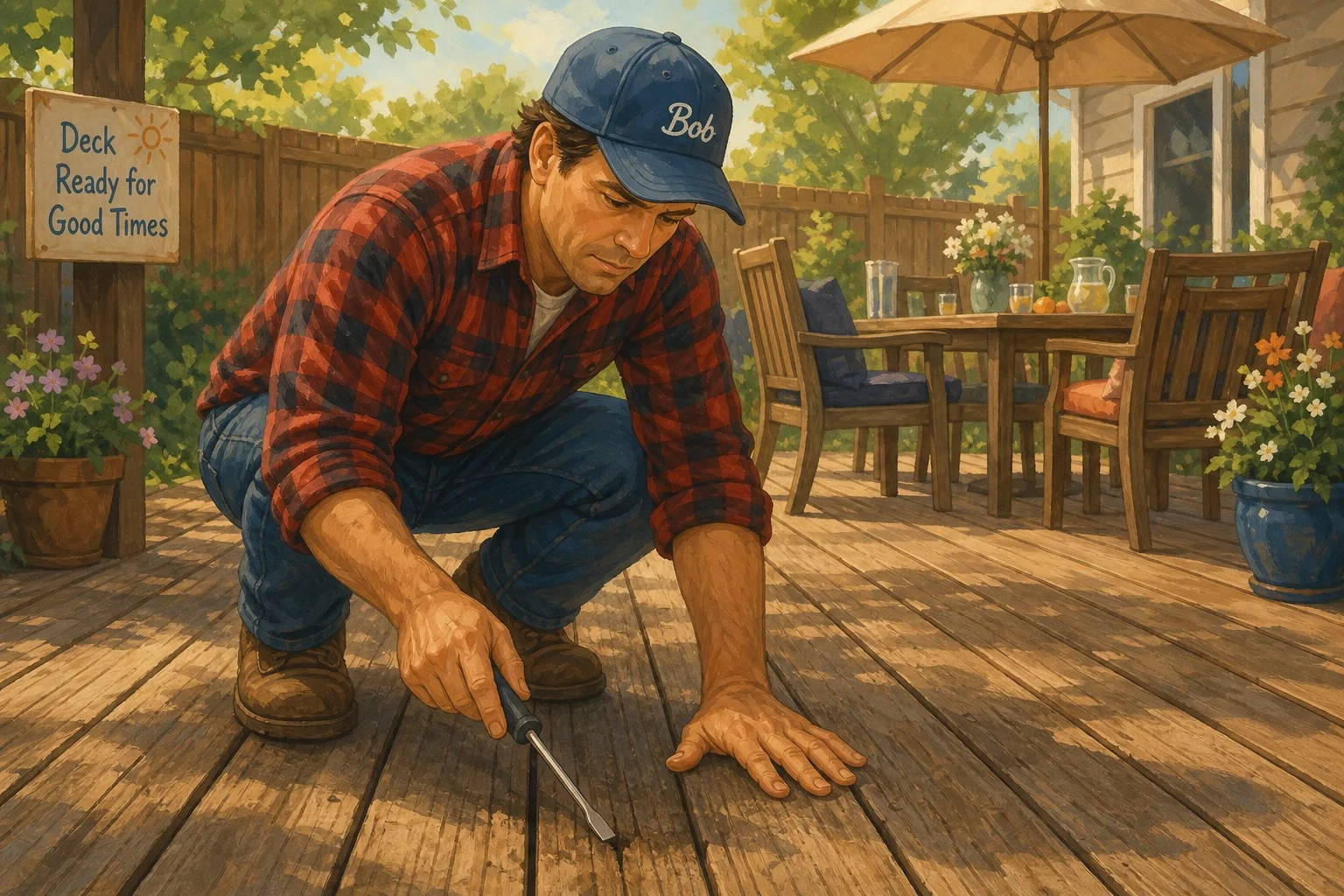
Check for rust streaks running down from the bolts. Rust means water is getting behind the ledger, and if water is getting behind it, the wood underneath — including the rim joist of your house — is probably rotting. Push a screwdriver into the wood around the ledger. If it sinks in more than a quarter inch, that’s rot, and rot means a phone call.
While you’re under there, look for flashing — a metal strip that should be tucked behind the siding and lapped over the top of the ledger. If there’s no flashing, water has been running behind that board for years. Doesn’t mean the deck is falling tomorrow. Does mean you need somebody who knows what they’re doing to open it up.
Walk the deck — and I mean actually walk it
Get on the deck and walk every square foot of it, heel to toe, slow. You’re feeling for spring. Some flex is normal. A soft spongy spot where the board dips under your weight is not. Neither is a hollow thud when you tap a board with a hammer handle.
Look at every board:
- Splits and cracks longer than the width of your hand mean the board is compromised. Replace it.
- Cupped boards — where the edges curl up — pool water and rot faster. Not an emergency, but put them on the list.
- Popped fasteners — nails or screws sticking up above the surface — are trip hazards and a sign the wood is moving. Drive them back down, or better, pull them and drive in a longer coated deck screw. Do not just kick them and forget.
- Dark black or green stains around fasteners often mean rot underneath. Poke it.
Pay extra attention around anything bolted through the deck — planter boxes, benches, hot tub feet. Water sits there and does damage you can’t see from the top.
Grab the railings like you mean it
Walk the perimeter and put real weight against every section of railing. Lean into it. Push. If the whole thing moves, it’s not safe. A railing has to hold a 200-pound adult falling into it, not just look nice with a string of Edison bulbs on top.
Common failures: railing posts nailed to the outside of the deck instead of through-bolted. Spindles pulled loose from the top rail because somebody used trim nails instead of the right fasteners. Loose staircase handrails where bracket screws pulled out of thin trim.
Spindle spacing matters too. Code is no more than four inches between spindles, so a small kid’s head can’t get stuck. If you’ve got gaps bigger than that and children coming to the party, block them off with something temporary until you can fix it right.
The stairs — where people actually get hurt
Stairs cause more injuries than deck collapses. Check the stringers — the diagonal boards holding the treads — for splits or rot at the bottom where they meet the ground. That end sits in wet dirt or grass and rots first. If a stringer feels punky, don’t use the stairs until it’s fixed.
Check every tread for wobble. Check the handrail — grab it and pull hard. It should not move. Not a little. Not at all. If it moves, tighten the brackets or replace them. A handrail that fails when someone’s already falling is worse than no handrail at all, because people trust it and lean harder.
What you can fix yourself vs. what needs a pro
DIY territory: replacing individual deck boards, driving popped nails, tightening railing brackets, swapping rusted screws for coated ones, sanding down a splintered board, cleaning the deck and reapplying sealer.
Call a pro: anything wrong with the ledger board, any structural rot in joists or posts, any railing that can’t be made solid, and anything involving load-bearing framing. I had a homeowner in Roxborough try to sister a rotted joist with a piece of scrap pine and a handful of drywall screws. Two months later the corner of his deck dropped six inches while his in-laws were sitting on it. Nobody was seriously hurt, but nobody should’ve been sitting there in the first place. Some things you don’t guess at.
The bottom line
Give yourself an hour with a screwdriver, a hammer, and a flashlight. If everything checks out, great — enjoy your party. If something’s off, better to know now than to find out with a plate of ribs in your hand and thirty people on the boards. Decks aren’t complicated. They just get ignored. Don’t ignore yours.