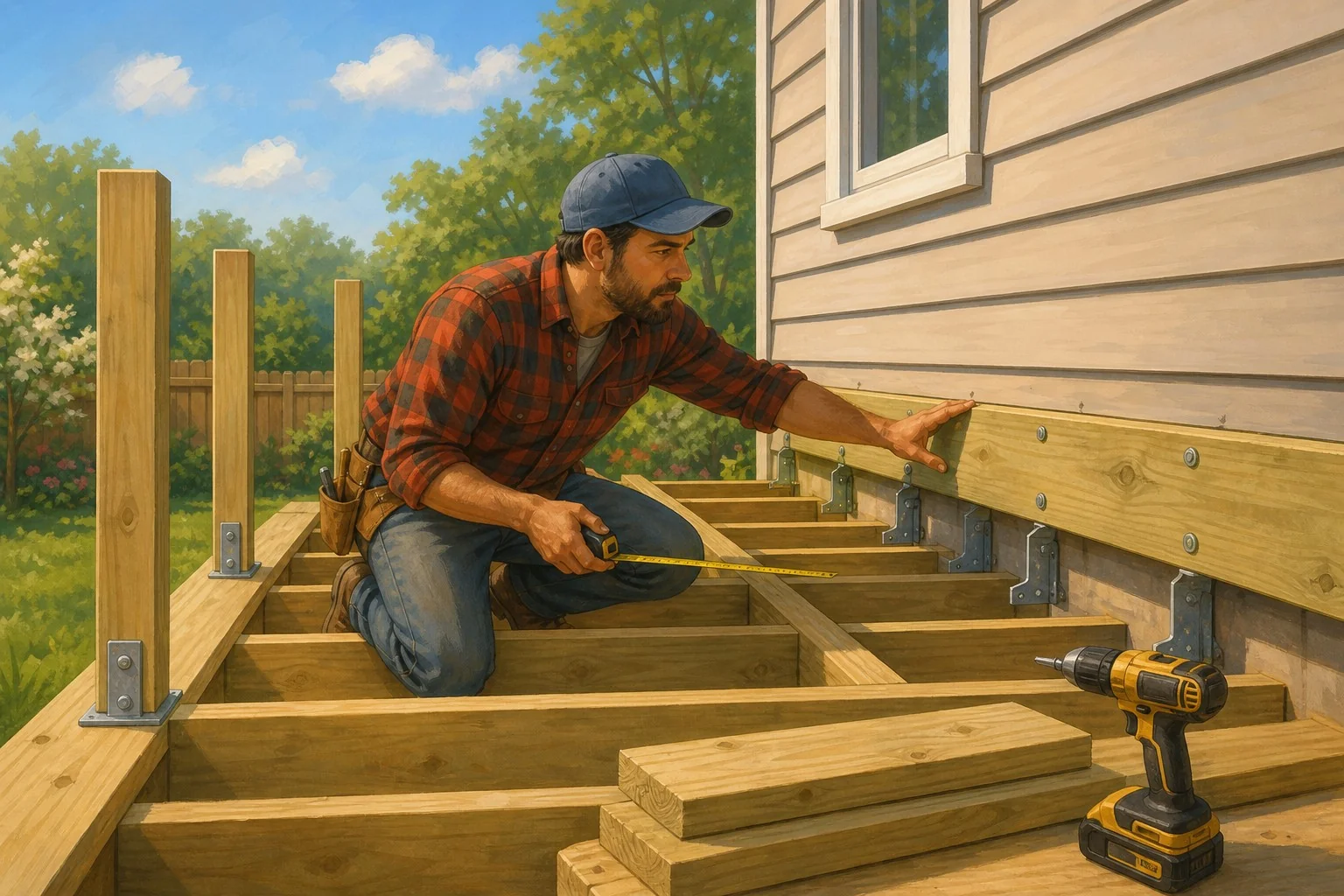
Most deck problems I get called out to look at aren’t from bad wood or bad weather. They’re from three specific mistakes that homeowners either didn’t know about or trusted the wrong guy to handle. Before you swing a hammer or sign a contract, understand these three things. Ledger board. Railing code. And why that fresh, wet pressure-treated lumber is not ready for stain no matter what the guy at the paint counter told you.
If you get these right, you’ve already outdone about half the decks in your neighborhood.
The Ledger Board Is the Whole Ballgame
The ledger board is the piece of lumber that bolts your deck to your house. It carries a huge portion of the load. If it fails, the deck doesn’t sag — it comes off the house. Whole thing. With people on it.
This isn’t a scare tactic. Deck collapses almost always trace back to the ledger. Either it wasn’t bolted in properly, or — more common — it wasn’t flashed, so water got behind it and rotted out the band joist for ten years before anybody noticed.
Two things have to be right:
Bolts, not nails. The ledger has to be attached with proper structural lag bolts or through-bolts sized and spaced to code. Not deck screws. Not framing nails. Not “whatever the last guy used.” If someone tries to sell you a nailed ledger, walk away.
Flashing has to be layered right. You need metal flashing — typically stainless or heavy galvanized — that tucks up behind the siding or house wrap, comes down over the top of the ledger, and drips water away from the joint. If flashing sits under the siding wrong, or if somebody caulked the top and called it a day, water is going to sneak in. Guaranteed.
I got called to a place in South Philly a few years back where the homeowner wanted a “quick inspection” before selling. Deck felt solid enough walking on it. I put a screwdriver into the band joist behind the ledger and it went through like wet cake. Somebody had screwed the ledger straight through vinyl siding with no flashing, no bolts, nothing. Ten years of rain had eaten the framing behind it. The whole deck was hanging off a house that couldn’t hold it anymore. That deck didn’t get sold — it got demolished.
If your deck is already built and you have no idea how the ledger was attached, get someone qualified to pull a piece of siding and look. It’s a twenty-minute check that can save your family.
Railing Rules Aren’t Suggestions
Here’s the part homeowners always want to argue with me about: if any part of your deck surface is 30 inches or more above the ground below it, you need a code-compliant guardrail. That’s it. Doesn’t matter if you have a “great view.” Doesn’t matter if the deck is only 32 inches up on one corner. Doesn’t matter if you promise nobody will lean on it.
The specifics vary a little by jurisdiction, but the general rules most inspectors hold you to:
- Guardrail height: usually 36 inches minimum for residential, 42 in some places. Check your local code.
- Baluster spacing: no gap larger than 4 inches. The old test is a 4-inch sphere shouldn’t pass through anywhere. This is a kid rule. Kids get their heads stuck in wider gaps. It’s not theoretical.
- Load rating: the top rail has to handle a 200-pound push in any direction without giving. That means real posts, real connections, and no notching the crap out of the post at the deck framing.
- Stairs: if your stairs have four or more risers, you need a graspable handrail. Not a 2x6 laid flat. A round or shaped rail your hand can actually close around.
I know railings feel like the boring part of the project. They’re also the part that keeps somebody from falling off your deck at a party.
Do Not Stain That New Deck Yet
This one drives me nuts because every spring somebody stains a brand-new pressure-treated deck, watches the finish peel off in four months, and blames the product.
Pressure-treated lumber is called “wet” for a reason. That wood was pumped full of preservative in a liquid bath. When it shows up at your house, it can be dripping. If you seal or stain that surface, the finish sits on top of a film of water and preservative that has to get out. It can’t. So it flakes, peels, and blotches.
The rule I give homeowners: wait 6 to 12 months before you stain or seal a pressure-treated deck. Longer if you live somewhere humid or shady. There’s a quick check — sprinkle water on the board. If it beads up and sits there, the wood isn’t ready. If it soaks in within a minute or two, you’re good to go.
A few more things people get wrong here:
- Don’t power wash it right before staining. You just soaked the deck. Wait a week of dry weather at minimum.
- Clean it first. Even a new deck picks up mill glaze, dirt, and pollen. Use a proper deck cleaner, not just a hose.
- Follow the can. Stain manufacturers actually mean their instructions. Temperature range, drying time, recoat window. Ignore them and you get a mess.
- Semi-transparent or solid, not clear. Clear sealers on horizontal deck boards in direct sun fail fast. Get some pigment on there. Pigment blocks UV.
Bottom Line
A deck is not a weekend craft project. It’s a structure that holds your family thirty inches or more off the ground and takes a beating from weather every day of its life. Get the ledger right. Meet railing code without arguing. Give the wood time to dry before you finish it.
Do those three things and you’ve handled the parts that cause 90 percent of the problems I get called out to fix.