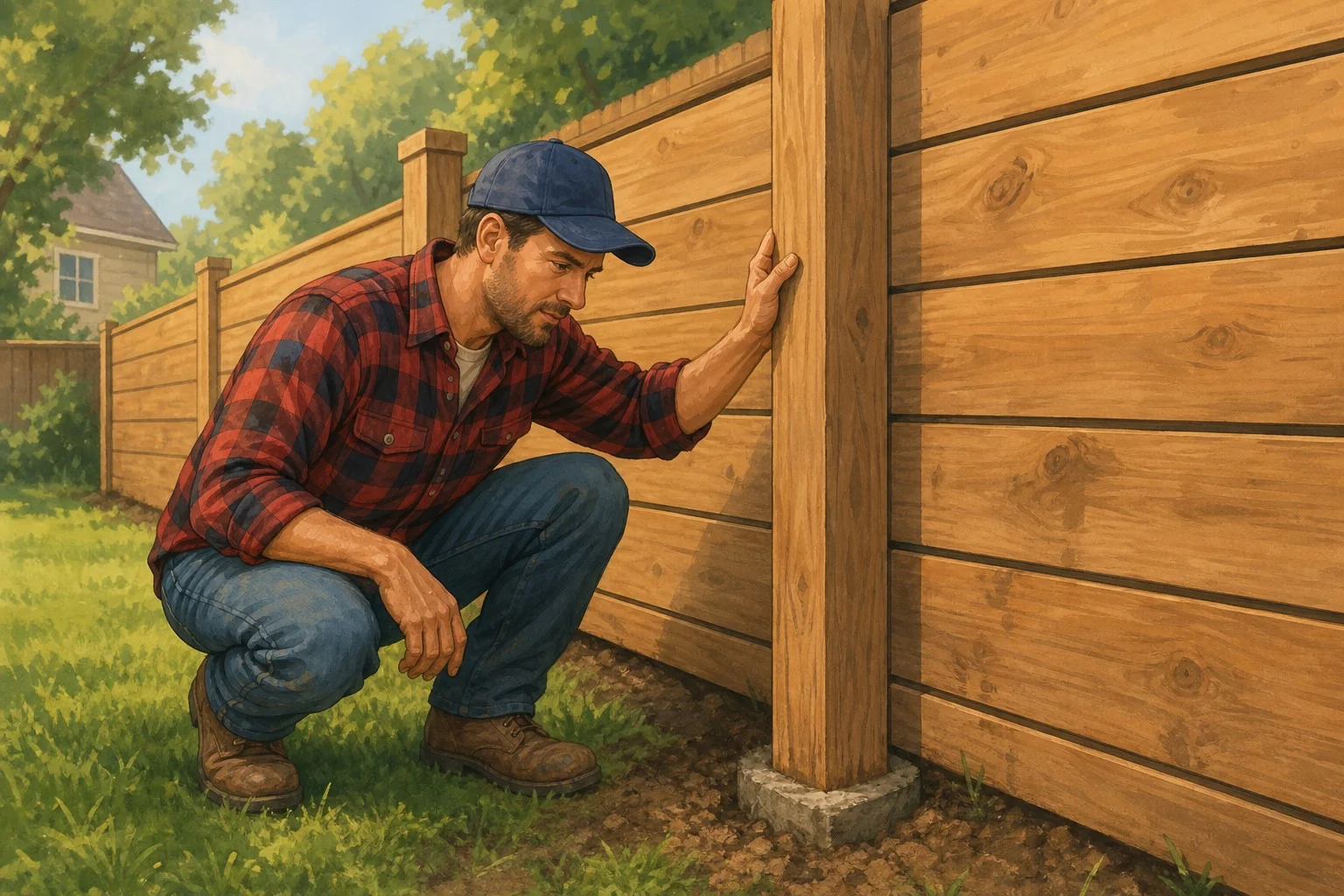
Yes. Short answer. Now let me tell you why, and what “extra” actually means, because most homeowners who go this route find out the hard way that a deck board fence is not a picket fence with thicker slats. It’s a whole different animal.
A traditional fence picket is dog-eared cedar or pine, maybe 5/8“ thick. Weighs almost nothing. A 5/4 deck board is more than twice that, and a composite deck board is heavier than a brick of cheese. Stack thirty of those vertically between two posts and you’ve built yourself a sail with a serious weight problem.
If you don’t account for that, you get sag, lean, and eventually a fence laying in your neighbor’s yard after the first nor’easter.
Forget the standard 4x4. Sometimes.
A 4x4 pressure-treated post is the default for a reason. It works fine for a normal 6-foot privacy fence with cedar pickets. It does not always work for deck boards.
Here’s the rule of thumb:
- Wood deck boards, fence under 6 feet, posts under 8 feet apart: a 4x4 will do the job if everything else is dialed in.
- Composite deck boards, anything over 6 feet, or a windy lot: go 6x6. Don’t think about it. Just do it.
- Tall fences (7–8 feet) with deck boards: 6x6 minimum.
The 6x6 isn’t just bigger. It resists twisting and racking, which is what kills these heavier fences over time. The extra wood also gives you something real to fasten your rails to without splitting the post.
Post spacing: 8 feet is too far. Period.
Standard fence panel kits come 8 feet wide because that’s how lumber comes. For a regular picket fence, fine. For deck boards, that’s how you end up with rails that bow in the middle and a fence that looks drunk by year three.
Plan on 6 feet between posts. On taller fences or wide composite boards, drop it to 5. Yeah, you’ll dig more holes. You’ll also have a fence that’s still straight in ten years.
I had a job out in Roxborough where the homeowner insisted on 8-foot spacing with 5/4 cedar deck boards because his buddy “did it that way.” Two winters later he called me back to redo the whole run. The rails had sagged so bad the top boards were touching in the middle of every section. He paid for it twice. Don’t be that guy.
Footings: dig deeper than you think.
Around Philly, the frost line sits around 30 to 36 inches. That’s not a suggestion. That’s the depth your concrete footing has to extend to so frost heave doesn’t lift your posts out of the ground every winter.
For a deck board fence, I don’t go shallower than 36 inches, ever. With 6x6 posts on a tall fence, I go 42. Wider holes too — 10 to 12 inches across for a 4x4, 14 to 16 for a 6x6. The extra concrete adds mass at the base and resists the leverage from all that weight sitting up top.
And please, for the love of God, don’t use those quick-set foam products for a fence this heavy. Use real concrete. Mix it, dry-pour it, whatever — just use the real stuff.
Rails: 2x4 isn’t going to cut it.
A standard fence uses 2x4 rails because pickets are light. With deck boards, that 2x4 is going to bend over time, especially the bottom rail carrying gravity duty.
Use 2x6 rails. Three of them — top, middle, bottom. On a 6-foot fence the middle rail isn’t optional with this kind of weight. On a taller fence you might even want four.
Fasten with structural screws, not nails, not deck screws. Pay the extra twenty bucks for a box of GRK or equivalent. The connection between the rail and the post is where these fences fail, and a real screw makes a real difference.
Pick your boards right.
Not every deck board makes a good fence board. Some composites are designed for horizontal loading and don’t hold up well vertically with cut ends exposed to weather. Read the spec sheet, or call the manufacturer and ask. If they hem and haw, pick a different board.
Same goes for wood. Kiln-dried boards are going to twist less. Wet pressure-treated lumber straight from the yard is going to do whatever it feels like, and on a fence that means cupping and gaps in a year.
Bottom line
A deck board fence looks fantastic when it’s built right. It’s heavier, more substantial, holds up to weather. But you cannot build it like a picket fence and expect it to behave like one. Bigger posts where needed, tighter spacing, deeper footings, beefier rails. Skip any of those four and you’re going to be calling somebody like me to fix it.
Spend the extra two days and a couple hundred bucks now. Or spend a weekend tearing it all down in three years. Your call.