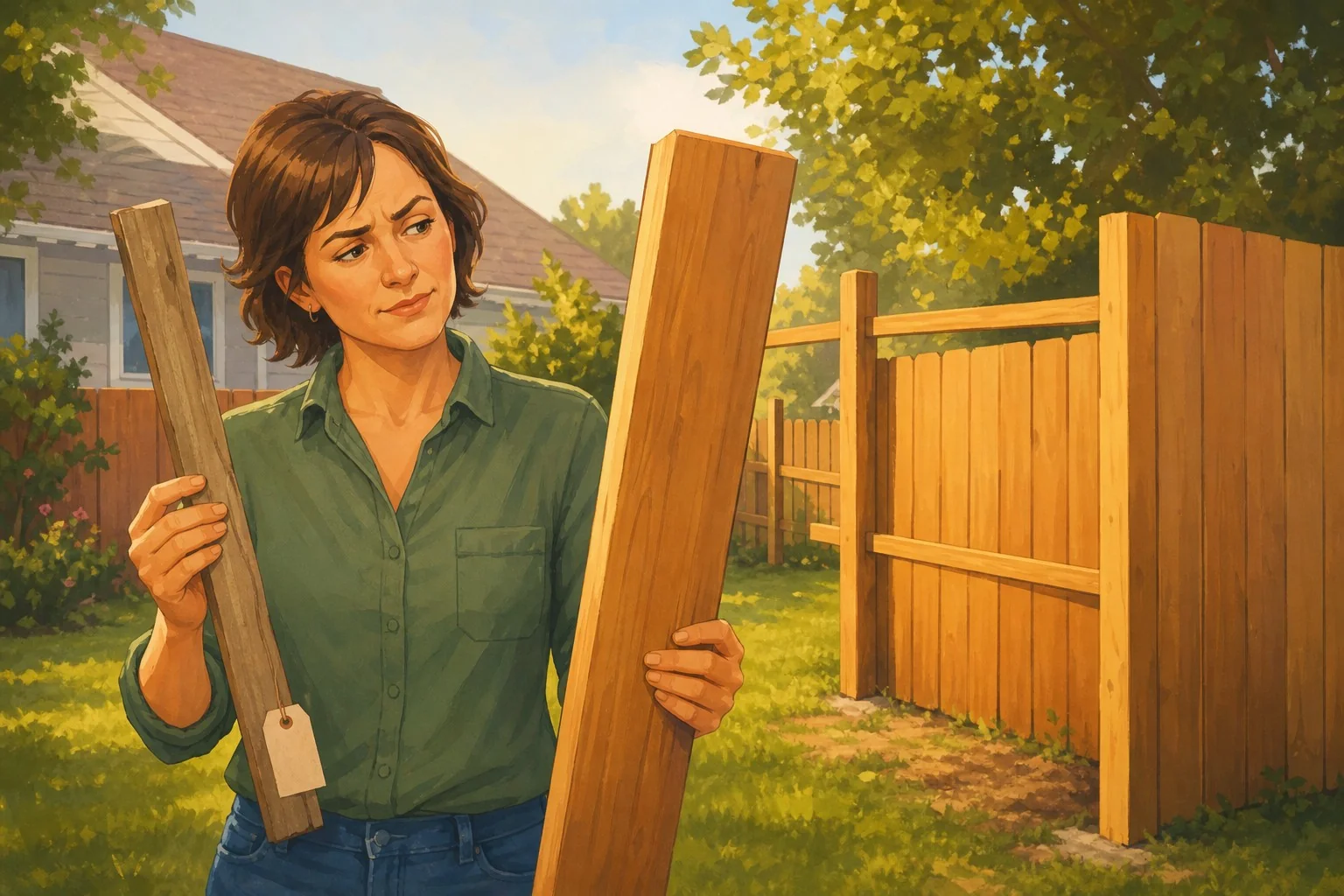
Don’t buy a fence just because the price looks low.
Every fence quote tells you a story. Most homeowners only read the last line.
I’ve been called out to look at fences that were three years old and already falling apart. Owners always say the same thing: “It was the best price.” Yeah. It was. That was the problem.
A cheap fence quote isn’t a gift. It’s a warning. When one guy comes in three grand under everyone else, he’s not being generous. He’s cutting something. And you’re the one who’s going to find out what.
Here’s what the low number is usually hiding.
The wood is thinner than what you think you’re buying
When you picture a fence, you probably picture a six-foot cedar privacy fence with solid pickets, real posts, and it looks decent from both sides. What the low guy is quoting you is a fence that has the same silhouette from the street and almost nothing else in common.
Pickets can be 5/8“ thick or a full 1“ thick. That’s the difference between a fence that warps in the first summer and one that stays flat for fifteen years. Same with rails. A 2x3 rail is not a 2x4 rail. It sags, especially on long runs.
Posts are the biggest place they cheat you. A real fence post is a 4x4 set 36 inches deep in concrete. A cheap fence post might be a 3.5x3.5 pressure-treated stick set 18 inches deep with a bag of dry-pour dumped in the hole. First freeze-thaw cycle, that post moves. First real wind storm, it leans. Two years in, you’re calling somebody like me to reset the whole run.
Ask what the pickets are. Ask what the rails are. Ask how deep the posts go, and ask what’s holding them in the ground. If the guy hedges on any of that, you already have your answer.
The hardware is where they save real money
Nobody looks at hardware on a fence quote. That’s exactly why they cheat you there.
Galvanized nails and screws cost more than plain steel. Stainless costs more than galvanized. Ring-shank framing nails hold three times better than smooth-shank. Structural screws are twice the price of drywall screws — and yes, guys use drywall screws on a fence. I pulled apart a two-year-old fence in South Philly last spring and found black drywall screws in every rail. Every single one had rusted through. The whole fence was hanging on rust dust and hope.
Then you get to hinges and latches. A cheap gate gets two small hinges and a spring latch you can buy in a bubble pack for four bucks. A good gate gets three heavy-duty strap hinges, a real drop-rod, and a latch that’ll still work in ten years. The hardware on a gate should cost more than the lumber in the gate. If it doesn’t, they cheaped out.
The gate is where the whole job shows up
The gate is the one part of the fence that moves. That’s why it’s the one part that fails first, and it’s how you tell a real fence guy from a hack in about ten seconds.
A gate needs a diagonal brace running from the bottom hinge side up to the top latch side. It needs the correct hinges for its weight. It needs to be hung so it swings clean and shuts on its own. And it needs enough clearance that when the ground swells in winter, it still opens.
The low-bid guy hangs a gate square with no brace, uses whatever hinges came in the pack, and doesn’t set the latch post plumb. Six months later it’s dragging in the dirt, the latch won’t catch, and the top corner has already dropped a half inch. You’ll spend the next ten years shouldering that thing open every time you take the trash out.
The install details you don’t see until it’s too late
Are the posts plumb? Is the top of the fence level, or does it step properly on a slope? Are the pickets spaced evenly? Are the cuts capped so end grain isn’t sitting in weather? Is there gravel under the concrete for drainage, or did he just dump concrete straight into wet dirt?
None of that costs a fortune. All of it takes time. Time is what the low-bid guy is cutting.
The lifespan math
A properly built cedar or pressure-treated fence should give you fifteen to twenty years easy. A cheap-built one gives you three to seven before it looks like garbage and eight to ten before it comes down.
Spread the cost out over the years you actually get. That $6,000 fence over twenty years is three hundred bucks a year. That $3,500 fence over five years is seven hundred bucks a year — and now you’re doing the whole thing again, including tearing out the old one. You didn’t save. You paid double and got worse.
How to actually compare quotes
Stop reading the number at the bottom first. Start at the top and read what’s included. If two quotes don’t list the same materials, gauges, depths, and hardware, they’re not the same job. You’re comparing a steak to a hot dog and picking based on price.
Get every quote to spell out:
- Picket thickness and species
- Rail size and how they’re attached
- Post size, depth of the hole, and what goes in the hole
- Fastener type — galvanized, stainless, or “we’ll see what’s on the truck”
- Gate hardware, diagonal brace, and hinge count
- Whether they’re setting a new latch post or reusing a rotten one
- Cleanup and old fence removal
- Warranty in writing, not “I stand behind my work”
Once everything is on paper the same way, the low quote usually isn’t the low quote anymore. And if it still is, now you know why — and you can decide if you actually want to buy that fence.
A fence is a long-haul purchase. Pay for ten years, you’ll be dealing with it in three. Pay for twenty, you’ll forget it’s even there. Your call.