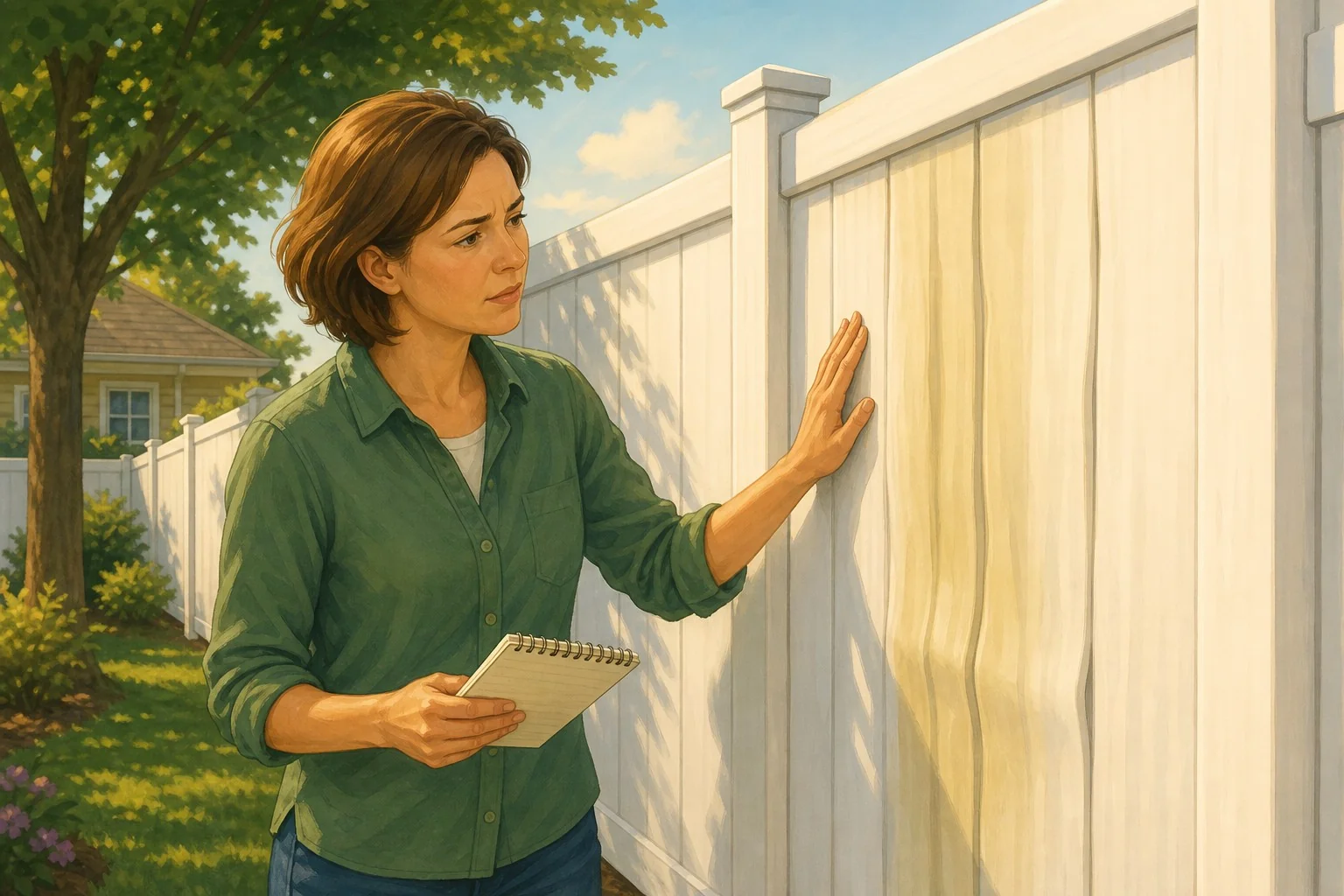
Vinyl fencing gets sold hard. Walk into any big-box store or talk to a fence salesman and they’ll tell you it’s low maintenance, it’s clean, it lasts forever, never needs paint. And look, some of that is true. But “some of that is true” isn’t the whole story, and nobody’s going to volunteer the rest when they’re trying to close a sale.
Here’s what vinyl actually is, where it falls short, and — because I get asked this more than you’d think — what the so-called seven-year fence law means for your property.
The Real Downsides of Vinyl Fencing
It Doesn’t Like Cold. Or Heat. Or Wind.
Vinyl is plastic. That sounds obvious, but people forget it until it matters. In cold weather, PVC gets brittle. A hard enough impact — a branch, a snowplow clipping the corner, a kid on a bike — and it cracks clean. You’re not patching a crack in vinyl fencing the way you’d patch a dent in wood. You’re replacing a section. Maybe more, depending on the style, because panels have to match.
Heat is the other side of it. Vinyl expands and contracts with temperature swings. If it was installed without proper spacing for expansion, you’re going to see buckling in summer and gaps in winter. This also means vinyl fencing is not where you want to be in high-wind areas. It has no flex. Wood bends a little and comes back. Vinyl takes the force differently, and if the posts aren’t set deep and solid, you’re losing panels in a bad storm.
It Looks Like What It Is
This is a taste argument, but it’s worth saying plainly: vinyl fencing looks like plastic. Some people don’t care. Fine. But if you’re putting it next to a natural-stone walkway, a wood-frame house, or an established garden, there’s a disconnect. The stuff doesn’t age the way wood does. It doesn’t get better looking over time. It just sits there, same as the day you put it in — or slightly yellowed, if it’s cheap material or gets a lot of direct sun.
UV degradation is real. Lower-grade vinyl will chalk and yellow. Better vinyl has UV inhibitors that slow this down, but they don’t stop it entirely. And once it’s yellow, you can’t paint it. That’s the trap — one of the selling points of vinyl is that you never have to paint it, but the flip side is that you can’t paint it if you want to. You’re locked into the original color forever.
Installation Shortcuts Will Haunt You
Vinyl fence posts need to go in the ground properly — typically 1/3 of the post length buried, set in concrete, at the right depth for your frost line. I see vinyl fences installed with posts barely two feet down, no concrete, backfilled with loose soil. They lean within two winters. The posts heave in freeze-thaw cycles, and because vinyl is rigid, the whole run goes with it.
The other issue is drainage. Hollow vinyl posts collect water if the caps aren’t sealed. Water freezes, expands, cracks the post from the inside. Nobody talks about this at the point of sale.
I had a homeowner in Manayunk call me after her vinyl fence — installed by the previous owner — started leaning like a drunk after four winters. When we pulled the posts, they’d gone in maybe eighteen inches with no concrete. The whole fence had to come out. That’s a cheap install that ends up costing twice what a done-right install would have cost the first time.
You Can’t Repair It the Way You Can Wood
Wood is forgiving. A rotted post? Replace the post. A damaged board? Swap the board. The rest of the fence doesn’t care. Vinyl is modular, which sounds good until you need to repair something. You need matching panels. If the manufacturer has discontinued that style, or if the color has faded differently than the replacement piece, you’re stuck with a mismatched fence or you’re replacing the whole run.
Structural repairs are limited. You can’t sister a cracked post. You can’t plane down a warped rail. What’s broken is broken, and your only real move is replacement.
The Environmental Reality
This one’s worth knowing even if it doesn’t change your decision. PVC production is not clean, and vinyl fencing is difficult to recycle at end of life. If environmental impact is part of how you make decisions, that belongs in the calculation. Wood from a responsibly managed source, or metal, may be a better fit.
What Is the 7-Year Fence Law?
This comes up constantly, and there’s a lot of confusion about it, so let me be straight with you.
There is no single “7-year fence law” that applies everywhere in the United States. What people are usually referring to is adverse possession — a legal doctrine that says if someone openly uses or occupies land that isn’t theirs for a statutory period without the true owner objecting, they can eventually make a legal claim to it.
The time period varies by state. Some states use 7 years. Others use 10, 15, or 21. Pennsylvania, where I’ve done most of my work, uses 21 years under general adverse possession, though specific circumstances can shorten it. Other states with 7-year statutes include Florida and Texas, but even there, conditions apply.
Here’s what this means for a homeowner putting up a fence:
If you put your fence on your neighbor’s land — even by accident — and it sits there long enough, your neighbor may lose their legal claim to that strip of land. Conversely, if your neighbor puts their fence on your land and you don’t object for the statutory period, you could lose it.
This is not hypothetical. Property surveys get misread. Old fence lines get assumed to be property lines when they’re not. People install fences based on where they think the line is, not where it actually is.
What You Need to Do Before You Install Any Fence
Get a survey. Not “check the tax map online.” Not “ask your neighbor where they think the line is.” An actual survey by a licensed surveyor who puts stakes in the ground and gives you documentation.
Yes, it costs money. A few hundred dollars, typically. Compare that to a legal dispute over land that’s been sitting on the wrong side of a fence line for years. There’s no comparison.
Once you have your line, build a few inches inside it. Not on it. Inside it. This gives you margin for error and eliminates any question about encroachment.
If you’re buying a house with an existing fence, do not assume that fence is on the property line. Have it verified before you close, or at least before you rely on it for anything legal.
When It Actually Becomes a Problem
The legal dispute usually starts when someone wants to sell, renovate, or has a falling-out with a neighbor. A fence that’s been “fine” for fifteen years suddenly becomes a problem when someone pulls a survey. At that point, depending on your state’s law and how long the fence has been there, the resolution may not be simple.
The courts don’t automatically hand land to whoever’s been using it. The person claiming adverse possession has to meet specific criteria — continuous use, open and notorious, hostile (meaning without the owner’s permission), and for the full statutory period. But getting into a dispute over it is expensive and time-consuming even if you’re in the right.
The short version: know your line before you build anything permanent on it.
Bottom Line
Vinyl fencing is not the maintenance-free miracle it gets sold as. It has real limitations in cold climates, real failure modes when installed poorly, and real constraints when you need to repair or change it later. It might still be the right choice for you — but go in knowing what you’re actually getting.
And before any fence goes in, regardless of material, pull a survey and know exactly where your property ends. The seven-year law, or whatever your state’s version of it is, is not something you want to learn about after the fact.