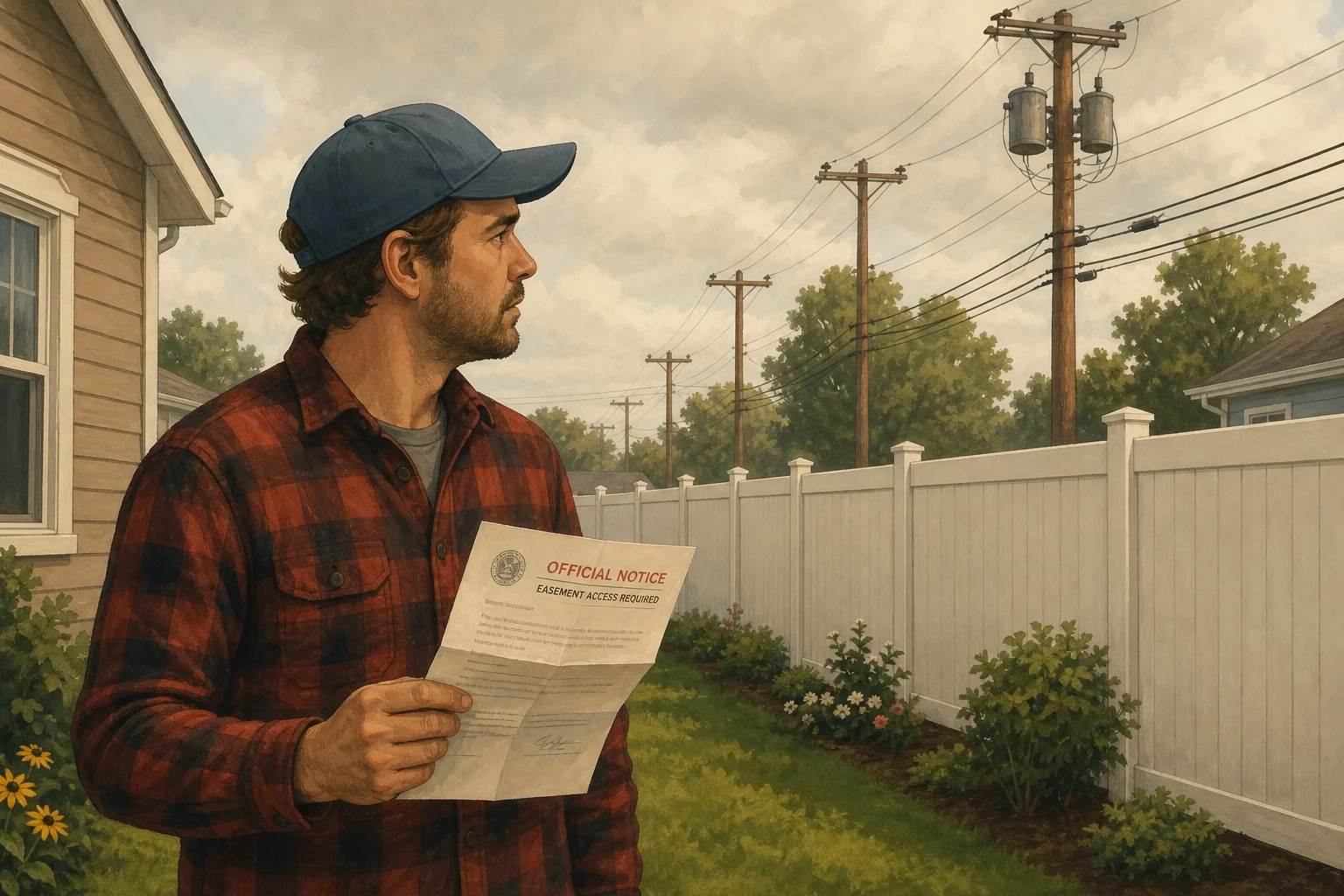
I’ve had this conversation more times than I want to count. Homeowner drops eight grand on a nice cedar fence. Two years later PECO or the water company shows up and says the fence has to come down. Homeowner loses their mind. And the worst part? The utility company is right.
Nobody reads their deed. Nobody looks at the plat map. Then they call me in a panic when the yellow spray paint shows up on the grass.
Here’s the deal on easements, in plain English.
What an easement actually is
An easement is a legal right somebody else has to use part of your property. You still own the dirt. You still pay taxes on it. But somebody — usually a utility company, sometimes a neighbor, sometimes the municipality — has a written legal right to access it. And that right existed before you bought the house.
The most common kind is a utility easement. Gas lines, water mains, sewer pipes, electric, cable, fiber. That stuff runs somewhere, and when it runs across your property, there’s an easement that says the utility can dig it up, work on it, or replace it whenever they need to.
Drainage easements exist for stormwater. Access easements exist for landlocked neighbors. Some old properties still have easements for things that haven’t existed since the Nixon administration. Doesn’t matter. If it’s on the deed, it’s real.
When they can legally force the fence out
Any structure you put in an easement — fence, shed, retaining wall, that fancy pergola from Home Depot — is fair game if the easement holder needs to get in there. And here’s the kicker: in most cases they don’t have to pay to remove it, and they don’t have to pay to replace it. That’s on you.
They can make you tear it down when:
- The fence sits inside the easement footprint. Not near it. Inside it. Even a foot or two over the line counts.
- They need physical access to their equipment. A gas line inspection, a sewer repair, a pole replacement. The easement gives them the right to bring a backhoe through your yard.
- The fence blocks a right-of-access route. Sometimes the easement isn’t over the pipe itself — it’s the path they use to get to the pipe.
- It creates a safety issue. Buried electric with chain link nailed too close, or a fence that traps gas near a leak.
I had a job in Roxborough — nice couple, put up an eight-foot cedar privacy fence, real proud of it. Turns out half of it was sitting in a fifteen-foot PECO easement running to their transformer. When that transformer failed the following winter, PECO cut the fence apart with a chainsaw to get their bucket truck in. That’s legal. That’s in the easement. Homeowner was screaming and there was nothing anyone could do. They didn’t get a dime.
What to do before you build
Do these three things before you sink a single post. This isn’t optional. This is what separates the people who keep their fence from the people who tear it out twice.
1. Read your deed and pull your plat map. Your title paperwork lists easements. If you can’t find it, call your title company or hit the county recorder’s office. In Philly that’s the Department of Records. In the suburbs it’s the county courthouse. Every easement is on paper somewhere.
2. Call 811 before you dig. Every time. No exceptions. Free service, and it’s the law. They mark every utility line under your yard within a few business days. If the paint sits inside the line you were about to fence, you just saved yourself thousands of dollars. Do not skip this because you “know where the gas line is.” You don’t.
3. Check with your township before you build. Zoning and permits will flag right-of-way and setback issues that don’t always show up on the plat. Some townships have their own easements granted decades ago that nobody remembers.
What if the fence is already up
If the utility shows up and tells you the fence has to go, ask for it in writing. Ask for the specific easement they’re relying on, and the section of it that gives them the right. A legit request will get you the paperwork. If they can’t produce it, they’re bluffing.
But if the paperwork’s there, don’t fight it. You will lose. And you’ll pay the legal bill on top of the fence bill.
Best case, negotiate. Sometimes they’ll agree to a removable panel or a hinged section you can drop out when they need access. Sometimes they’ll survey the exact easement line and you can shift the fence a few feet the other way. Sometimes they won’t budge. Depends on the utility and depends on the guy you get on the phone. Be polite. Be persistent. That gets you further than yelling.
Bottom line
You own your property. But you don’t own it free and clear if there’s an easement, and almost every property has one. That’s not a bug in the system — that’s how the utilities work. Water gets to your house because there’s an easement letting it get there.
Check the paperwork before you build. It costs nothing. Not checking? That’s the eight-grand mistake I see every summer.