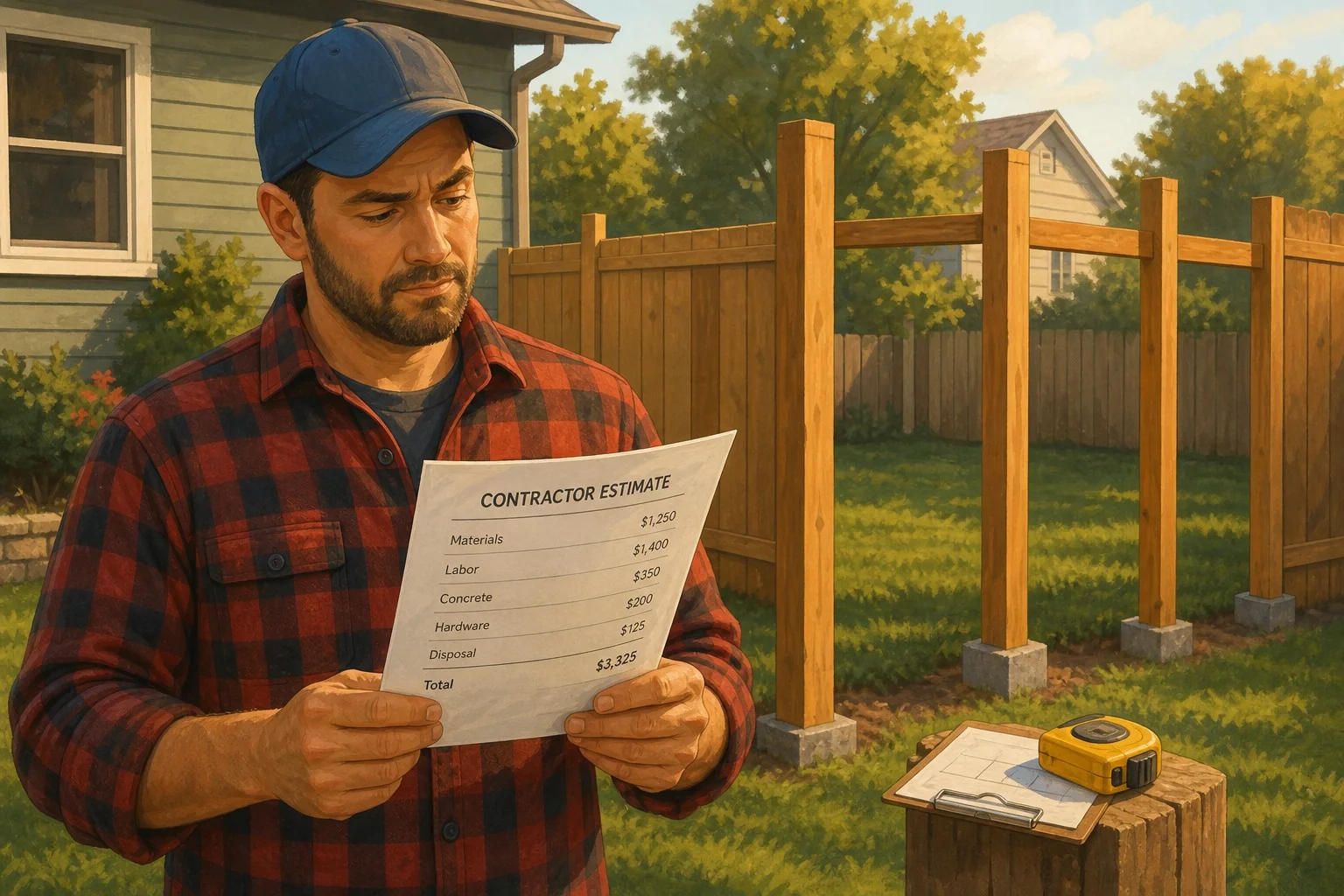
So you got a fence quote and it knocked the wind out of you. Before you start calling the guy a thief, slow down. Sometimes the number is honest and the job is just expensive. Sometimes the number is fat and the guy is hoping you don’t ask any questions. Knowing the difference is the whole game.
Here’s how to actually read a fence quote without getting taken — or insulting a guy who’s giving you a fair price.
1. Look at the materials line — what kind of wood, what gauge, what hardware
A fence is not a fence. A 6-foot pressure-treated pine privacy fence and a 6-foot western red cedar privacy fence look the same in a photo and cost wildly different at the lumberyard. Same goes for chain link — 11-gauge is the cheap stuff, 9-gauge is heavier and lasts longer. Vinyl? Junk-grade vinyl gets brittle and cracks in three winters. Good vinyl runs you double.
Ask the contractor exactly what species, grade, and gauge he’s pricing. If he can’t tell you off the top of his head, that’s a problem. If he says “standard” — that means nothing. Standard for him might be the cheapest thing on the truck.
And don’t forget the guts of the job. Galvanized vs. stainless screws, concrete vs. dry-set posts, aluminum vs. steel hardware. These are not little things. Cheap hardware will rust out and leave you with a wobbly fence in five years. Good hardware is the difference between a fence that lasts twenty years and one you’re already cursing at by year six.
2. Labor is where the spread comes from
Two guys who price the same materials can be a few thousand dollars apart on labor — and both of them might be right. A small two-man crew banging out a flat backyard in one day is a different job than a crew that has to grade, hand-dig, and work around utilities for three days.
Ask how many guys, how many days. If they’re vague, push. A fair contractor will tell you. A guy padding his number won’t want to break it down because the math doesn’t work.
One thing to know: cheap labor is almost never cheap. Either the crew is green and you’ll be looking at crooked posts, or the guy is paying his guys under the table and skipping insurance, which means if someone gets hurt on your property, it’s your homeowner’s policy holding the bag. That’s not a deal. That’s a trap.
3. Demo isn’t free — and old fences are worse than you think
If you’ve got an existing fence coming out, that’s a separate job buried inside the new one. Pulling posts set in concrete forty years ago is brutal work. Chain link with the bottom rail rusted into the dirt? Worse. And then you’ve got to haul it. Dump fees in the city aren’t what they used to be.
A quote that includes demo is going to be higher than one that doesn’t. That’s not a markup. That’s reality. If two quotes look way different, check whether one of them is even pulling the old fence — because if it’s not, that’s a cost you’re going to eat later.
4. Your yard might be the problem
I had a job in South Philly years back where the homeowner couldn’t figure out why his quote was almost double his neighbor’s. The neighbor had a driveway you could back a truck into. This guy? Row house, no rear access, every post, every bag of concrete, every panel had to come through the house and out the back door. Two extra days of labor right there. He thought I was gouging him until I walked him through it. Then he understood.
Access matters. A truck that can pull right up to the fence line is a one-day job. A yard you have to wheelbarrow through a side gate is two days, easy. Slope, tree roots, buried utilities, narrow alleys, soft soil that won’t hold a post — all of that drives the number.
If your neighbor got a cheap quote and you didn’t, look at your yard. The answer is probably right there.
5. Gates are not just doors
Every gate is a small custom build. It needs a heavier frame, real hinges, a working latch, and posts set deeper because that gate is going to swing on them ten thousand times. A double drive gate is even more — bracing, drop rods, the whole bit.
If your quote has three gates in it, that’s not three pieces of fence. That’s three little projects. They add up fast, and they should.
6. Delivery, dump, and the stuff nobody mentions
Lumber delivery isn’t free. Concrete bags aren’t free. Hauling away your old fence isn’t free. Permits, if your township requires them, aren’t free. Marking utilities through 811 is free, but the contractor’s time to coordinate it isn’t.
A clean quote will have these spelled out. A sloppy quote rolls them all into one number, and that’s where the games get played — either the contractor forgot them and is going to come back asking for more later, or he stuffed extra in and is hoping you don’t notice.
So is the quote actually too high?
Maybe. Maybe not. Get two more bids — three quotes is the minimum on a job this size. Compare them line by line, not just bottom line to bottom line. If one guy is way lower, find out what he’s leaving out. If one guy is way higher, ask him to walk you through it. A real contractor will. A guy with something to hide won’t.
And pick the guy who answers your questions straight. That tells you more about how the job is going to go than the price ever will.