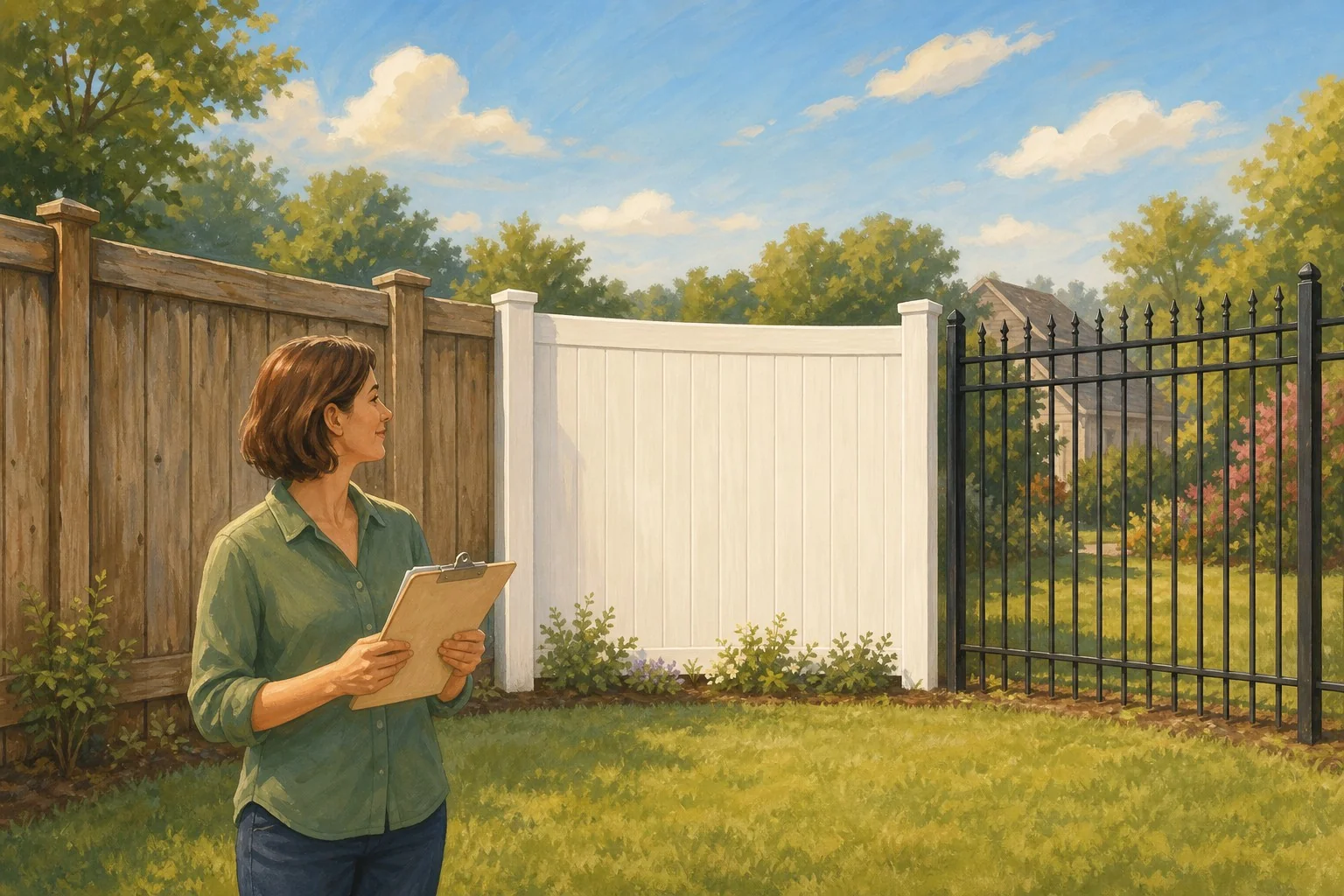
Everybody asks me the same question when they’re getting a fence: “Mike, which one’s the best?” Wrong question. The right question is which one’s the cheapest to own, not the cheapest to buy. Because the second that fence goes in the ground, it starts costing you money to keep it standing. Some materials nickel-and-dime you for thirty years. Others ask for almost nothing.
Here’s the ranking, from cheapest to most expensive to maintain over the long haul. Numbers are based on a standard 150 linear feet of residential fence — basically a typical city or suburban backyard. Adjust up or down for your yard.
1. Aluminum — about $25 to $60 a year
Aluminum is the quiet winner most homeowners never consider. Powder-coated finish, doesn’t rust, doesn’t rot, doesn’t warp. Hose it off twice a year and you’re done. The only real cost is touch-up paint when a kid hits it with a bike or a landscaper gets too cute with the weed whacker — call it a $15 can of matched powder-coat paint every other year.
Catch is up front. You’re paying $30 to $60 a linear foot installed, so it’s not cheap to put in. But over a 30-year ownership window, your total maintenance bill is under a grand. That’s a winner.
2. Vinyl — about $30 to $75 a year
Vinyl gets a bad rap because the cheap stuff is genuinely garbage, but the mid-grade and better panels are solid. You wash it. That’s basically the job. Soap, water, soft brush, twice a year. Maybe a pressure washer on low if it’s been a rough winter.
The cost shows up when something cracks. UV breakdown is real, especially on the south-facing side. After 15 years, expect to swap out a panel or two. A replacement panel runs $80 to $180, plus a couple hundred for a contractor to do it right — or zero if you’re handy and the panel slides into the existing posts. Average that out and you’re at $30 to $75 a year, and that’s being honest about long-term replacements, not just the wash-and-rinse years.
One warning: don’t buy bargain-bin vinyl. The thin-wall stuff turns brittle in about ten years and cracks if you look at it sideways. Spend the extra money up front on a thicker mil panel and your annual cost drops.
3. Chain link — about $40 to $120 a year
Galvanized chain link will outlive you. The fence itself is basically zero maintenance. What kills your budget is everything attached to it — the gates, the tension bands, the ties, and especially the vinyl coating if you went that route.
Vinyl-coated chain link looks better for the first five years, then the coating starts cracking and peeling, and once water gets under there, the wire underneath rusts fast. Plain galvanized doesn’t have that problem. Either way, plan on a gate hinge or latch repair every few years ($50 to $150 a pop), and tie wire replacement every decade.
Chain link’s biggest hidden cost isn’t maintenance — it’s that it looks like a chain link fence. Resale value doesn’t love it. But you asked about maintenance, and the answer is: cheap.
4. Wood — about $200 to $500 a year, sometimes more
Now we get to the expensive one. Wood fences are the default in a lot of neighborhoods because they’re the cheapest to install. They are not cheap to keep.
Here’s what nobody tells you. Pressure-treated pine, which is what 80% of wood fences are, needs to be sealed or stained every 2 to 3 years. Materials alone — stain, brushes, rollers — run $150 to $300 for a typical yard. Pay a contractor to do it and you’re looking at $600 to $1,200 every cycle. That’s $200 to $400 a year just to keep the finish on.
Then there’s the rot. Posts go first, usually 8 to 12 years in, right at the ground line where the concrete meets the wood. Replacing a single post properly — pulling concrete, resetting, attaching rails — runs $150 to $300 each. Cedar lasts longer than pine but costs more and still rots eventually. Pickets warp, split, and pop their nails. Plan on replacing 5 to 10% of them per decade.
I had a client in Roxborough call me out for a “small repair” on a 12-year-old pressure-treated fence the previous homeowner had installed. We pushed on a post and it broke off at the ground like a piece of cardboard. Pulled three more — same story. The whole back run was eight years past its sell-by date. Six grand later, she had a new fence. That’s what deferred wood maintenance looks like.
The takeaway
If you want the lowest lifetime cost and you can afford the install, aluminum. If you want the best balance of price and easy ownership, mid-grade vinyl. If you don’t care how it looks and you want it cheap forever, galvanized chain link. If you want wood, fine — but budget for it like a car. It needs regular service or it falls apart.
Buy the fence you can afford to maintain, not just the one you can afford to install. That’s the whole game.