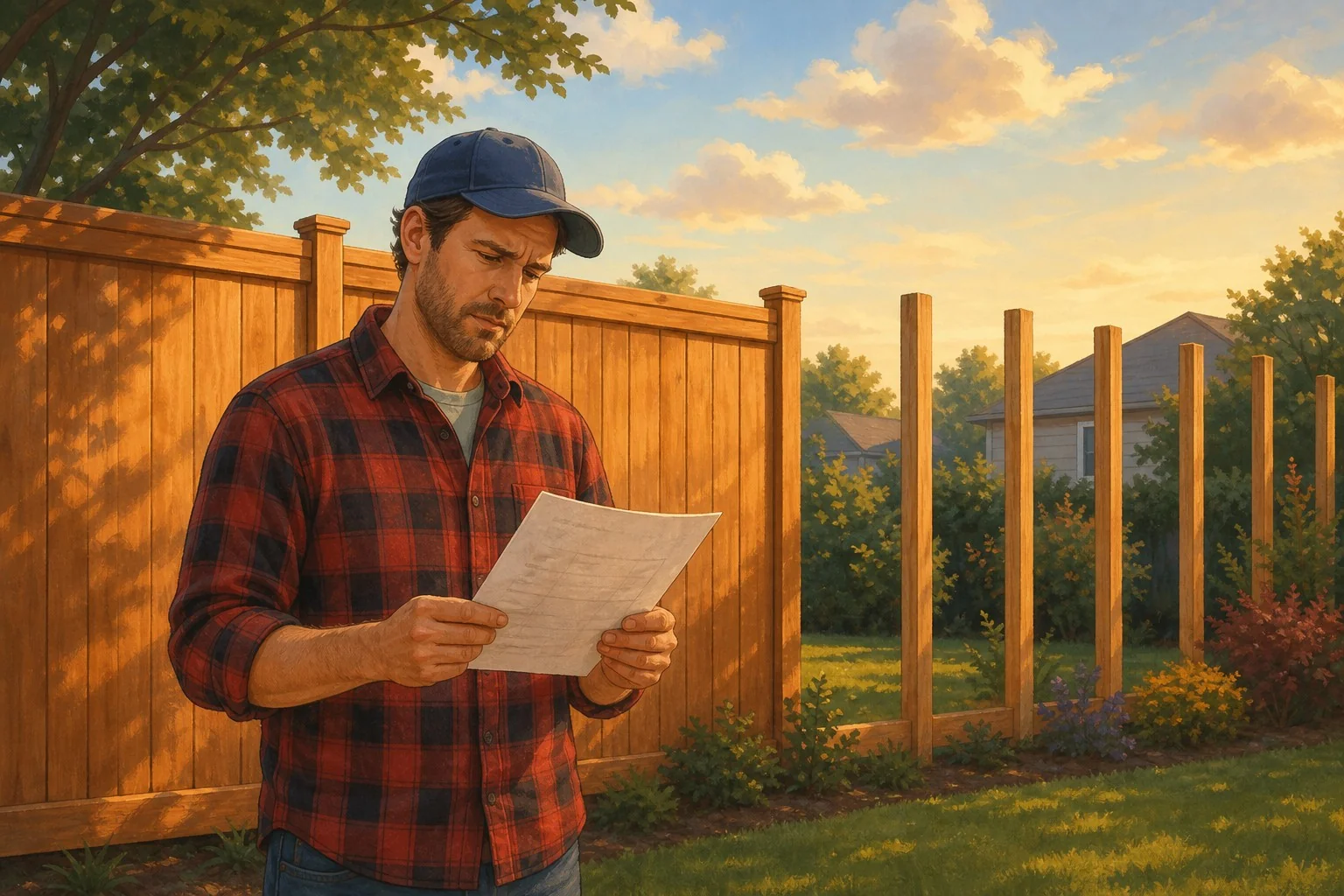
You call three fence companies. You get three prices. One guy’s at twelve grand, another’s at seven, the third’s somewhere in the middle. And not one of them tells you why.
I’ll tell you why. There’s about seven things buried in a fence quote, and most contractors won’t walk you through them because it either makes them look expensive or it makes the other guy look shady. Either way, you’re the one standing there with a checkbook and a headache.
Here’s what’s actually in that number.
Post count and spacing
Posts are the skeleton of the fence. Everything hangs off them. More posts means more concrete, more digging, more labor — and a fence that actually stays standing when the wind picks up.
Standard privacy fencing runs six or eight feet between posts. Some cheap outfits stretch that to ten with lighter panels to save on material. That fence will sag inside two summers. You’ll be staring at a wavy row of pickets by the second Fourth of July.
If one quote has 22 posts on your job and another has 18, that’s not a rounding error. That’s hundreds in materials and a full day of labor.
Ask how many posts. Ask how deep they’re going. Ask what they’re setting them in. If the answer is “we just tamp them into dirt,” thank them for their time and close the door.
Material quality
“Cedar” doesn’t mean cedar. It could be western red cedar, northern white cedar, or something the lumber yard is calling cedar because it’s a softwood and nobody’s checking. Same story with pressure-treated pine — there’s ground-contact rated stuff and there’s the cheap grade that rots in five years if it so much as looks at wet soil.
Panel thickness matters too. A one-inch dog-ear picket and a five-eighths picket look identical from the curb. One lasts twenty years. The other warps by August of year three.
If the quote just says “cedar fence” and stops there, that’s a red flag. A real quote tells you species, grade, and dimensions.
Gates — the silent budget killer
This is where homeowners get blindsided the most.
A gate is not a section of fence. It’s a whole different animal. It needs a heavier frame, stronger posts on either side, deeper footings, the right hinges, and a latch that actually works. All of that costs money because a gate has to swing, hold its own weight, and take abuse from every kid, delivery guy, and dog that touches it.
I had a job in South Philly a few years back — nice couple, brand new vinyl fence, put in by some outfit that gave them a suspiciously good price. Six months later, both gates were dragging on the concrete. The installers had used residential-grade hinges rated for a screen door on a six-foot vinyl gate. I had to yank the whole gate assembly, sink new steel posts with proper footings, and put commercial hardware on it. It cost them more to fix it than it would have to buy a real gate in the first place.
Look at the gate line item on your quote. If it’s not itemized, ask. A single walk gate should be a few hundred bucks in materials and labor at minimum. A double drive gate is more. Anybody quoting you a gate as a rounding error is not building you a gate that will still swing right in five years.
Hardware
Galvanized versus stainless. Coated screws versus bare. Post caps versus none. Hurricane ties on the rails versus toenailed with a couple of nails and a prayer.
Little stuff. Adds up fast. Cheap hardware is why fences fail — not the wood, not the vinyl, the hardware.
Delivery and demo
You’re paying for the truck. You’re paying for the guys unloading it. You’re paying for the trailer that hauls out your old fence and takes it to the dump. And the dump fee. That’s real money and it belongs on the quote as its own line.
If a contractor bundles demo into “labor” with no dollar figure, ask. Tearing out an old chain link with concrete footings is a full day of miserable, back-breaking work. Ripping out a rotted wood fence sounds easy until you hit the third post that snaps at the ground and leaves the footing in place. That should be priced. If it’s not, either they’re eating it (unlikely) or they’re planning to hit you with a change order.
Grading and slope
If your yard slopes — and most Philly yards do — you have two choices. Step the fence, or rack it.
Stepping means each panel drops down a bit to follow the grade. Simple. Cheaper. But you get triangular gaps at the bottom that small dogs and every raccoon in the neighborhood will find within a week.
Racking means the panels are custom-cut to follow the slope smoothly. Looks better. Costs more. Takes real skill.
If your quote doesn’t mention how they’re handling the slope and your yard isn’t a pool table, they either haven’t looked closely or they’re planning to figure it out on install day. Neither one ends well.
Bottom line
A real fence quote should tell you:
- How many posts, how deep, and what they’re set in
- Exact material — species, grade, thickness
- Gate details, including hinges and latch
- Hardware type
- Whether demo and disposal are included and priced
- How they’re handling any slope
If it’s one number scribbled on a piece of paper, that’s not a quote. That’s a guess. Get it in writing, get it itemized, and if a contractor won’t do that — there’s a reason. And you don’t want to find out what it is once the fence is already in the ground.