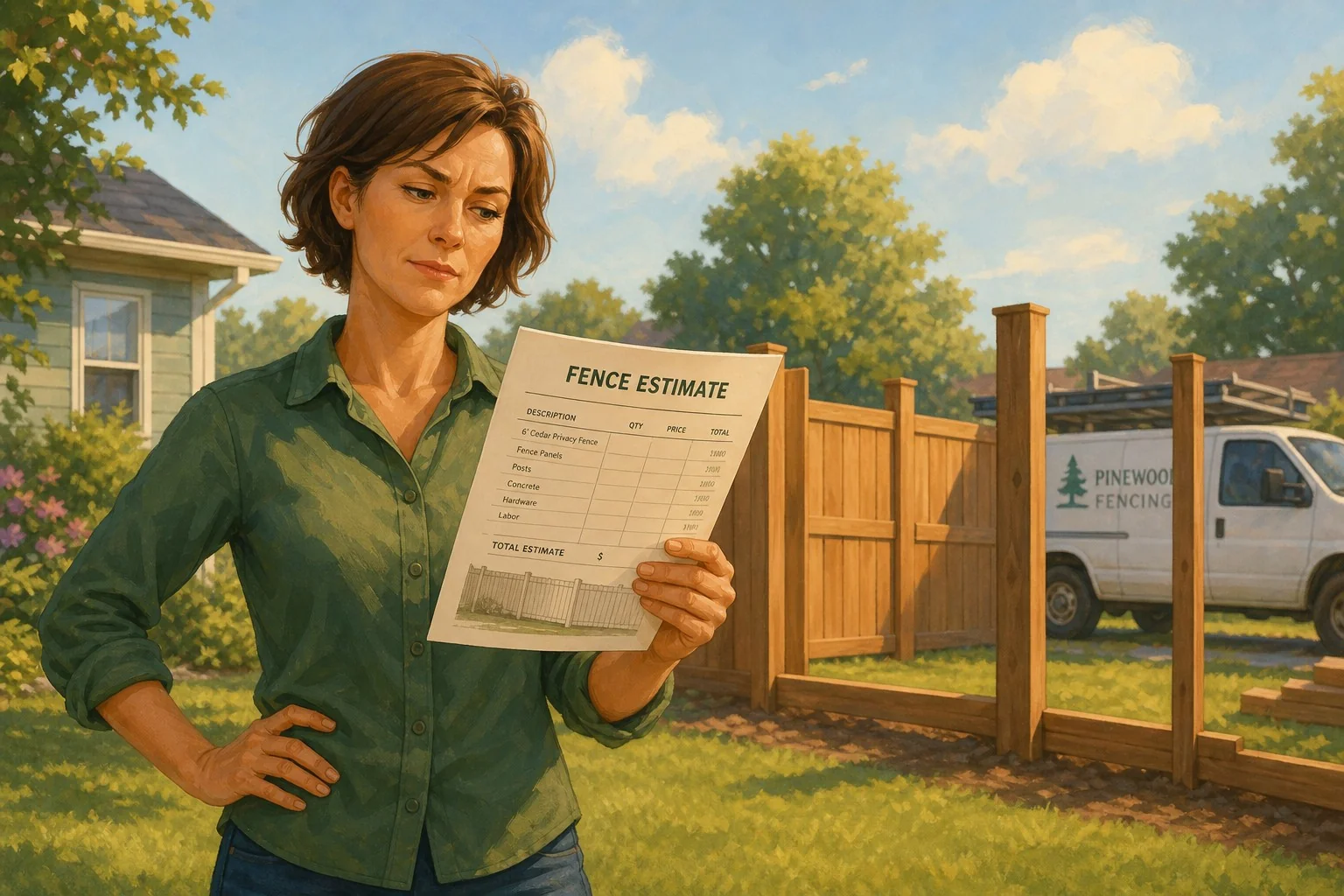
You look at three fence quotes. One is nine grand. One is eleven. One is fourteen. You want to pick the nine grand one and get your Saturdays back.
Slow down.
Cheap quotes usually aren’t cheap. They’re incomplete. What separates a real quote from a garbage one is what’s written on the page — and just as important, what isn’t. I’ve had homeowners call me a year after another crew wrapped up, standing in their yard next to a fence that’s already leaning, wondering how they ended up here. Almost every time, the answer was on page one of the quote they signed. They just didn’t know what to look for.
Here’s what I want you to look for before you sign anything.
Gate hardware
Gates are where fence jobs go to die. A gate takes abuse the panels never see — kids swinging on it, dogs charging it, a wet post that heaves in February and now the latch doesn’t line up.
Read the quote. Does it list hinges by name and quantity? Latches? A gate stiffener? A drop rod for a double gate? Self-closing hardware if you’ve got a pool?
“Gate included” isn’t an answer. That could mean a fifteen-dollar latch from a big-box store and two junk hinges that’ll rust out in eighteen months. It could also mean heavy-duty stainless hardware rated for the actual weight of your gate. Those are two completely different fences and two completely different prices.
If you don’t see specific hardware listed, ask. Get it in writing.
Post type and how they’re set
Six-foot cedar privacy fence sounds the same on every quote you’ve got. It isn’t.
Are the posts pressure-treated 4x4s? 6x6s at corners and gates? Steel posts sleeved in wood? What depth are the footings? How much concrete per post? Are they wet-setting the concrete or dumping in dry mix and hoping the ground moisture handles it?
A few years back I got called out to a house up in Roxborough. Guy had paid seven grand for a fence that was leaning inside eighteen months. The crew set his posts about a foot deep in dry Quikrete. They didn’t dig below the frost line. First hard winter, the ground moved. So did every post. He tore the whole thing out and started over. His “great deal” cost him fourteen grand by the time it was done.
Post depth in this region should be three feet minimum. Concrete wet-mixed, sloped away from the wood. If none of that is on your quote, that’s not a detail. That’s whether your fence stands or falls.
Stiffeners and the structural stuff nobody talks about
If you’re getting vinyl, this one matters. Vinyl looks nice out of the box. It also sags, bows, and wobbles if there’s nothing inside holding it up.
Any decent vinyl fence has aluminum inserts running through the bottom rail — those are your stiffeners. If your quote doesn’t mention them, the contractor is either skipping them to save money or planning to charge you extra later when you complain about the sag.
Same story for reinforcing brackets at gate posts and end posts. Ask.
Demo of the old fence
If you already have a fence coming down, who’s tearing it out? Who’s hauling it away? Are the old post footings coming out or just getting cut off at grade?
I’ve seen quotes for “installation of new fence” that quietly did not include removal of the old one. Homeowner assumes it’s covered. Crew shows up, tells him it’s an extra two grand, or he can rip it out himself. Now he’s standing in his backyard with a Sawzall and a bad afternoon.
Read the demo section. If there isn’t one, ask why.
Delivery, dump fees, permits
Material delivery isn’t always free. Some yards charge, some don’t. Some contractors bake it in, some tack it on later.
Dump fees for hauling out the old fence — same story. A truckload of rotten pressure-treated wood and rusted footings costs money to get rid of, and somebody’s paying it. Make sure it’s not you by surprise.
And permits. In Philly you usually don’t need one for a residential fence under a certain height, but plenty of the outer neighborhoods and most of the surrounding boroughs absolutely do. Is that included in the price? Is the contractor pulling it, or is that on you? A missed permit turns into a stop-work order, and a stop-work order turns into a fence project you finish in October instead of July.
Sales tax
Some quotes show a subtotal and pretend you’re done reading. Then the invoice hits and there’s another six or seven percent tacked on. Pennsylvania charges sales tax on materials. Make sure your quote either includes tax or clearly states it doesn’t.
You’d rather know now than find out when the check gets written.
What “site conditions” actually means
Watch for phrases like “based on standard site conditions” or “additional charges may apply for unusual grading, rock, or obstructions.”
That’s boilerplate contractor-speak for “if we hit anything we didn’t plan for, we’re charging you.” Fine. That’s fair, honestly. But you need to know what “unusual” means to them. If they hit a tree root or an old brick foundation from a shed the last owner tore down, is that a normal day’s work or an extra thousand bucks?
Get a number, or at least an hourly rate, in writing.
Bottom line
A good quote is boring. It’s specific, it lists things you didn’t want to have to read, and it doesn’t leave you guessing.
If a quote is short and vague, that’s not efficiency. That’s a contractor giving himself room to charge you more later — or skip work you thought you were paying for.
Ask the questions. Push back if the answers are fuzzy. And if the guy gets annoyed at you for wanting a straight answer about your own fence, that tells you everything you need to know about how the job would’ve gone.