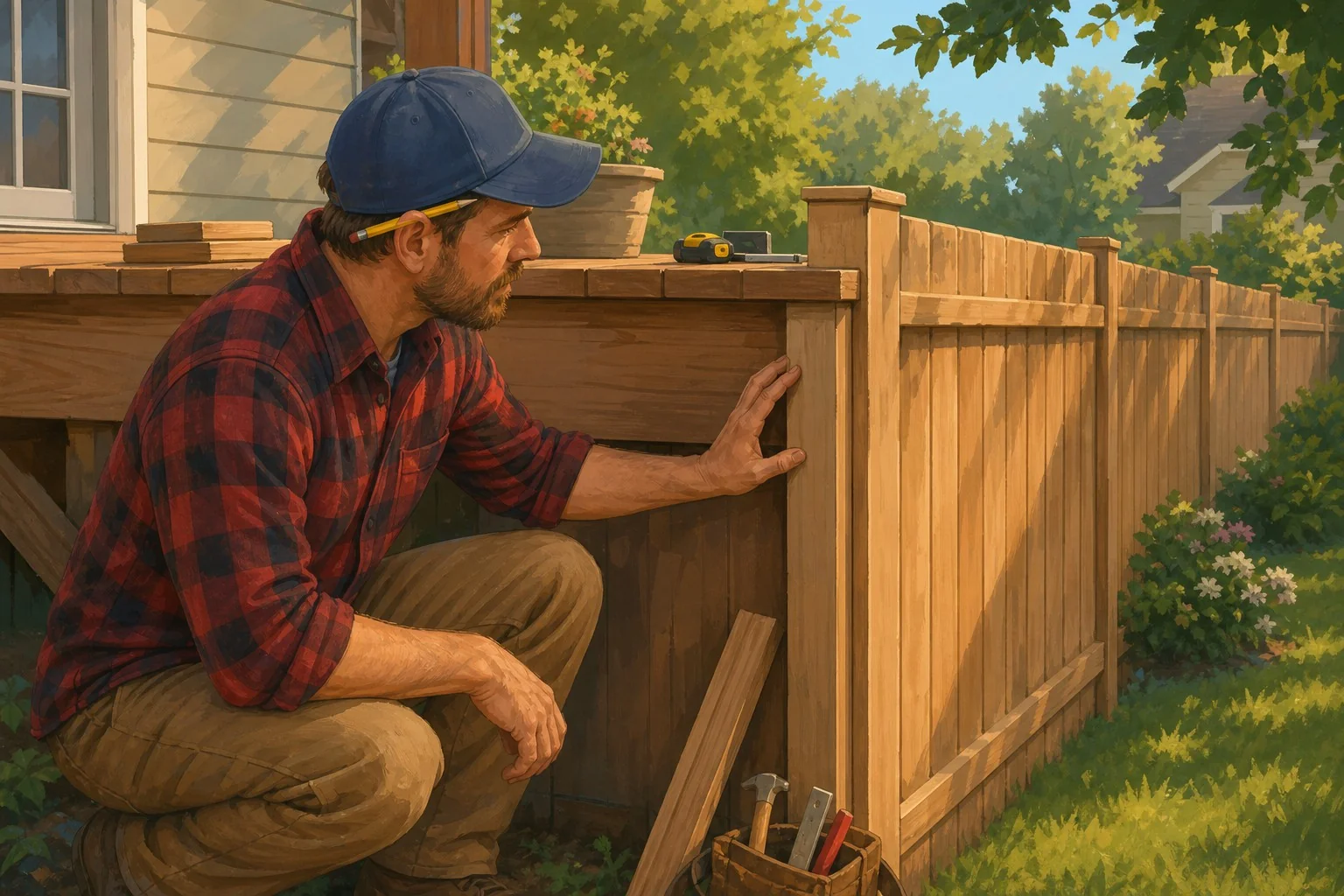
Nine times out of ten, when a fence meets a deck, it looks like garbage. The last fence post sits two inches off the deck edge. The heights don’t line up. The materials clash. And the whole thing screams “we ran out of ideas here.” Fix it before you build it. That’s a lot cheaper than tearing it out.
Here’s how to make that transition look like it was actually planned.
Anchor to the deck frame — not to nothing
The first mistake people make is treating the fence and deck like two separate projects. They set the last fence post in the ground three feet from the deck edge and hope the eye doesn’t notice the awkward gap between them. It does. Everyone notices.
The move is a shared post — one post doing double duty as the last fence post and as an anchor point tied to the deck itself. Bolt it to the deck’s rim joist with lag bolts. Half-inch minimum. And make sure you’re actually hitting solid framing, not just the fascia board. If your deck is already built and you’re adding the fence later, you can still do this. Pull the fascia off, find the rim joist, bolt the post right to it, and re-skin the fascia when you’re done.
If for some reason you can’t bolt to the frame — floating deck, weird cantilever, whatever — set your last fence post in concrete as close to the deck as you can get it. Within an inch. Any more than that and you’re going to be looking at a gap you can’t unsee.
Match your heights, or make the difference intentional
Second problem: the fence is six feet, the deck railing is thirty-six inches, and where they meet looks like a staircase built by two people who never spoke to each other.
You’ve got two ways to handle this. Either step the fence down as it approaches the deck so the top rail meets the deck railing cleanly, or you leave the height difference and make it look like a deliberate design choice. If the fence needs to be six feet for privacy and the code-required railing is three feet, put a hard vertical break where they meet. A shared post capped with a decorative post cap that’s wider than both hides the transition. The eye reads it as two things meeting on purpose, not somebody who screwed up.
I had a homeowner in Fishtown call me a few years back because her contractor left her with a six-foot vinyl fence butted straight into a three-foot deck railing with nothing between them — just a stepped gap you could stick your hand through. Squirrels were using it as a highway. We pulled the last fence panel, set a new shared post bolted to the deck frame, and ran a wider cedar cap across the top of both. Took half a day. She’s still telling her neighbors about it.
When the materials don’t match — and they usually don’t
Wood fence to composite deck. Vinyl fence to pressure-treated wood. Cedar to whatever the last guy stuck up there. You are not going to find a fence that perfectly matches most composite decks. Stop trying.
Instead of matching, use a transition piece. One vertical trim board — same material as the deck, or something that ties visually to both — right at the point where the fence meets the deck. It reads as intentional. It also gives you something clean to caulk against, which matters because water is going to attack that joint every time it rains.
If your deck has fascia wrap — that finished skirt around the perimeter — continue it up and around the shared post. This is one of those small moves that makes the whole thing look like a real design decision instead of a Frankenstein job.
For color: if you can’t match, contrast on purpose. A dark trim piece between a light fence and a dark composite deck ties the whole scene together. Trying to almost-match usually makes both pieces look cheap.
A few things that will bite you
- Leaving a gap under the fence at the deck edge. Animals, kids’ toys, and drainage all become problems. Run the fence tight to the deck or add a kick board.
- Not thinking about the stairs. If your deck stairs come off the same side as the fence, the fence has to step down with them or terminate cleanly at the stair stringer. Plan this before you dig post holes, not after.
- Painting or staining afterward. Whatever finish you’re putting on that fence, hit it before or during install. The joint where the fence meets the deck is impossible to reach with a brush later.
- Ignoring the property line. If the fence is on the line and the deck sits inside your yard, you can’t just run the fence straight into the deck without checking your setback. Measure twice before you dig.
Bottom line
Do the transition right and nobody notices it. That’s the point. Do it wrong and it’s the first thing every guest sees when they walk into the yard. A shared post, a clean height decision, and one honest trim piece — that’s the whole recipe. It’s not fancy, but it works, and it’ll still look right in ten years.