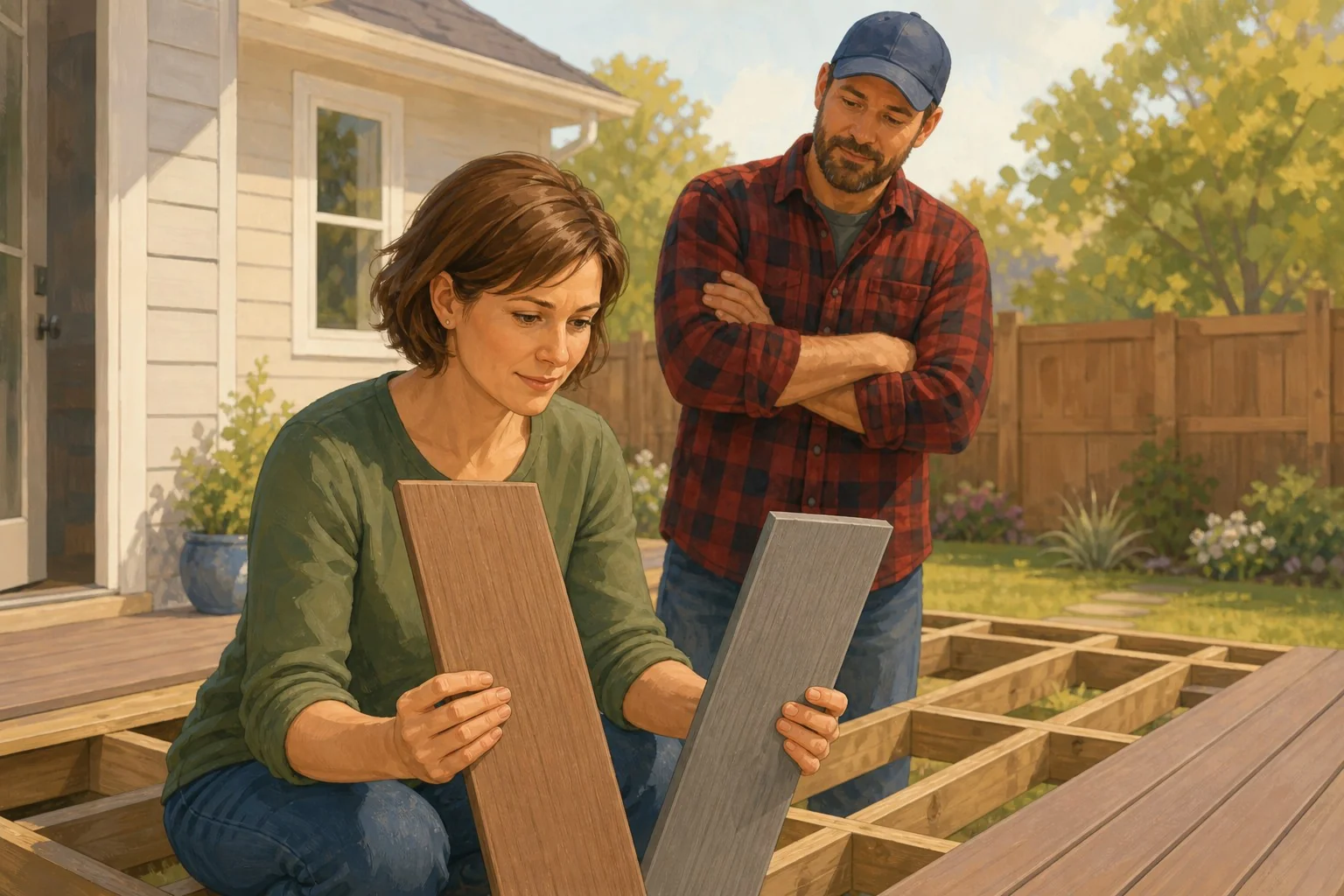
You’ve decided on composite decking. Smart move. Now you’re staring at two names that keep coming up — Fiberon and TimberTech — and you want to know which one to actually buy.
I’ll tell you what I know about both. No corporate spin.
What You’re Actually Comparing
Before we get into brands, understand what you’re paying for with composite decking. You’re buying a product that resists moisture, rot, and fading better than pressure-treated wood, and you’re trading a higher upfront cost for lower maintenance over time. That’s the deal. Both Fiberon and TimberTech are real products that deliver on that basic promise. Neither one is junk.
The differences show up in the details — warranty coverage, how the boards look after a few years, price per linear foot, and what happens when something goes wrong.
Warranties: Read the Fine Print
TimberTech backs their higher-end lines — AZEK and Pro Reserve — with a 50-year fade and stain warranty. That’s a lifetime warranty for most homeowners, and it covers transferability to a new owner if you sell the house. Good selling point.
Fiberon’s top lines, like Symmetry and Horizon, also come with 25- to 50-year warranties depending on the product tier. Their warranty language is solid, but you need to read what’s covered. Stain and fade protection is standard across composites at this price point. What varies is how easy it is to actually make a claim, and that’s something you only find out the hard way.
The general rule: the more you pay within either brand’s lineup, the better the warranty and the better the protection. Buying a builder-grade composite and expecting premium performance is how disappointment happens.
Price: Where They Land
TimberTech AZEK — their capped PVC line — runs at the higher end of the composite market. You’re looking at $8 to $12 per linear foot for boards alone, sometimes more depending on profile and where you buy. It performs, but you’re paying for it.
Fiberon hits a wider price range. Their entry-level boards come in closer to $4 to $6 per linear foot, and their top-tier products compete directly with TimberTech’s mid-range. If budget is tight but you still want composite, Fiberon gives you more rungs to work with on the ladder.
Neither brand is cheap once you add hidden fasteners, fascia, trim, and labor. Budget accordingly. A 300-square-foot deck in composite is not a $2,000 project — not in this market, not with a crew you can trust.
Aesthetics: Which One Looks Better
This is personal, but I’ll tell you what I’ve seen hold up over time.
TimberTech AZEK boards have a tight, consistent wood grain that looks good when it’s new and keeps its color well. The capped PVC construction means it’s not going to absorb much of anything — stains wipe off, and the fade resistance is genuine.
Fiberon’s higher lines — Symmetry especially — have gotten better on aesthetics in recent years. The variegated patterns look more like real wood than older composite products did. Where Fiberon’s lower lines fall short is in how they look after a few summers of sun. You’ll see more variation in how the boards weather if you’re not in a protected area.
If aesthetics matter a lot to you and you’re building something that’s going to be a centerpiece of the yard, spend the money on the top tier of either brand. The cheap end of composite can look cheap in year three.
What I’ve Seen in the Field
I put in a TimberTech deck for a client in Chestnut Hill — nice house, wanted something that would look sharp for years. Five years later, the boards still look good. No complaints.
That said, I’ve also done jobs where homeowners went with mid-tier Fiberon because the budget was firm, and the decks came out fine. The right installation matters more than most people think. Poor drainage, improper gapping, boards installed too tight — those problems show up regardless of brand.
Don’t Overlook Trex
While you’re comparing Fiberon and TimberTech, you’d be missing something if you didn’t at least look at Trex. They’re the most widely distributed composite brand in the country, which means easier sourcing and more contractors who’ve worked with it. We carry Trex, and for good reason — the Transcend and Select lines cover a wide range of budgets, the warranty is competitive, and the boards are consistent. If Fiberon or TimberTech isn’t available locally or the lead times are too long, Trex is not a consolation prize. It’s a legitimate first choice.
Which Brand Wins?
It depends on what you’re optimizing for.
Go with TimberTech AZEK if you want the most durable, low-maintenance product available and you’re willing to pay for it. Best-in-class fade resistance and a warranty that actually means something. Good choice for a high-visibility deck where you want it to look right for 20 years.
Go with Fiberon if you want more flexibility on price without dropping into truly cheap material. Their Symmetry line is a strong product. Their entry-level boards are fine for covered areas or lower-traffic spaces.
Consider Trex if you want broad availability, a well-proven product, and easy access to replacement boards down the road if you ever need them.
None of these brands will let you down if you buy the right tier, hire a crew that knows what they’re doing, and let the deck breathe the way composite is supposed to. That last part — proper installation — is where most composite decks that go wrong actually go wrong. The boards aren’t the problem. The install is.