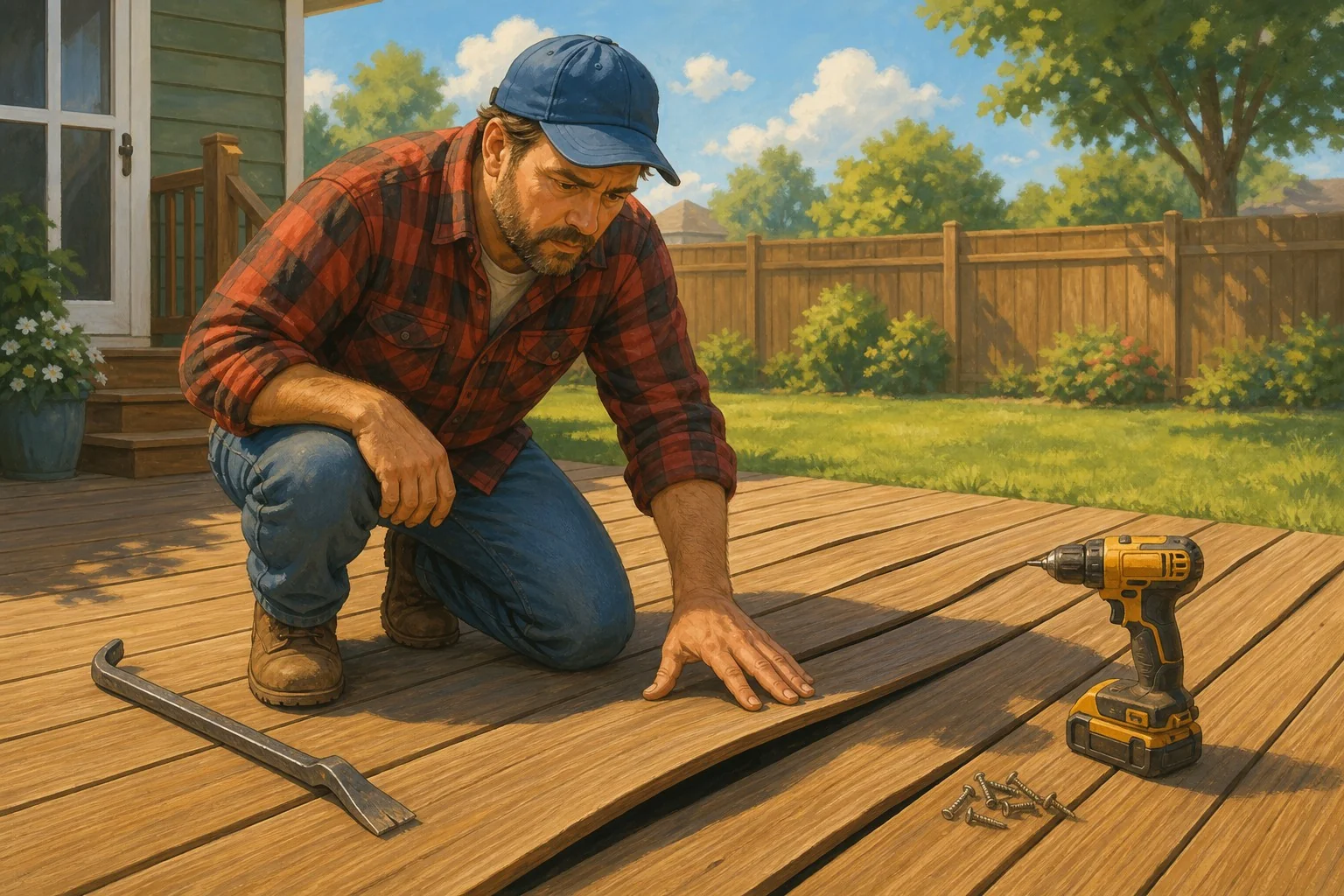
August in the mid-Atlantic is rough on wood. Ninety-plus degrees, humidity that soaks your shirt walking to the mailbox, then a thunderstorm rolls through and drops half an inch of rain in twenty minutes. Your deck sits out there taking it every day. By the end of the summer, if you’ve got wood boards, some of them are moving. Cupped up on the edges, humped in the middle, twisted at the ends, pulling at the screws. That’s normal. What’s not normal is ignoring it and hoping fall fixes it. Fall doesn’t fix it. Fall makes it worse.
Here’s the short version of what’s happening. Wood is a sponge. It swells when it soaks up moisture and shrinks when it dries out. Sun hits the top face all day, dries it fast, while the underside stays damp because air doesn’t move under there. Different sides of the same board are doing different things, so the board moves. Pressure-treated pine moves the most. Cedar moves less. Composite doesn’t do this at all, so if that’s what you’ve got, you can go back to your coffee.
Cup, crown, twist — know what you’re looking at
You need to know these three words before you fix anything.
Cupping is when the edges of a board curl up and the middle stays low, so the board looks like a shallow trough. Water pools in it. This one you’ll notice because you’ll be barefoot and your foot lands on the two edges instead of the flat.
Crowning is the opposite. The middle rises up and the edges stay pinned by the screws. Feels like a speed bump when you walk over it. Usually means the board was installed bark-side down, which is a rookie mistake, or the underside is drying faster than the top for some reason.
Twisting is when one end of the board rotates and lifts a corner. That’s the one that snags toes and rips the crap out of a bare foot. It’s also the one that means the board is done fighting and you’re probably replacing it.
Cupping is usually cosmetic if it’s shallow. Crowning is annoying but often fixable. Twisting is structural — the board has lost the argument with itself.
What to check before the leaves fall
Walk the deck slowly, in socks, and pay attention. Here’s the list.
- Look for standing water spots. Any board holding water after a rain is cupped. Mark it with painter’s tape.
- Check every screw and nail head. If they’re sitting proud of the wood, the board has lifted. If the head has popped off entirely, the fastener rusted through — that’s a bigger problem, and you’ll find more of them.
- Grab a corner of any board that looks lifted and try to move it. If it flexes, the fastener isn’t holding anymore. If the whole board rocks, the joist underneath might be soft.
- Look at the end of every board that overhangs the framing. Ends dry fastest and split first. Cracks running with the grain are called checking and are mostly cosmetic. Cracks running across the grain mean the board is failing.
- Get down and look under the deck if you can. You’re looking for dark stains on the joists, soft wood you can push a screwdriver into, and any board that’s cupped so bad you can see daylight between it and the joist.
That last one matters. A cupped board that’s lost contact with the joist is a board that’s about to snap when your brother-in-law walks across it at Thanksgiving.
Fixes that actually work
For mild cupping, if the board is still solid and the fasteners are intact, you can often flatten it. Pull the screws in that board, flip it over so the previously-down side is now up, and re-screw with new deck screws one size longer. The board will re-acclimate the other direction over a few weeks. This only works if the underside isn’t rotted or full of holes.
For crowning, you can sometimes drive a couple of long structural screws through the crown into the joist to pull it back down. Predrill so you don’t split it. If it splits, you’re replacing it anyway, so who cares.
For twisted boards, replace them. Don’t waste an afternoon fighting a board that’s decided it’s a corkscrew now.
For loose fasteners, don’t just drive the screw back in the same hole. The wood there is chewed up. Move over an inch, drill a fresh pilot, and set a new screw. If you drive the same screw back into the same hole, it’ll back out again by Christmas.
I had a homeowner in South Philly call me one October because his deck was “a little bouncy.” I got there and half the field boards were cupped bad enough to hold a puddle, and the ledger board — the piece bolting the whole deck to the house — was black with rot behind it because water had been running off the cupped boards, through the gap at the house, and down the siding for two summers straight. Whole thing had to come off. If he’d flipped or replaced the worst boards the summer before, he’d have kept the deck. Instead he got a bill for a new one. Little problems don’t stay little on a deck.
Do this before the first hard freeze
Three things, in this order.
Clean it. Sweep out the gaps between boards. Leaves and dirt pack in there, hold water, and rot the tops of your joists from above. A putty knife dragged down the gap works better than a broom.
Reset or replace the bad boards. Do it while it’s still dry and warm enough to work. Trying to swap deck boards in January is miserable and you’ll do a worse job because your hands are cold.
Seal it if it needs it. Splash some water on a few boards. If it beads up, your finish is fine. If it soaks in like a paper towel, you need to reseal before winter. Water sitting on bare, thirsty wood, then freezing, then thawing, then freezing again — that’s how a deck ages five years in one season.
Decks are simple. They’re wood in the weather. Pay attention twice a year and you get twenty-five years out of one. Ignore them and you get eight, and the last three are ugly.
Go check yours this weekend. It’ll take you thirty minutes and it’ll save you a deck.