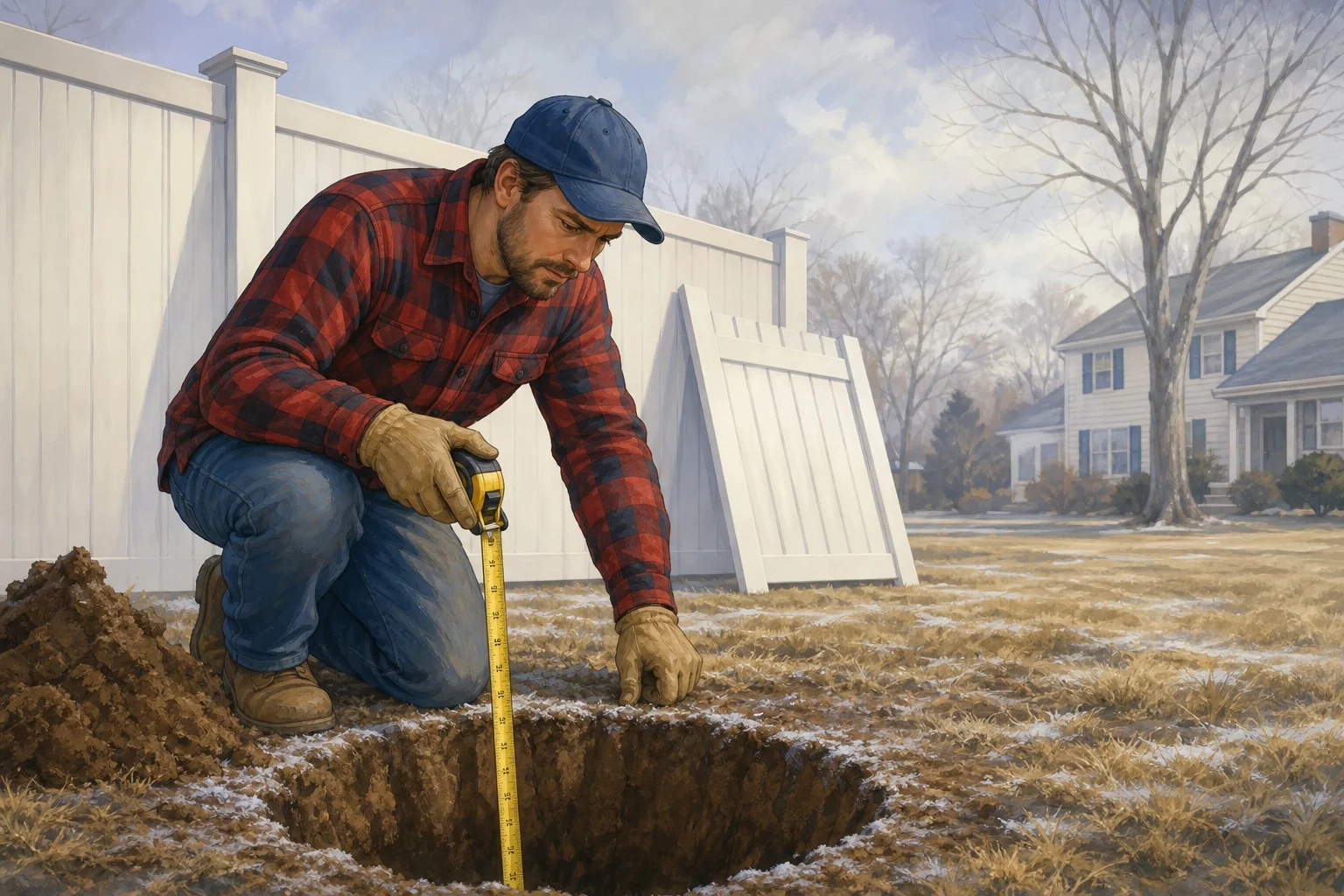
Here’s a thing homeowners in Pennsylvania keep learning the hard way: the ground moves. Every winter, wherever water sits in the soil and freezes, it swells. When it swells, it lifts whatever is set into it. Deck posts. Fence posts. Sonotubes. Mailbox posts. Concrete stairs that were level in October and by March are leaning like they had a rough night.
That’s frost heave. It’s not a mystery. It’s physics. Water expands about nine percent when it freezes, and when you’ve got a whole column of wet soil doing that under a footing, something’s gotta give. Usually it’s your deck.
The fix is simple in theory: get your footing below the frost line. But here’s the part most people miss — Pennsylvania’s frost line isn’t one number. The state stretches from Delaware Bay clear up to Lake Erie. That’s a different climate. Different soil. Different frost. What works in Roxborough will fail you in Wilkes-Barre.
What the frost line actually looks like across PA
Rough numbers, and yes, they matter:
- Philadelphia and the southeast: about 30 inches of typical frost penetration. Local code usually calls for a minimum 36-inch footing. That’s your baseline.
- Lehigh Valley, Harrisburg, Lancaster, the central belt: 36 to 42 inches, depending on the township. Most inspectors around there want 42.
- The Poconos, the Endless Mountains, anywhere above about 1,500 feet: 42 to 48 inches. And that’s on a normal winter.
- Erie and the northwestern corner: 40 to 48 inches. Lake effect keeps it cold, wet, and mean well into spring.
That range — 30 inches down in Philly, up to 48 inches in Erie — is huge. If you build a deck in Stroudsburg using footing specs from a Bucks County job, you’re setting yourself up to redo it.
Call your local township or borough. Their code will tell you the required minimum footing depth for your zip code. Don’t guess, and don’t trust the neighbor across the street who “did his the same way for twenty years.” Twenty years ago the winters were softer. Doesn’t matter now.
Go deeper than code. It’s cheap insurance.
Code is a minimum. Code is not a target. Code is the worst you’re allowed to build.
If your zone says 36 inches, dig 42. If it says 42, dig 48. Another six inches of hole costs you almost nothing and buys you a lot of peace. You know what’s expensive? Tearing out a heaved deck three winters from now because you saved twenty minutes on the auger.
I got called out to a place outside East Stroudsburg — nice family, small back deck, hired somebody cheap the year before I showed up. Their guy went to 36 inches because that’s what he did in Bethlehem. Poconos aren’t Bethlehem. Two winters later half the posts had lifted, the ledger was pulling off the house, and the whole deck had a dip in the middle you could roll a marble down. I ended up replacing every footing, dug 48 inches, flared the bottoms, and backfilled with clean stone. Deck hasn’t moved since.
The three things people get wrong even when the hole is deep enough
Even when the depth is right, folks blow the details. Watch for these:
1. Backfilling with the wet native soil you just dug out. In a lot of PA, that’s clay. Clay holds water. Water freezes. You just wrapped your footing in the exact material that causes the problem. Backfill with clean crushed stone or 2A modified. Let water drain past your post, not sit against it.
2. Not flaring the base. A straight sonotube filled with concrete can still get grabbed by freezing soil on the sides and lifted like a fence post out of loose mud. A wider base — a bell footing, a footing form like a Bigfoot, or a proper flared pad poured under the tube — anchors the whole assembly below the frost line. The ice can push all it wants; it’s not lifting a mushroom-shaped chunk of concrete.
3. Setting the wood post directly against the concrete up near the surface. The upper foot or two of that tube freezes to the surrounding soil and wants to pop up. Use a proper post base bracket, keep the wood off the concrete, and in a heave-prone spot wrap the upper portion of the tube in a smooth plastic sleeve so the freezing soil can’t grip it. That sleeve costs a few bucks. Do it.
Fence posts and mailboxes count too
Everyone thinks about decks. Nobody thinks about fences until the gate stops closing. Same rules apply. A six-foot privacy fence in Erie set at 24 inches deep? You’re going to be rebuilding sections. Set your fence posts below frost, or use a proper concrete footing with a flared base and a gravel drain layer at the bottom.
Mailbox posts too. The reason your neighbor’s mailbox leans by April isn’t the plow guy every time. Sometimes it’s the ground pushing it up crooked all winter, one freeze-thaw cycle at a time, until it’s tilted enough that the next snowplow finishes the job.
Bottom line
Pennsylvania is not one climate. What passes in Philly gets torn out in the Poconos. Know your local frost depth, add six inches of safety, backfill with stone, flare your footings, and keep the wood off the concrete. That’s it. Do that, and your deck stays where you put it — for as long as you own the house and probably longer.