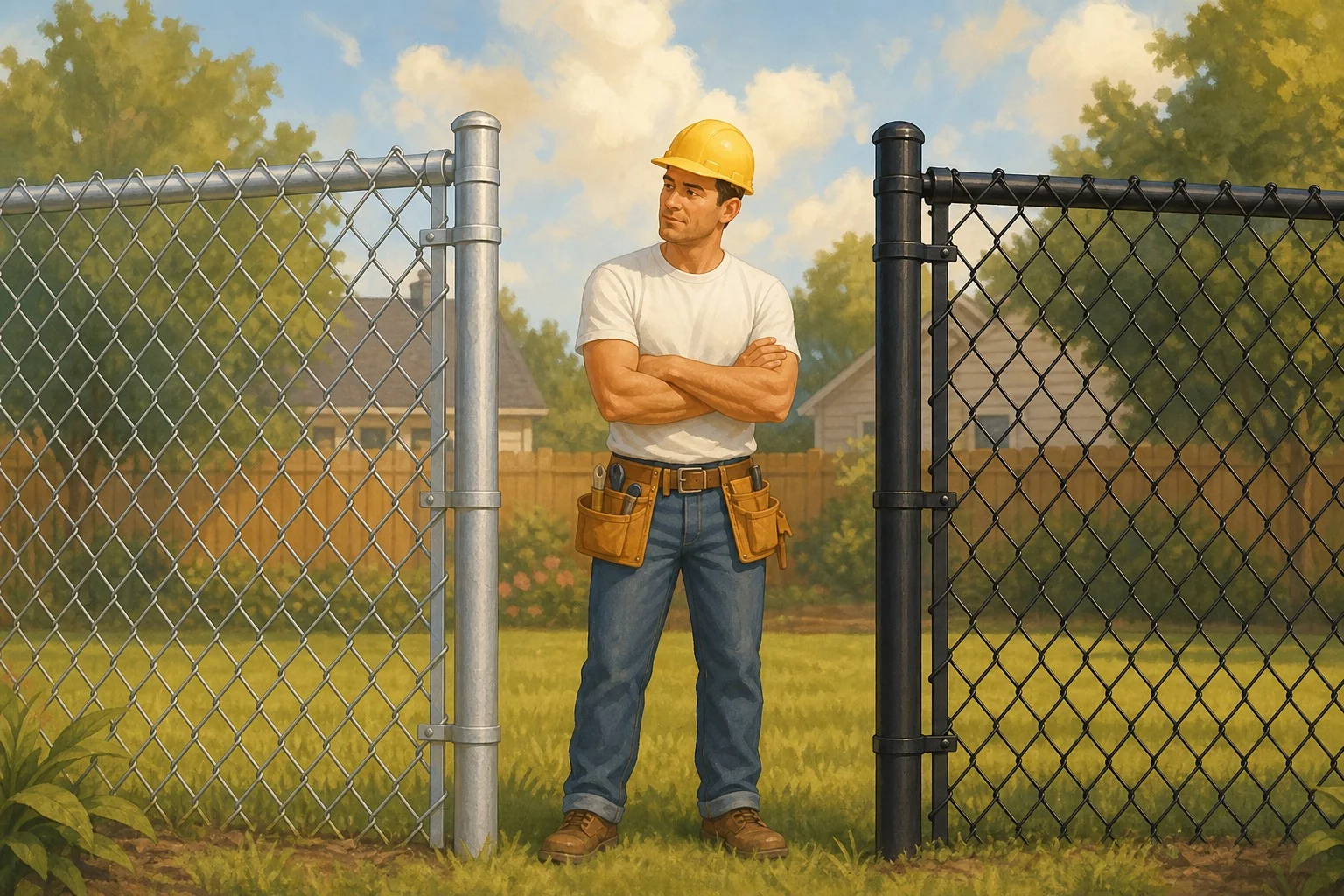
You go to the fence supply house, and the guy behind the counter asks you: galvanized or vinyl-coated? You stare at him. He waits. You say, “Uh — which one’s better?”
Wrong question. Better for what? They’re not interchangeable. One costs less and takes a beating. The other looks cleaner and plays nicer with your neighbors. Which one you need depends entirely on what you’re actually trying to do.
Here’s what you need to know before you order.
What Galvanized Actually Is
Galvanized chain link is steel coated in zinc. That zinc layer is the rust protection. It’s silver-gray, it’s industrial-looking, and it’s been the standard for decades because it works. Utility yards, commercial properties, dog kennels, school playgrounds — that’s galvanized country.
It’s also cheaper. Depending on the gauge and roll size, you can save 25 to 40 percent going galvanized over vinyl-coated. For a long fence run around a backyard or a work yard, that difference adds up fast.
The tradeoff is looks. Galvanized is not pretty. It has that chain-link-fence look that reads “industrial” from the curb. If your neighbors are already giving you the side-eye, this won’t help. And in a coastal or high-humidity environment, galvanized will eventually show rust — usually not catastrophic structural rust, but orange staining and surface corrosion that gets worse over time if you don’t stay on top of it.
For applications where appearance doesn’t matter — around a utility area, a work compound, a kennel, a rear perimeter you never look at — galvanized is exactly what you want. Spend the money somewhere else.
What Vinyl-Coated Adds
Vinyl-coated chain link is the same steel mesh underneath, but it’s been dipped or extruded with a PVC coating. Black is the most common color by far, and here’s why: black visually recedes. You can look right through it into the yard. It’s far less obtrusive than silver galvanized, and it photographs well if you’re selling the house.
The coating also adds a meaningful layer of corrosion protection. You’re not just relying on zinc anymore — you’ve got PVC between the steel and the elements. That matters in coastal areas, near pools, or anywhere the fence is going to get wet regularly. Vinyl-coated holds up better in those conditions over the long run.
HOA-controlled neighborhoods tend to require vinyl-coated or nothing at all. If you’re in one of those, check your CC&Rs before you order anything. Don’t assume. I’ve seen homeowners install galvanized, get a letter from the HOA within 30 days, and have to pull the whole thing out. That’s an expensive lesson.
The downside: if the vinyl coating gets gouged or cracked — from a lawnmower, a falling branch, a kid with a bike — moisture can get under the coating and accelerate rust right at that spot. It doesn’t happen often, but when it does, you get a rust bleed that’s ugly and not easy to fix. Inspect your vinyl-coated fence once a year. Touch up any cuts with a vinyl repair product before they become a problem.
The Gauge Question Nobody Talks About
Both galvanized and vinyl-coated come in different gauges. The lower the gauge number, the thicker the wire. 11-gauge is heavy and commercial-grade. 12-gauge is the residential standard. 14-gauge is the bargain-bin stuff that you’ll regret.
Whatever type you’re ordering, don’t cheap out on gauge to save a few dollars a roll. Thin chain link sags, stretches, and dents. A dog can push through it. A kid can climb it and bend it into a hammock shape. Go 11-gauge if you have large dogs or any kind of real security concern. Go 12-gauge minimum for a standard yard fence.
The gauge matters more than the coating choice for actual structural performance.
The Honest Answer on Which One to Buy
If appearance matters — front yard, visible from the street, near neighbors, in an HOA, around a pool — go vinyl-coated black. It’s worth the price difference.
If appearance doesn’t matter and you’re covering a lot of ground — rear perimeter, work yard, commercial use, rural property — go galvanized and put the savings somewhere useful.
I had a guy in Northeast Philly who wanted chain link around the perimeter of his rental property — maybe 400 linear feet. He was ready to order vinyl-coated because he’d seen it at the big box store and it “looked nicer.” I asked him who was going to see it. He thought about it. His tenants would see it. That was it. He went galvanized, saved around $600, and used the money to fix the drainage on the property that was actually causing him problems.
That’s the right call. Don’t spend money performing for nobody.
One More Thing Before You Order
Check your post sizing and concrete while you’re at it. Chain link fails more often at the posts than in the mesh itself. If you’re going taller than four feet, use 2-inch line posts and 2.5-inch terminal posts. Set them at least 2 feet deep, ideally 2.5. Use concrete. Don’t let anybody talk you into skipping it.
The fence material is almost the easy part. The install is where it goes wrong.
Know what you need, order what fits the job, and don’t overthink it.