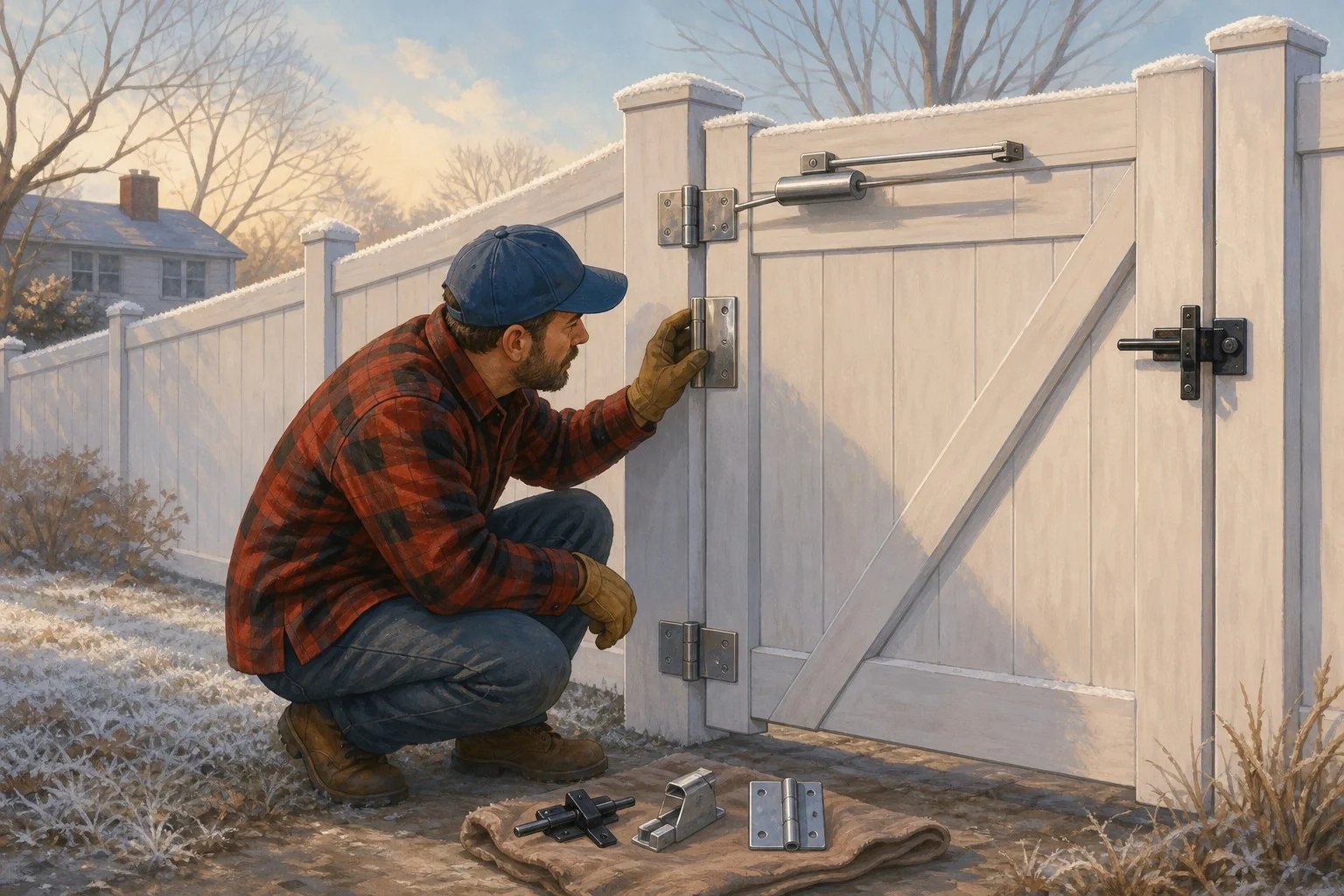
Every February I get the same phone calls. A gate that won’t close. A latch frozen open. A hinge that snapped clean off when a kid pushed on it. The homeowner is standing outside in twenty degrees looking at a swinging piece of cedar and a busted hunk of metal in the snow, and now they want to know what went wrong.
What went wrong is they bought whatever was hanging on the peg at the big-box store. That hardware was fine for July. It was not built for a Pennsylvania winter.
PA winters aren’t the worst in the country, but they’re mean in a specific way. We freeze, we thaw, we freeze again. Water gets into everything, expands, contracts, expands, contracts. Salt from the road spray creeps up your driveway. That cycle chews through cheap zinc and mild steel like it’s paper. And then you get one good ice storm on top of it, and any latch with a spring-loaded gravity mechanism turns into a decorative brick.
Here’s what actually works. And what doesn’t.
Hinges: The Part That Actually Kills Your Gate
The number one killer of residential gates in this climate isn’t the wood — it’s the hinge. Wood swells and shrinks with humidity. In summer your gate hangs one way. In January it hangs a different way. Cheap hinges can’t handle that movement. They fatigue at the barrel, they wallow out the screw holes, and eventually the whole thing sags into the latch post and won’t shut.
Do not buy stamped-steel hinges from the hardware aisle. They are made for interior cabinets and light shed doors. Put those on a real gate and you’ll be repairing it before Easter.
What to use instead:
- D&D Technologies TruClose Heavy Duty (TCHD1) or TCHD2. These are polymer self-closing hinges. Sounds crazy — plastic hinges? Yes. The polymer doesn’t corrode, doesn’t rust, doesn’t seize in the cold, and the internal spring is enclosed. I’ve pulled TruClose hinges off gates after twelve winters and they still worked. They handle up to 154 pounds per pair on the heavy-duty version.
- Snug Cottage hardware. Made in the US, powder-coated over stainless or galvanized steel. Their strap hinges are what you want for a heavier wood or iron gate. The pins are stainless, the barrels are sealed, and they cost real money. Worth it.
- Simpson Strong-Tie Outdoor Accents. Powder-coated black steel, decent for lighter cedar gates. Not the tank that Snug is, but a huge step up from generic bin hinges.
Stay away from anything that just says “galvanized” without telling you the base metal, coating thickness, or fastener spec. Galvanized zinc coating gets scratched during install and starts rusting from that scratch outward. Two winters and the whole thing is orange.
One more thing on hinges — use stainless steel screws. Not the ones that came in the package. Those are almost always zinc-plated garbage that will bleed rust stains down your gate post inside a year.
Latches: Where Ice Actually Wins
Every gate latch has one job: catch when it closes, release when you want it to. In August, any $9 gravity latch does this fine. In February, most of them do not.
The problem is water. A standard gravity latch has a metal arm that drops into a slot. Water gets in the slot, freezes, and either welds the arm in place or props it up so it never catches. Either way, your gate doesn’t work.
The two latches I actually trust in this climate:
- D&D Magna-Latch Series 3. Magnetic latch. There is no gravity arm to freeze. When the gate swings shut, magnets pull the bolt across. Ice can’t stop a magnet. I install these on every pool gate in every neighborhood from Chestnut Hill to Media, and I’ve never had one fail from cold. They’re pricey — around $70-90 — but they work and they meet pool code.
- D&D LokkLatch Deluxe. External key access, keyed alike or keyed different. Weather-sealed. Good for a side yard or a gate you want to actually lock. Handles a serious freeze better than any traditional thumb-latch design I’ve used.
What to avoid: any decorative black powder-coat gravity latch from the garden center. They look great on Pinterest. They are hot garbage in January. The powder coat chips, water gets under it, rust forms, and the arm binds. Then you’re chipping ice out of it with a screwdriver at 6 a.m. before work.
Self-Closers: Hydraulic vs. Spring
If you have kids, dogs, or a pool, the gate has to close on its own. State code requires it for pool enclosures. Even if it’s not required, you want it — because nobody remembers to close the gate every time.
Two categories:
- Hydraulic closers (Lockey TB-175, TB-200, TB-400 series). These mount to the gate and post, similar to a screen door closer but built heavier. Adjustable speed. In cold weather, the hydraulic fluid thickens, so the gate closes slower in January than in July. Not a defect — that’s the trade-off. They last a long time if you buy the actual Lockey and not a knockoff.
- Self-closing hinges (D&D TruClose again, or Stanley spring hinges). Built-in spring pulls the gate shut. TruClose polymer version handles cold better than metal spring hinges because there’s no metal spring to lose tension when frozen. Metal spring hinges from the hardware store lose closing force badly below freezing.
For most residential gates under 150 pounds, TruClose hinges do both jobs — hinge and closer — and eliminate one point of failure. That’s what I’d put on my own house.
Real Talk on Installation
Hardware only performs as well as the install. A few things homeowners consistently get wrong:
- Gate post has to be plumb and set in concrete below the frost line. In most of PA that’s 36 inches. If your post heaves in winter, no hardware on earth will save you.
- Leave a 3/8-inch gap on the latch side to account for wood swelling. Tight in July equals stuck in April.
- Pre-drill every screw hole. Cedar and pressure-treated wood split, and a split post means a loose hinge.
- Grease the hinge pins with marine-grade grease once a year, in the fall. Takes ten minutes.
Bottom Line
If I’m spec’ing hardware for a residential gate in Bucks, Chester, Delaware, or Philadelphia County and I want it to still work in 2036 without me coming back:
- Hinges: D&D TruClose Heavy Duty or Snug Cottage strap hinges
- Latch: D&D Magna-Latch Series 3 for anything with kids or a pool; LokkLatch Deluxe if you need to lock it
- Closer: Built into the TruClose, or a Lockey hydraulic if the gate is heavy
Buy it once. Install it right. Grease it in the fall. That’s the whole game.