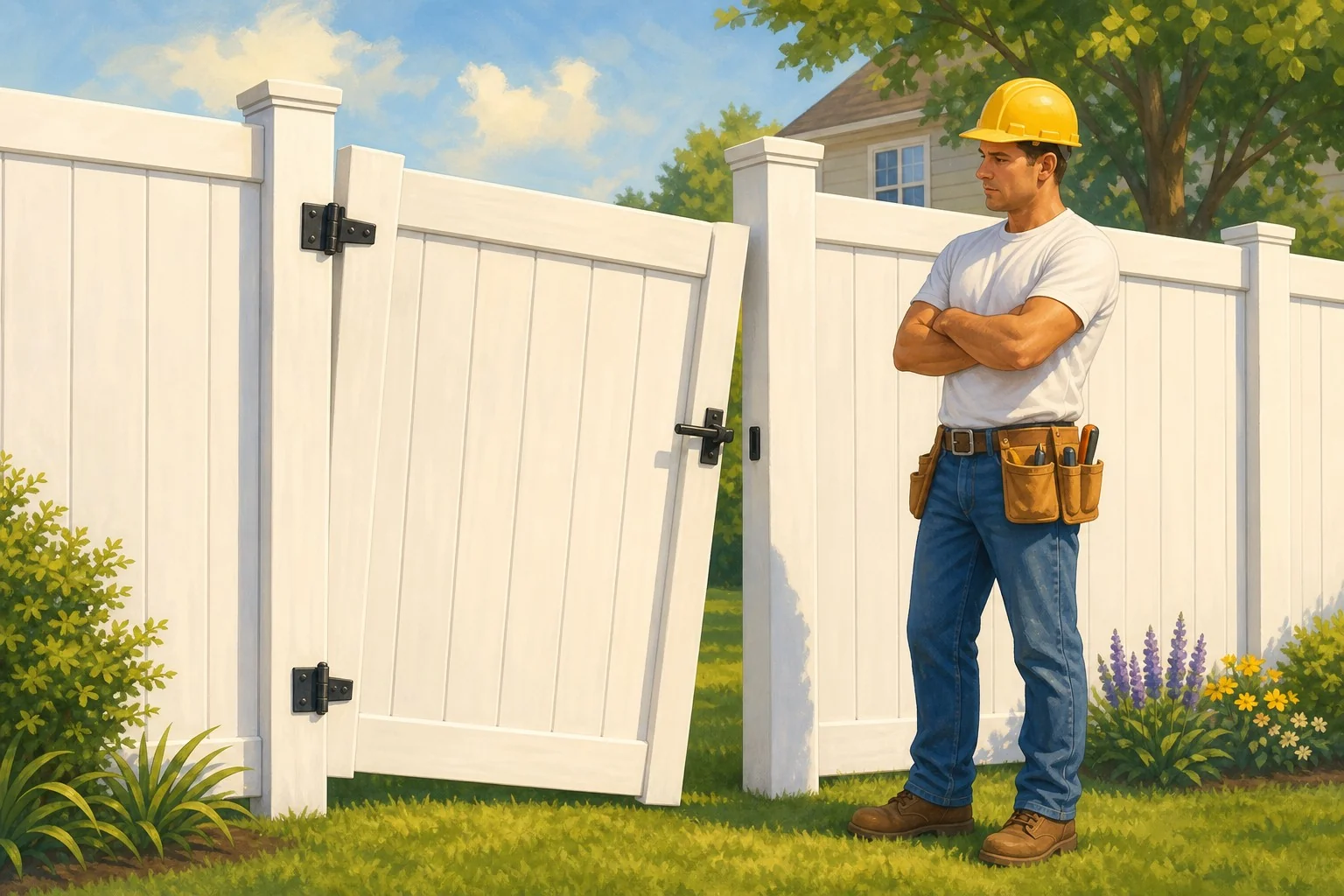
Homeowners get sold on vinyl fencing because it’s low maintenance. And mostly that’s true — you’re not painting it, you’re not treating it, you’re not watching it rot. Fine. But the gate? The gate is where the whole thing unravels, and it almost always comes down to the hardware.
I’ve seen it a hundred times. Beautiful vinyl fence, clean white panels, looks sharp right off the truck. Six months later the gate is sagging off to one side, the latch won’t catch, and the thing drags across the ground every time you try to open it. The homeowner calls and wants to know what happened. What happened is the installer treated a gate like it was just another section of fence. It’s not.
A gate swings. It takes repeated stress at two points — the hinges and the latch post. That stress adds up every single day. If the hardware isn’t right and the posts aren’t right, failure is just a matter of time.
The Posts Are Load-Bearing. Treat Them That Way.
Most vinyl fence posts are set the same way: dig a hole, drop in the post, pour some concrete, move on. For a line post holding a static panel, that’s fine. For a hinge post holding a swinging gate, that’s not enough.
Gate posts need more concrete, deeper holes, and in many cases a steel insert running down the center of the vinyl sleeve. Vinyl is not structural. You’re hanging weight on it and swinging that weight repeatedly. Without reinforcement, the post will eventually flex, twist, or pull. When the hinge post moves, the gate moves with it — and not in a good way.
Same goes for the latch post. Every time someone closes the gate, it’s taking a hit. That post needs to be just as solid as the hinge side. Double up the concrete. If you’re pouring, go 12 inches of diameter minimum. Don’t cut corners here because you can’t easily fix it later without digging.
Use Adjustable Heavy-Duty Hinges. Don’t Negotiate on This.
Standard residential hinges look fine in the bag. On a gate, they’re a problem waiting to happen. They don’t give you any room to correct for the slow shifts that every post makes over a freeze-thaw cycle, or as the ground settles. And they will make those shifts. The ground always moves.
Adjustable heavy-duty hinges let you dial in the position after installation. Up-down, in-out. That means when the gate starts to creep — and it will — you have options. You can bring it back into square without pulling the post or replacing the hardware. That adjustment range is not a luxury. It’s the difference between a five-minute fix and a whole afternoon of work.
For a standard single gate, three hinges beats two. Yes, it costs more. Yes, it looks better too. More importantly, it distributes the load. Two hinges put all the stress at two points. Three spreads it out, and the gate stays true longer.
Square Before You Hang. Then Check Square Again.
Here’s the part where most installations go wrong before a single hinge goes on. The gate doesn’t get squared before hanging.
I had a job in Northeast Philly — a homeowner called me in after another crew finished a vinyl privacy fence and the gate was already dragging within a month of install. When I checked it, the gate had been hung three-eighths out of square. Not a ton, but enough. The latch side was low. All that weight swinging on a misaligned frame means the gate is constantly fighting itself. The hinges were torqued at a bad angle from day one. Nothing was going to save it.
Measure the diagonals. Corner to corner, both ways. If they match, you’re square. If they don’t, you fix it before you hang anything. This takes maybe two minutes and saves hours of grief later. Do not skip it because you’re in a hurry or because the gate “looks” square. Looks don’t tell you anything.
After the gate is hung, check the swing. Check the latch engagement. Make sure the latch lines up clean — not close enough, but clean. A latch that’s riding the edge of the strike plate is going to fail. Adjust the latch post or the hardware until it catches solidly and releases smoothly.
A Few More Things Worth Knowing
Self-closing hinges add wear to the posts faster than standard hinges because they’re under tension all the time. If you want a self-closing gate, make sure the posts are built to handle it — extra concrete, steel-reinforced sleeves. Otherwise you’re accelerating the timeline to failure.
Gravity latches are simple and they work. Spring latches are convenient but they wear out faster. For a gate that gets used a dozen times a day, a gravity latch on the inside and a keyed latch or pin on the outside gives you durability without complexity.
Check your hardware clearances after installation. The latch post and hinge post should be plumb. The gate itself should have even reveal — the gap between the gate frame and the posts should be consistent top to bottom on both sides. If it’s not, something is off. Find it now, not a year from now.
Bottom Line
Vinyl gates fail because of hardware choices and post preparation, not because vinyl is a bad material. The fence panels will outlast all of us. The gate is the mechanical part of the system, and mechanical parts need to be built accordingly.
Reinforce the posts. Use adjustable heavy-duty hinges. Square the gate before you hang it. These aren’t advanced techniques. They’re just the steps that don’t get skipped on a job done right.