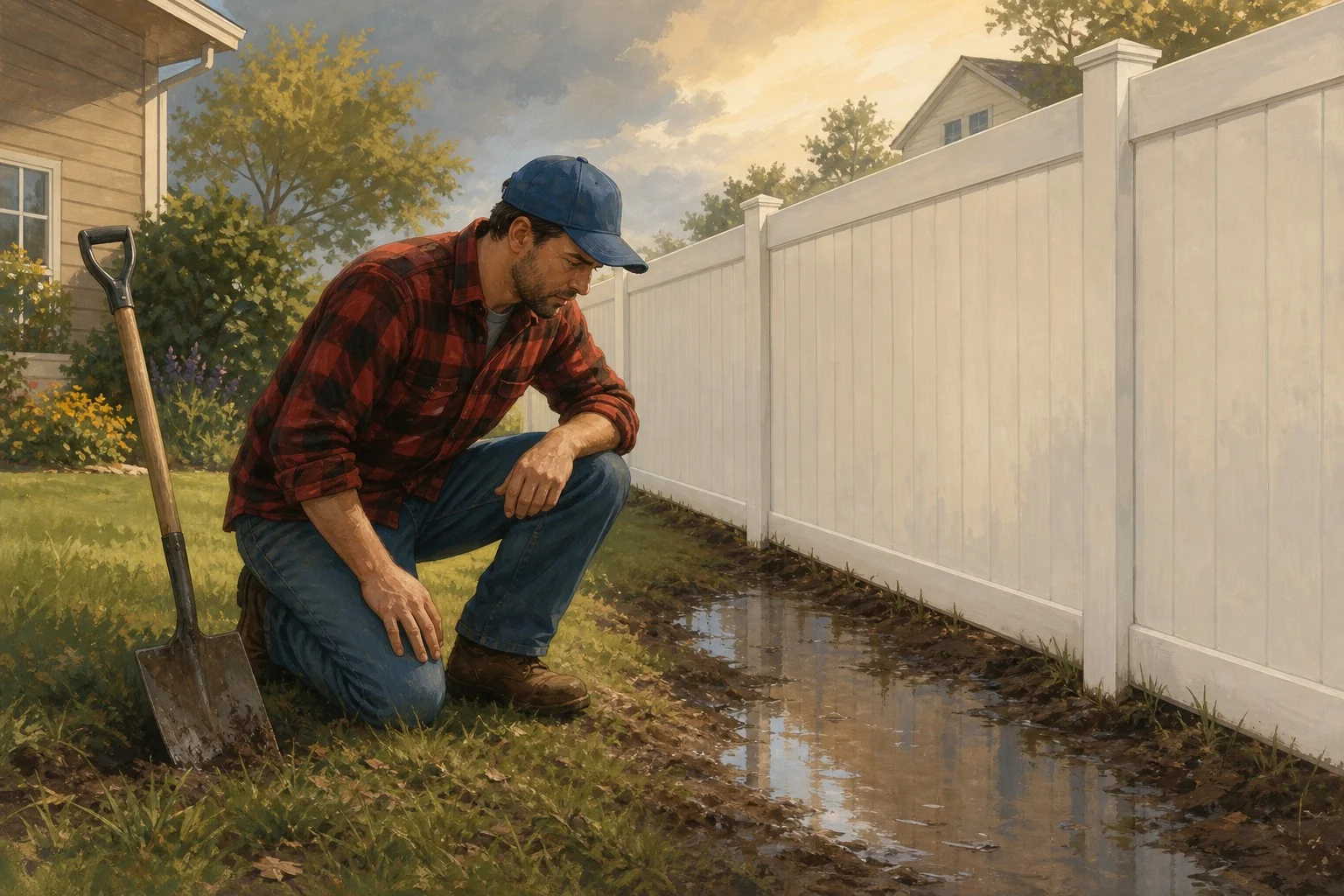
Grading, Drainage, and Fences: Why Your New Fence Might Cause a Flooding Problem Next Door
You put up a fence. Looks great. Nice clean lines, straight posts, everything level. Three months later your neighbor’s basement takes on eight inches of water and she’s got a lawyer’s number in her hand.
You didn’t cause the storm. But you might have caused the flood.
Here’s the part nobody tells you when you’re standing in the aisle at Home Depot picking out picket styles: your yard is part of a system. Water moves across your property in patterns that were set before you ever bought the place. Sometimes those patterns are obvious. Most of the time they’re not. And when you drop a fence line into that system without thinking about it, you’re not just marking your property — you’re re-routing a small river.
Your fence is a dam. You just don’t see it yet.
A wood or vinyl privacy fence with a solid bottom rail sitting flush against the ground is a wall. That’s what it is. Water hits it, water stops, water pools, water finds the lowest point it can — which is usually your foundation, your neighbor’s foundation, or the low corner of the yard where the sump pump lives.
Even chain link causes problems. Not the fabric — the concrete footings. You dig twenty post holes, dump a bag of Quikrete in each one, and you’ve just installed twenty little dams three feet into the soil where water used to move sideways.
That’s not a theory. That’s what happens.
The swale — the thing most homeowners have never heard of
A swale is a shallow, engineered dip in the ground that carries stormwater from point A to point B. In a lot of developments built in the last forty years around here, there’s a swale running between backyards. You can’t always see it. It’s not a ditch. It’s usually just a gentle depression that looks like normal lawn.
Guess where people love to put fences. Right down the property line. Right through the middle of the swale.
I had a job in Roxborough about ten years back — homeowner called me because his neighbor’s yard flooded twice in a summer and the guy was threatening to sue. Turned out he’d installed a nice cedar privacy fence two years earlier and set the bottom rail two inches into the dirt to keep his dog from digging out. That two inches was sitting right in a swale that used to drain half the block toward a storm inlet. We ended up cutting the bottom rail off, notching the posts, and putting in a proper gap with river rock underneath. The neighbor still didn’t like him. But she stopped calling her lawyer.
If your yard has a low strip running across it that stays soggy longer than the rest of the lawn, that’s probably a swale. Treat it like a live wire — don’t block it.
Water-flow easements — you might not own what you think you own
A lot of properties have drainage easements written right into the deed. Sometimes they’re wide — five, ten, fifteen feet along a property line. In plain English: you own the land, but the municipality or the HOA has the legal right to let water move across it. You can’t legally block that flow. You put a fence through it, you’re on the hook when someone downstream floods.
Nobody reads their deed. Read your deed. Or call the township zoning office and ask them to pull the plat map. Takes ten minutes. Costs you nothing.
If the map has a dashed line labeled anything close to “drainage easement,” “stormwater easement,” or “swale,” that’s the fence contractor’s problem to solve, not yours to guess at. Hire someone who knows what those words mean.
The township is going to find out
Every township in the area has a stormwater management ordinance now. Some are strict. Some are toothless. But all of them give the code enforcement office the authority to order you to remove or modify a fence that’s causing runoff issues. And when the neighbor files a complaint — and they will file a complaint — the code guy shows up. That’s his job.
You get a violation notice, you don’t get to argue whether the fence looks nice. You fix it. On your dime. Which usually means tearing out sections, digging new footings, and paying twice for something you thought you were done with.
Do it right the first time. Cheaper. Faster. Fewer lawyers.
Three things to do before you dig a single post hole
-
Walk your yard after a hard rain. Not the next day. During or right after. Watch where the water actually goes. If it crosses the fence line you’re planning, you have a problem to solve before you build. Take pictures on your phone.
-
Pull your plat map or plot plan. Look for easements, swales, or drainage notes. Township office has it. So does whoever handled your closing. Read the deed too — half the time the answer is right there.
-
Design the fence to let water through. A two-inch gap under the bottom rail is a bare minimum. If you’re crossing a real drainage path, you need a wider gap, a gravel base, or a proper cut-through section. A decent fence guy knows how to hide it so it still looks clean from the patio.
Bottom line
A fence isn’t just carpentry. It’s site work. And site work you get wrong shows up two seasons later as somebody else’s ruined basement — and your problem.
You don’t need a civil engineer for a backyard fence. You need to look at your yard, read a couple of documents, and hire someone who’s done more than watch YouTube videos. That’s the whole trick.