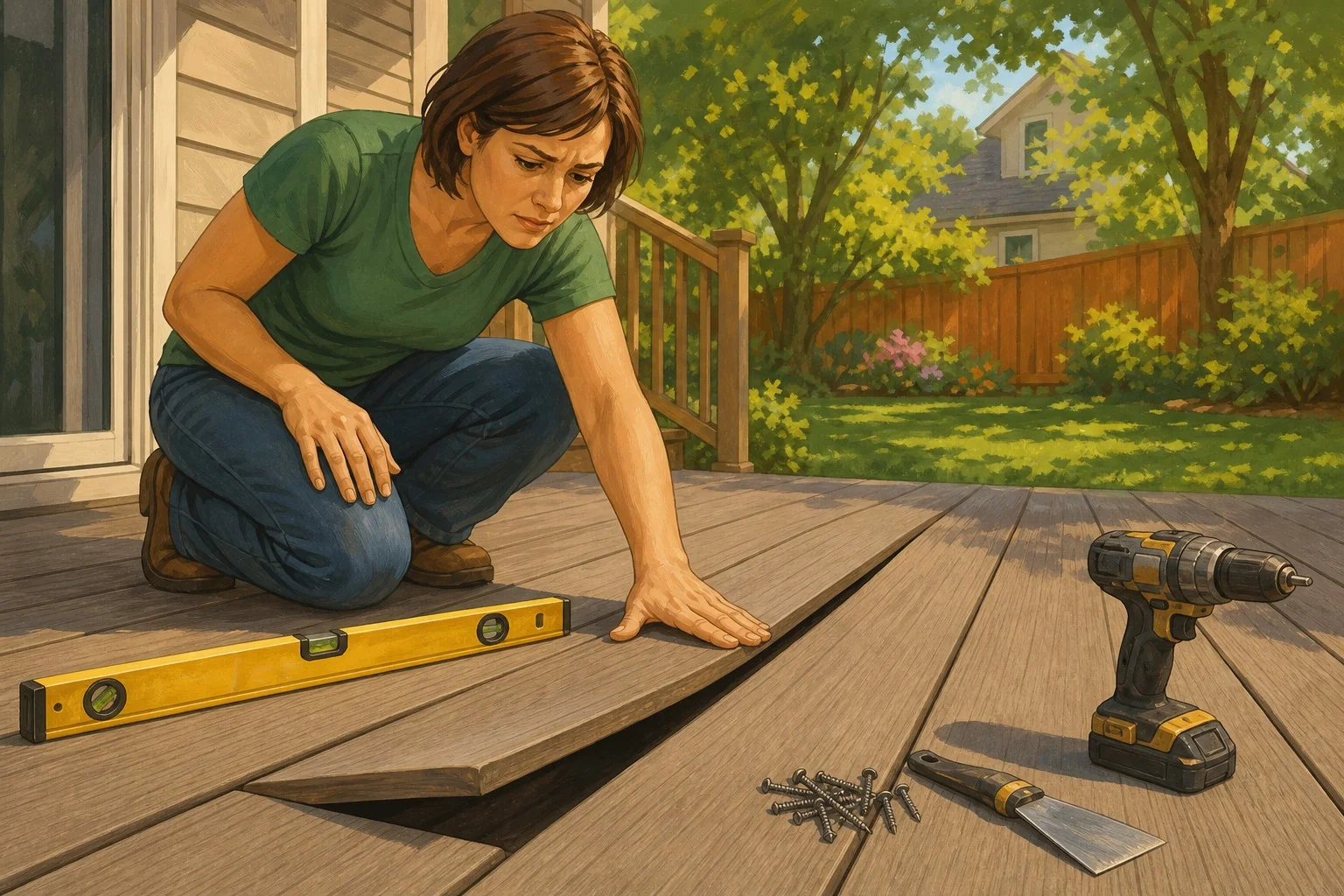
Composite decking gets sold like it’s bulletproof. It ain’t. Heat is its kryptonite. When Philly hits the mid-90s for a week straight — the kind of July stretch we just had — those boards move. They expand, they push against each other, they hump up in the middle, and sometimes they don’t go back down when the temperature drops.
If you’re catching the problem now, you’re ahead of most people. Most homeowners don’t notice until a board is doing an impression of a speed bump or the whole deck looks like a warped record. By then you’re not fixing. You’re replacing.
Here’s how to spot it early, and how to tell the difference between a board you can save and one that’s already lost.
What heat actually does to composite
Composite is a mix of wood fibers and plastic. Plastic expands when it gets hot. That’s just physics — you can’t argue with it. On a 95-degree day, the surface of a dark composite board can hit 140 to 160 degrees. That’s hot enough to soften the plastic binder and let the board move under load.
The problem starts when boards are installed too tight. Manufacturers spec a gap between boards for a reason. When installers get lazy — or they’re using leftover boards from a different batch, or they installed in cold weather without accounting for summer expansion — those boards have nowhere to go when they grow. So they push each other up. That’s your hump. That’s your warp.
I had a job in South Philly a few summers back where the previous crew butted every board tight against the last one. Looked beautiful on install day in April. By August the middle of the deck looked like a skateboard ramp. Homeowner thought the joists were bad. Joists were fine. It was three grand of composite installed like it was solid oak. Half of it came out.
The three signs you need to know
Gaps that shift. Walk your deck in the morning when it’s cool. Look at the gaps between boards. Now come back at 3 PM when the sun’s been on it all day. If the gaps are noticeably tighter, or gone entirely on some boards, you’ve got expansion happening. That’s normal to a point. If boards are actually touching and rubbing, you’ve got a problem.
Cupping or crowning. Sight down the length of a board at eye level. A good composite board should be dead flat across its width. If the middle is higher than the edges, that’s crowning. If the edges are higher than the middle, that’s cupping. Cupping usually means moisture — water got trapped underneath. Crowning in summer usually means heat expansion with nowhere to release.
Fasteners popping up. If you’re seeing screws that used to be flush now sitting proud of the surface, or hidden fastener clips that have snapped, the board moved and took the hardware with it. That’s not a subtle sign. That’s the deck telling you loud and clear.
What you can fix yourself
If it’s one board and it’s just slightly crowned, you can probably save it. Pull the fasteners on the affected board, take a jigsaw or a track saw, and shave a quarter-inch off each end to give it room to breathe. Re-set the fasteners. Do this in the middle of a hot afternoon when the board is fully expanded — that way when it cools and shrinks back down, you’ve got clean gaps and no more pressure.
Loose or backed-out screws on an otherwise flat board are also a homeowner-level fix. Back the screw out completely, move over a half inch to fresh material, and drive a new one at the correct depth. Don’t just crank the old one back down into a stripped hole. It’ll pop again in a week.
When the board is done
If the board is warped along its length — twisted, curved, no longer sitting flat on the joists — you’re done. That’s a replacement. You can’t unwarp composite. Once the internal structure has deformed under heat, it’s not going back. Anyone who tells you to weight it down or hit it with a heat gun to bend it back is selling you a fairy tale.
Same story if the board is cracked, split at the ends, or has a soft spongy feel when you press on it. Soft spots mean the plastic binder is breaking down. Replace it. And when you replace it, match the brand and the color line if you can. Composite fades over time, and a brand-new board in the middle of a five-year-old deck is going to look like a bandage until it weathers in.
When to call somebody
If more than a few boards are affected, or you’re seeing warping across the whole deck, don’t start pulling stuff up on your own. You’ve probably got an installation problem — wrong fasteners, no expansion gaps, or joist spacing that’s too wide for the board rating. That’s a diagnosis job. Get somebody out there who works with composite regularly, not the guy down the street who does mostly pressure-treated. Composite has its own rules and if you don’t know them, you make things worse.
Also: check your warranty before you touch anything. Some manufacturers void coverage the second you modify a board. If you’ve got widespread warping and the deck is still under warranty, call the manufacturer first. Take pictures. Dig up the install date if you have it. A lot of these warranties run 25 years on the product, and most people forget they even have one.
Prevention for next time
If you’re re-doing anything or installing new, do it right. Leave the gap the manufacturer specs — end-to-end and side-to-side. Use the fasteners they call for, not whatever’s on sale at the box store. And if you’re installing in cool weather, leave a bigger end gap, because those boards are going to grow when summer hits.
One more thing while we’re here: dark boards get way hotter than light ones. If you’re picking out material and the deck faces west or south with no shade, do yourself a favor and skip the espresso brown. Go with a lighter gray or tan. Your bare feet will thank you in July, and your boards will move less.
Composite is a good product when it’s installed right. It’s a nightmare when it’s not. The heat doesn’t care about your budget or your timeline. It’ll find every corner somebody cut and make it your problem by August. Catch the small stuff now — the tight gaps, the popped screws, the one board that’s starting to hump — and you’ll save yourself a full tear-out down the road.