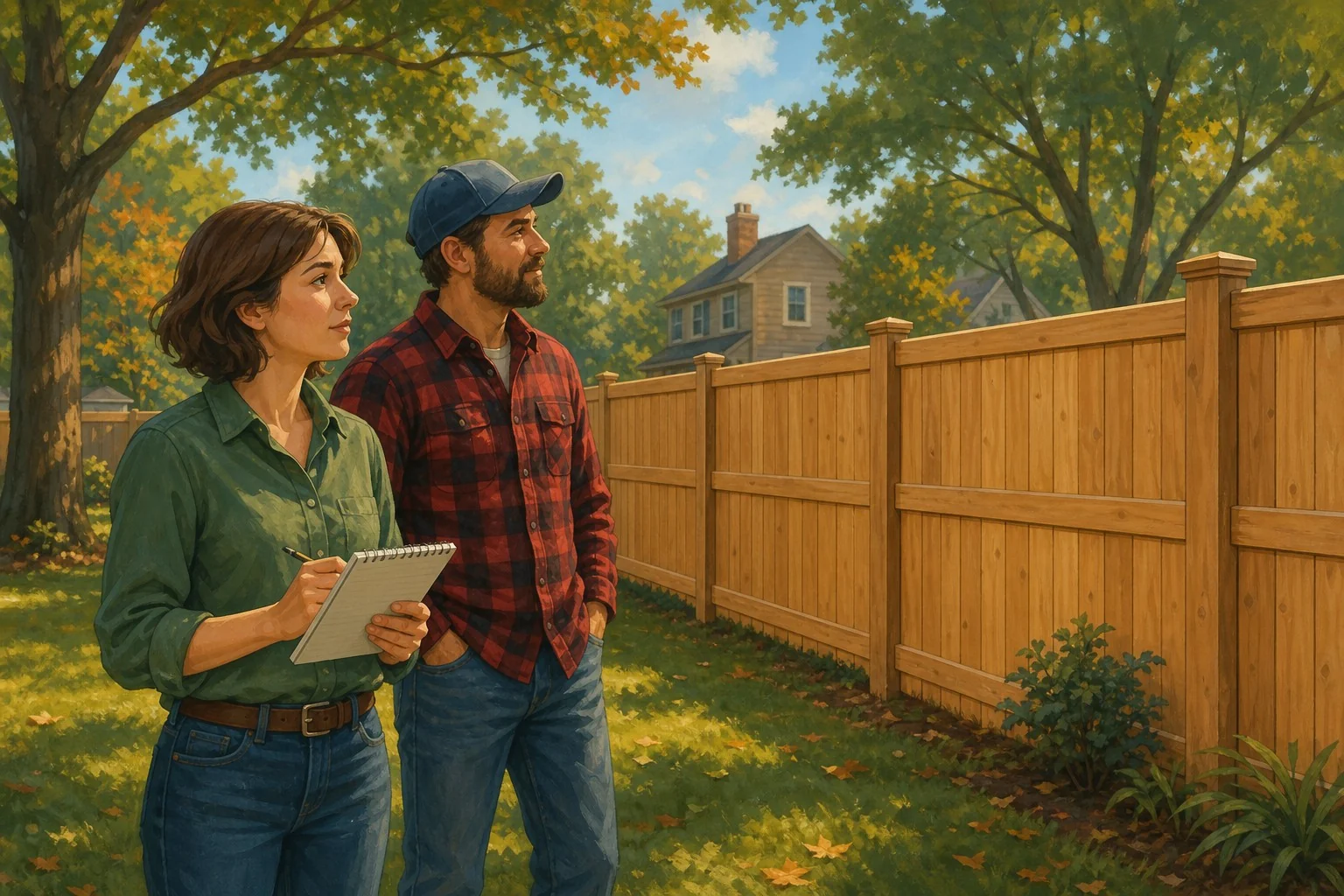
Here’s the short answer before you scroll. In Pennsylvania in 2026, a standard 6-foot pressure-treated wood fence runs $30 to $55 per linear foot installed. Cedar lands at $40 to $70. Vinyl is $35 to $65. Chain-link, usually 4 feet, is the cheapest at $18 to $32. Aluminum and ornamental iron sit at the top — $45 to $90 a foot and up.
That’s the honest range. Anything way under those numbers, somebody’s cutting a corner you can’t see yet. Anything way over, you’re either getting custom work or you’re getting taken for a ride. Let me walk you through what actually drives the price so you can read a quote like someone who knows what they’re looking at.
Material is the first big split
Pressure-treated pine is the workhorse. Treated right, it’ll give you 15 to 20 years. Cedar costs more, looks better, resists rot longer, and ages to that nice silvery gray if you let it. Vinyl is sold as “no maintenance,” which is mostly true until it cracks in a hard Pennsylvania winter or a riding mower clips it. Chain-link is functional, ugly, and cheap — pick two. Aluminum and wrought iron are for people who want the look of a real fence without the upkeep, and they pay for it.
What you pick here decides 50 to 60 percent of your total cost. Don’t choose based on a Pinterest board. Choose based on what your yard needs and what you’re willing to maintain.
Labor in southeast PA isn’t cheap
Around Philly, Bucks, Montgomery, and Delaware counties, fence labor runs $40 to $80 an hour per guy. A typical 150-foot residential install takes a two-man crew two to three days. Sometimes longer if the site fights them. Don’t expect a Philly-area contractor to match what some guy out near State College quotes. Insurance, fuel, dump fees, parking, workers’ comp — it all gets baked into the number. That’s not the contractor screwing you. That’s the cost of operating a legitimate business in this region.
Gates aren’t free, and they aren’t cheap
A single 4-foot walk gate is $300 to $600 installed, depending on material and hardware. A double drive gate, 10 to 12 feet wide for a mower or a truck, runs $800 to $1,800. Self-closing hinges, magnetic latches, key locks — every upgrade adds $100 to $200. Don’t try to save money by skipping a gate. The first time you have to lug a 65-gallon trash can around three sides of your house, you’ll wish you’d spent the extra $400.
Tearing out the old fence costs real money
If you’ve got an existing fence coming down, budget $4 to $10 per linear foot for teardown and disposal. A 10-yard dumpster around here is $400 to $700. Old posts set in concrete take time to break out — sometimes a lot of time. If the previous guy used proper footings 30 years ago, you’re going to earn every bit of that demo line on the quote.
What jacks up the price around here
A few things specific to Pennsylvania and Bucks County will move your number in a hurry.
Permits. Most townships require a fence permit. Around Bucks County, they run $50 to $200. Front-yard fences over a certain height usually need a zoning variance. Skip the permit and the township can make you tear it down. I’ve seen it happen.
HOAs. If you’ve got one, they’ll dictate material, color, style, and sometimes which contractors you can use. That cuts your options and bumps your cost.
Rocky soil. Parts of Doylestown, Newtown, and up around Yardley have ground that turns post-hole digging into a jackhammer job. When that happens, you’re paying for the extra hours.
Tree roots. Big mature trees mean big roots. Some can be routed around. Some have to be cut. Some make a post location flat-out impossible and you have to move the line.
Slope. A racked or stepped fence on a sloped lot takes more time and more material. Add 10 to 20 percent.
Utility marking. Free through PA One Call. Required by law. If your contractor wants to skip it because “we’ll be careful,” fire him on the spot.
The lowball quote is almost always a trap
Couple years back I went out to bid a backyard fence in Levittown. The homeowner already had three quotes — $4,200, $4,800, and one for $2,100. The cheap one was eating at her. I told her flat out: that guy is either skipping the permit, using under-spec lumber, or setting his posts straight into dirt instead of concrete. Probably all three. She thanked me for my time and hired him anyway. Six months later her gate had sagged so bad it wouldn’t latch, and two posts were leaning a good 15 degrees. She called me to come fix it. Cost her another $1,800 to make the thing right. So her “$2,100 fence” was really $3,900 and a year of frustration. The math on lowballs never works out.
What to budget for a typical Bucks County yard
For a fairly standard job — 180 linear feet of 6-foot privacy fence, one walk gate, one double gate, and teardown of an existing chain-link — here’s what you should expect in 2026:
- Pressure-treated pine: $6,000 to $9,500
- Vinyl: $7,000 to $10,500
- Cedar: $7,500 to $11,000
Add 10 to 15 percent on top for permits, a survey if you need one, and the surprises that always show up once we start digging.
How not to get hosed
A few rules that will save you real money.
- Get three written quotes. Apples to apples — same height, same material grade, same post depth, same hardware. If one quote leaves stuff vague, that’s on purpose.
- Make sure the quote spells out concrete-set posts, post depth (minimum 30 inches in southeast PA, deeper is better), picket thickness, gate hardware brand, cleanup, and warranty length.
- Ask for proof of insurance. Workers’ comp and general liability. If the guy hems and haws, walk away. You do not want to find out the hard way when somebody gets hurt on your property.
- Check the PA Home Improvement Contractor registration number. Every legitimate contractor in this state has one. It takes thirty seconds to verify on the Attorney General’s website. No number, no deal.
Bottom line
A real fence is a real expense. In 2026, plan on $35 to $65 per linear foot installed for what most homeowners actually want — a decent-looking, properly built privacy fence that’s going to stand up to PA weather for a couple decades. The cheapest quote is almost never the best deal. The most expensive isn’t either. The right contractor is the one who shows up when he says he will, answers your questions like a human being, and puts every detail in writing before he ever breaks ground.