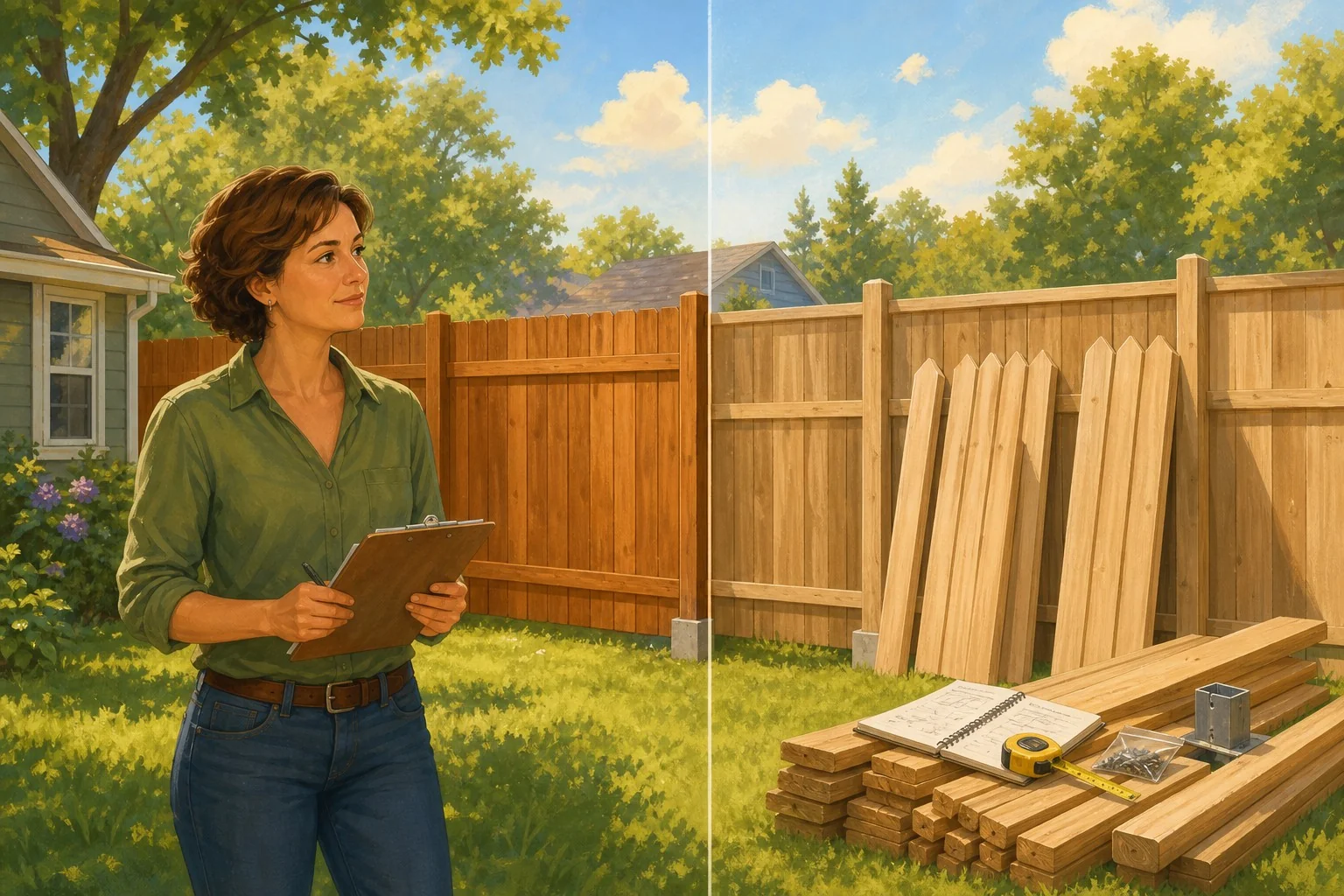
Someone asks me what a fence costs, my first answer is always the same: depends on what you’re putting up, how much ground you’re covering, and whether you know how to swing a post-hole digger without throwing your back out.
That’s the honest answer. The unhonest answer is a number pulled out of thin air by a website that’s never held a level.
Here’s how to actually budget for a fence — materials only versus a full install — without getting hosed.
Materials Cost by Type (Per Linear Foot)
Prices move around, so treat these as ballparks. But they’re honest ballparks — not the “starting at” nonsense fence companies use to get you on the phone.
- Chain link: $8 to $15 per linear foot for materials. Cheap, ugly, keeps the dog in. Nobody’s writing home about it.
- Pressure-treated wood (dog-ear or shadowbox): $15 to $30 per linear foot. Popular. Rots faster than people think.
- Cedar: $25 to $45 per linear foot. Nice-looking, lasts longer, costs more. Worth it if you like your fence.
- Vinyl: $25 to $50 per linear foot. Zero maintenance is the pitch. It’s mostly true.
- Aluminum: $30 to $60 per linear foot. Looks like wrought iron, doesn’t rust like wrought iron. Good for pool codes.
- Wrought iron (the real stuff, not the hollow tube junk): $50 to $120 per linear foot. If you want it, you know why.
Those are just the materials. Posts, panels, screws, brackets, concrete, gates. Now add labor.
What a Full Install Actually Costs
For a contractor doing the whole job — measuring, permitting, digging, setting, building, hauling out debris — double the materials number. Sometimes more.
- Chain link installed: $18 to $30 a foot
- Wood installed: $30 to $60 a foot
- Vinyl installed: $40 to $80 a foot
- Aluminum installed: $50 to $95 a foot
- Wrought iron installed: $80 to $200 a foot
Take a standard 150-foot backyard fence. Wood, installed. You’re looking at $4,500 to $9,000, easy. Vinyl? $6,000 to $12,000. That’s before a single gate or a slope adjustment.
The Hidden Costs Nobody Tells You About
Here’s where budgets go sideways. Every one of these can add hundreds — or thousands — to your bill.
Permits. Most townships require one. Around Philly, expect $100 to $300 depending on the neighborhood. Skip this step and you’ll be tearing the fence out when a neighbor complains to L&I.
Utility marking. Free through 811. Not optional. You dig into a gas line, you’re paying for the repair and probably an ambulance ride.
Demo of the old fence. Contractors charge $3 to $8 a linear foot to rip out and haul off what’s already there. Old chain link with concrete footings buried three feet down? Worse.
Gates. A basic 4-foot walk gate adds $200 to $500. A double gate for a driveway? $500 to $1,200. And they never last as long as the fence — hinges wear, kids swing on them, dogs push on them.
Slope and rocky ground. Digging post holes in Northeast Philly clay in August is a different animal than digging in soft topsoil. Contractors know this. They charge for it.
Property line surveys. If you’re not sure where the line is, get a survey. $400 to $800. Cheaper than tearing the fence out because it’s sitting on your neighbor’s grass. I had a couple in Roxborough hire me after their previous contractor put 80 feet of cedar three feet onto the neighbor’s property. Neighbor got a survey, lawyered up, whole thing came down. They paid twice — once for the mistake, once for the rebuild. Get the survey.
DIY: Materials Only
Doing it yourself cuts labor completely. On a 150-foot wood fence, that’s $2,000 to $5,000 in savings. Real money.
But — and this is the part homeowners always underestimate — you need:
- A post-hole digger (rent a powered one, don’t wreck your shoulders with the manual kind)
- A four-foot level
- A wheelbarrow and a strong back for concrete
- A helper who won’t quit at noon
- Two to four full weekends, minimum
You also need to know how to set a post plumb, how deep to go (below the frost line, which is 36 inches around Philly), and how to space rails so panels sit right. Screw that up, you’ve got a fence that looks drunk after one winter.
If you’ve never done it, budget for one bad panel you’ll rip out and redo. Everyone has one. Also budget for a bag of concrete you’ll spill and a screw gun battery that dies on the far side of the yard.
How to Actually Build Your Budget
Three numbers. Write them down.
- Materials: Length × price per foot for your material choice. Add 10% for waste and screwups.
- Add-ons: Permits, gates, demo, survey. Be honest with yourself.
- Labor (if hiring): Roughly equal to materials for wood and chain link. More for the fancy stuff.
Add all three. That’s your real budget. Whatever number you get, tack on another 10% for the surprise nobody saw coming — because there’s always one. Rock under the ground. A missing property pin. A gate post that has to be moved because the concrete stoop is in the way.
A Few Straight Rules for Getting Quotes
Get three. Not one, not two. Three.
Ignore the lowest bid. That guy is either cutting corners, using junk materials, or planning to disappear halfway through the job. The middle bid is usually the honest one.
Ask what’s included in writing. Demo? Haul-off? Permit pull? Gates? Get it on the estimate, not on a handshake. A contractor who won’t put it in writing is a contractor who’s already planning to charge extra later.
Ask when they can start and when they’ll finish. A vague answer is a red flag. A guy who says “we start Tuesday, done Friday, weather permitting” is a guy who runs a business.
And check that they’re insured. Not “yeah I’ve got insurance” — actual proof, actual certificate, with your name on it. If a worker gets hurt on your property and the contractor’s uninsured, guess who’s paying?
Fences aren’t complicated. They’re just expensive when you don’t plan right. Do the math up front, ask the boring questions, and you’ll end up with a fence that stands straight for twenty years instead of one you’re patching every spring.