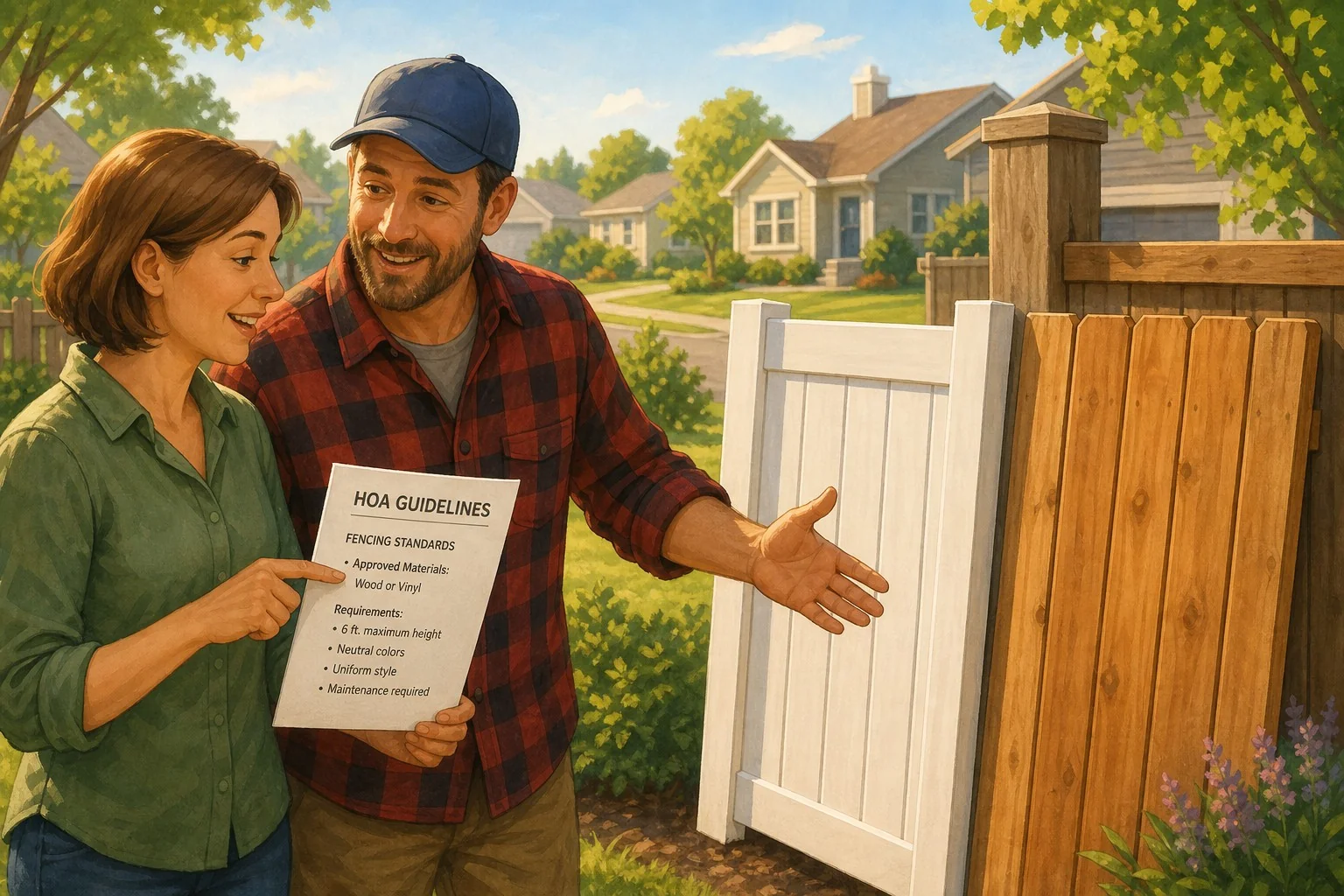
You want a fence. Simple enough — except you live in an HOA community, and now nothing about it is simple. Before you even price materials, you’ve got a board of volunteers with a rulebook telling you what color, what height, what style, and probably which direction your gate has to open.
I get why people find this maddening. But here’s the thing: if you do this right, you build the fence, get it approved, and move on with your life. If you do it wrong, you tear it down and start over. I’ve seen that happen more than once — homeowner builds first, asks second, gets a cease-and-desist letter, and calls a contractor to rip out a perfectly good fence.
Don’t be that homeowner.
Step One: Get the Actual Rules, Not Someone’s Summary of Them
Before you do anything — before you call a fence company, before you look at a single photo on Pinterest — get the CC&Rs and any supplemental fence guidelines from your HOA.
Not the summary on the website. The actual governing documents.
HOAs frequently have a master document (the CC&Rs), bylaws, and then separate architectural guidelines that get updated more often. The fence rules might be in any of them. If you only read one and miss the others, you’ll end up with a fence that passes on height but fails on material — or the other way around.
Call the management company. Email them. Get it in writing. If they tell you verbally that wood is fine, that means nothing when the architectural review committee comes back and says vinyl only.
Step Two: Know the Four Things HOAs Almost Always Regulate
Every HOA is different, but they’re all looking at roughly the same things when it comes to fences:
Height. Most residential HOAs cap rear fences at six feet and front or side-yard fences lower — four feet is common, three is not unheard of. Some allow taller in the backyard with neighbor approval. Know the limit before you pick a style.
Material. This is where a lot of people get tripped up. Some HOAs are wood only. Some are vinyl only. Some prohibit chain link entirely. Some allow a mix depending on where on the lot the fence sits. If the rules say “approved materials,” there’s usually a list — get that list.
Color and finish. Painted wood fences may need to be a specific color or match the house. Natural wood may need to be stained, not painted. Vinyl usually has to be white or tan. Read it carefully because “natural” and “neutral” mean different things to different boards.
Style and transparency. Solid privacy fences are often restricted to the backyard. Front yards frequently require picket or open-rail styles. Some HOAs prohibit anything that blocks sight lines from the street. If you want privacy in your front yard, you may just not be able to have it — that’s the deal you made when you bought there.
Step Three: Submit Before You Build — Every Time
I know it sounds obvious. Submit the architectural review request before you start. But I can’t count the number of times a homeowner has told me their contractor said it was fine and they’d deal with the HOA after.
That is never fine. Contractors don’t live in your house. They don’t get the violation letters. You do.
The approval process takes time — sometimes two weeks, sometimes six. Build that into your schedule. When you submit, include a site plan showing where the fence will run, the material spec sheet, the proposed height, and color samples if they’re required. The more complete your submission, the faster it moves.
I had a job in Cherry Hill years back where the homeowner had approval in hand, contractor started the install, and mid-job the HOA president’s wife drove by and said the fence looked too close to the property line. Turns out the approval had a setback requirement buried in the fine print. We had to pull two sections and reset them. The homeowner paid for that mistake — not the HOA, not me. Him. That’s what happens when you skim the approval letter instead of reading it.
Submit everything. Read everything they send back.
Step Four: Pick a Fence That Actually Works Within the Rules
Once you know what’s allowed, choose the fence that does the job within those limits — not the fence you saw at your cousin’s house in a non-HOA neighborhood.
If you need privacy and the rules allow six-foot solid wood in the backyard, cedar board-on-board is a solid choice. Holds up well, looks good, and can be stained to whatever the HOA will accept. Pressure-treated is cheaper but tends to warp and check over time unless it’s quality lumber.
If vinyl is required, don’t fight it. Modern vinyl privacy fences are better than they were twenty years ago. They don’t rot, they don’t need painting, and the better manufacturers make panels that don’t look like a suburban nightmare. Just make sure you’re buying from a manufacturer with a decent warranty — not the cheapest stuff on the market.
If you’re in the front yard and you need an open-rail or picket style, aluminum holds up better than wood in most climates and requires less maintenance. It’s not cheap, but it stays straight and doesn’t need to be repainted every few years.
Whatever you choose, bring the actual spec sheet to your contractor. Don’t just say “vinyl fence.” Say what color, what style, what height, what post spacing. Get that in writing before they start. Vague instructions on a fence job create problems at the survey line, at the HOA review, and in the final product.
Step Five: After It’s Built, Get Final Sign-Off
Some HOAs do a final inspection after installation. Some don’t. Either way, once the fence is up, document it yourself — photographs of the full perimeter, the gate hardware, the post depth if you can get it, the total height from grade to top rail.
If there’s ever a dispute down the road — a new board member, a neighbor complaint, a misremembered approval — you want the record. HOA boards turn over. The person who approved your fence may not be the person who gets the complaint about it two years later.
File the approval letter, the stamped drawings if you have them, and your post-installation photos somewhere you’ll actually find them. Not in a folder in your garage. Somewhere digital.
Fences and HOAs don’t have to be a war. Read the rules before you build, submit before you start, pick materials that are actually approved, and keep your paperwork. It’s not complicated — it just requires paying attention before the concrete is in the ground, not after.