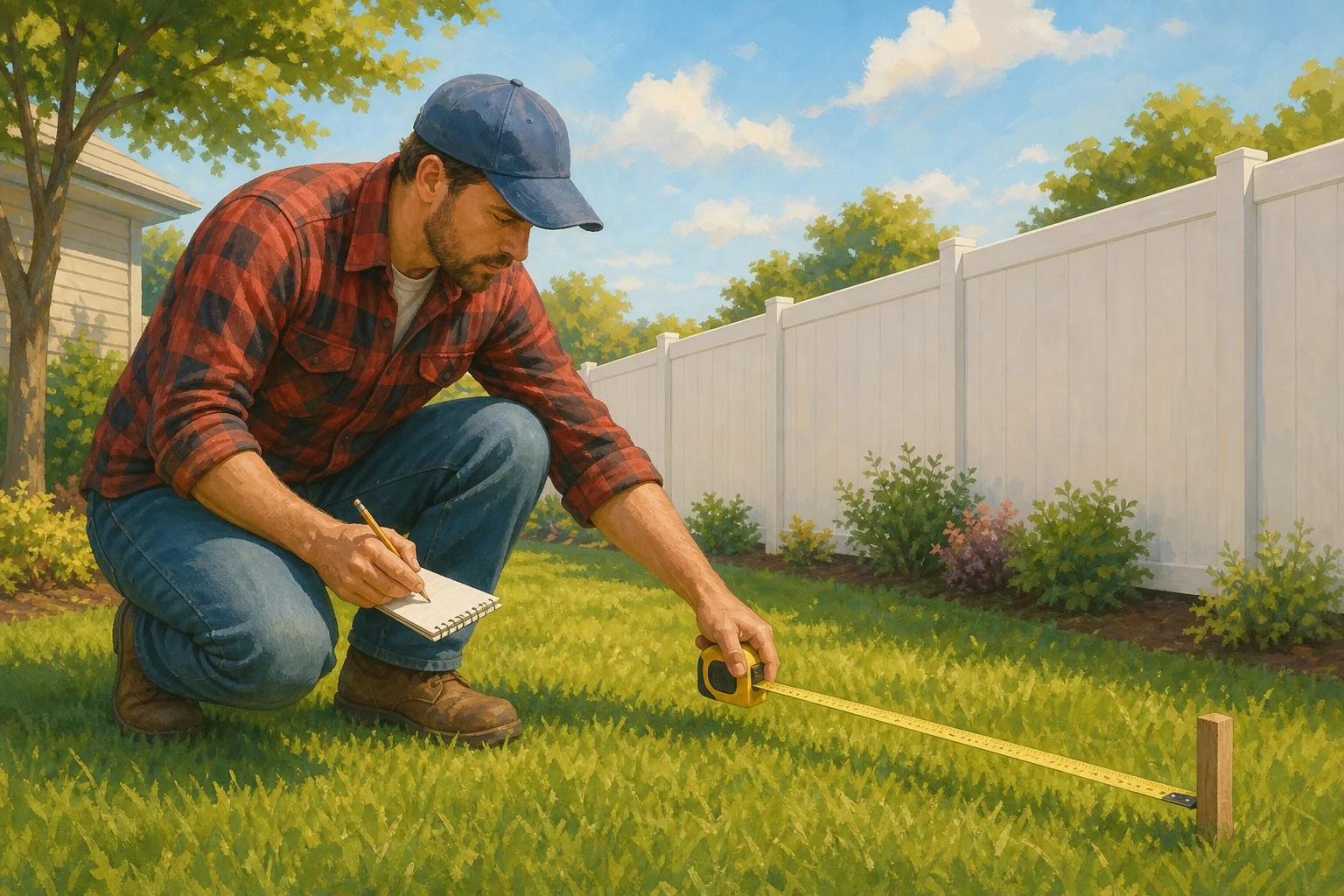
Every fence quote that comes back wrong starts the same way — with a homeowner who guessed. Guessed the footage. Guessed where the gate goes. Guessed the corners were square when they weren’t. Then the materials show up short, the crew is standing around, and everybody’s mad.
You want a quote you can actually trust? Measure it right the first time. It’s not hard. You just have to slow down for twenty minutes and pay attention.
Here’s how you do it.
Walk the whole line before you touch a tape measure
Before you measure anything, walk the entire perimeter of where the fence is going. The whole thing. Slowly.
Look for the stuff that’s going to bite you later. Tree roots. A shed you forgot about. That old clothesline post buried under ivy. A neighbor’s AC unit sitting six inches over the property line. That utility box. The gas meter. The corner of the deck. The buried downspout drain.
Half the surprises on a fence job aren’t surprises to the guy doing the walk-through. They’re surprises to the homeowner who never actually looked. Walk it. Twice.
Get your total linear footage — and be honest about it
This is the number everybody wants and everybody screws up.
Linear footage is the total length of fence you’re installing, measured along each straight run. Not the perimeter of your yard. Not “about half an acre.” Not “the whole back part.” Feet. Written down.
Use a 100-foot tape if you’ve got one. If you don’t, borrow one, rent one, or buy one for twenty bucks. The little 25-foot tape from your kitchen drawer is going to make you crazy and give you bad numbers. And don’t pace it off. I don’t care how many times you’ve heard some guy on YouTube say “one step equals three feet.” Your steps aren’t three feet. Nobody’s are. Use the tape.
Measure each straight run separately. Write each one down as you go. Don’t try to hold four numbers in your head — you’ll drop one, and it’ll be the biggest one.
Add them up at the end. That’s your total footage.
Count corners, ends, and gate posts separately
Here’s what the online quote form isn’t telling you: not every post is the same post.
- End posts — where the fence stops. Usually at a house, a garage, or just dead-ends in the yard.
- Corner posts — where the fence turns. A 90-degree turn, a 45, whatever.
- Line posts — the regular ones in between.
- Gate posts — heavier, because they carry the weight and swing of the gate.
Count them. All of them. If your fence goes around a rectangular backyard with no gate, you’ve probably got two corners and two ends where it meets the house. Simple. If it’s a weird lot with a jog in the middle and a section that runs around a shed, you might have six corners, three ends, and a couple more headaches waiting.
The quote depends on this. End, corner, and gate posts cost more and install different than line posts. Guess wrong and your quote’s off before it even starts.
Nail down the gates before you ask for numbers
Gates are where I see the most confusion, and it’s usually because the homeowner hasn’t thought it through.
Before you request a quote, know three things:
- How many gates. Most yards need at least one walk gate. If you’ve got a driveway, mower access, or a pool, you may need more.
- How wide each one needs to be. A walk gate is usually 3 to 4 feet. If you want to get a wheelbarrow, a lawn tractor, or a big garbage can through, go 5 feet. Driveway gates start at 10 feet and go up.
- Where each gate goes. Not “near the driveway” — mark it. Stakes, spray paint, a rock, something.
Had a homeowner in Fishtown a few years back who ordered a whole fence with one 3-foot walk gate. Day of install, she remembered she needed to get her riding mower into the back yard. Riding mowers don’t fit through 3-foot gates. We had to reorder a wider gate, wider posts, wider hardware, and delay the finish by a week. All of it avoidable if she’d thought it through before the quote went out.
Watch your slope and grade changes
If your yard isn’t flat, say so. Loud and clear.
Slopes change everything. You’ve got two options on a hill: stepped, where each section is level and the fence stair-steps down, or raked, where the fence follows the slope. Both cost more than a flat run. Both need more attention up front. And a fence guy quoting your job blind — off a satellite photo or a rough sketch — is going to assume flat ground. Then he shows up, sees the drop-off, and either the price jumps or the fence looks like garbage.
Measure the height of the drop from one end of the slope to the other. A three-foot drop over a fifty-foot run is a very different job than a three-foot drop over eight feet. Mention both numbers when you ask for a quote.
Take real photos — not just one from the back door
The photos you send are half of what a decent contractor is going to use to price your job. Give him something useful.
Take pictures:
- From each corner of the fence line, looking down the line in both directions
- Of every spot where the fence meets a structure — house, garage, shed, deck
- Of any slopes, drop-offs, or grade changes
- Of any obstacles the fence has to work around — trees, AC units, gas meters, utility boxes
- Of the whole yard from the back of the house, and from the back of the yard looking toward the house
One blurry shot from your kitchen window is not a fence quote. That’s a wish list.
Sketch it out
You don’t need to be an architect. Pencil, piece of paper, ten minutes. Draw the shape of the fence line. Write the footage of each section right on the drawing. Mark the corners. Mark the gates and their widths. Mark the ends. Note any slopes.
Snap a photo of that sketch and send it along with the photos and the total footage. A contractor looking at a clean sketch with real numbers on it is going to give you a real quote. A contractor looking at “I need a fence in the back yard, how much?” is going to give you a number so padded you could sleep on it.
The bottom line
An accurate quote starts with accurate information. Measure the line, count the posts, plan the gates, note the slopes, take real photos, and draw a sketch. Do that and you’ll get a quote that reflects the actual job — not a guess, not a lowball to hook you, not a padded number to protect the contractor from your bad measurements.
Twenty minutes with a tape measure saves you a week of headaches on the back end. Every time.