Late August in Pennsylvania is the sweet spot. The wood has been baking and swelling and drying all summer, and any weakness in your fence is showing itself right now. In about six weeks, the nor’easters start rolling in, the ground gets soggy, and the wind picks up. That’s when the rotten posts snap and the gates come off their hinges and you end up chasing a fence panel down the street in your slippers.
Do the walk now. It takes twenty minutes. Fixing it now costs a fraction of what it costs after a storm drops half your fence into the neighbor’s yard.
Here’s how I do the inspection, and here’s what to do about what you find.
Start at the posts. Always the posts.
Ninety percent of fence failures start at the post. The panels can look brand new, and the whole run will still come down if the posts are shot.
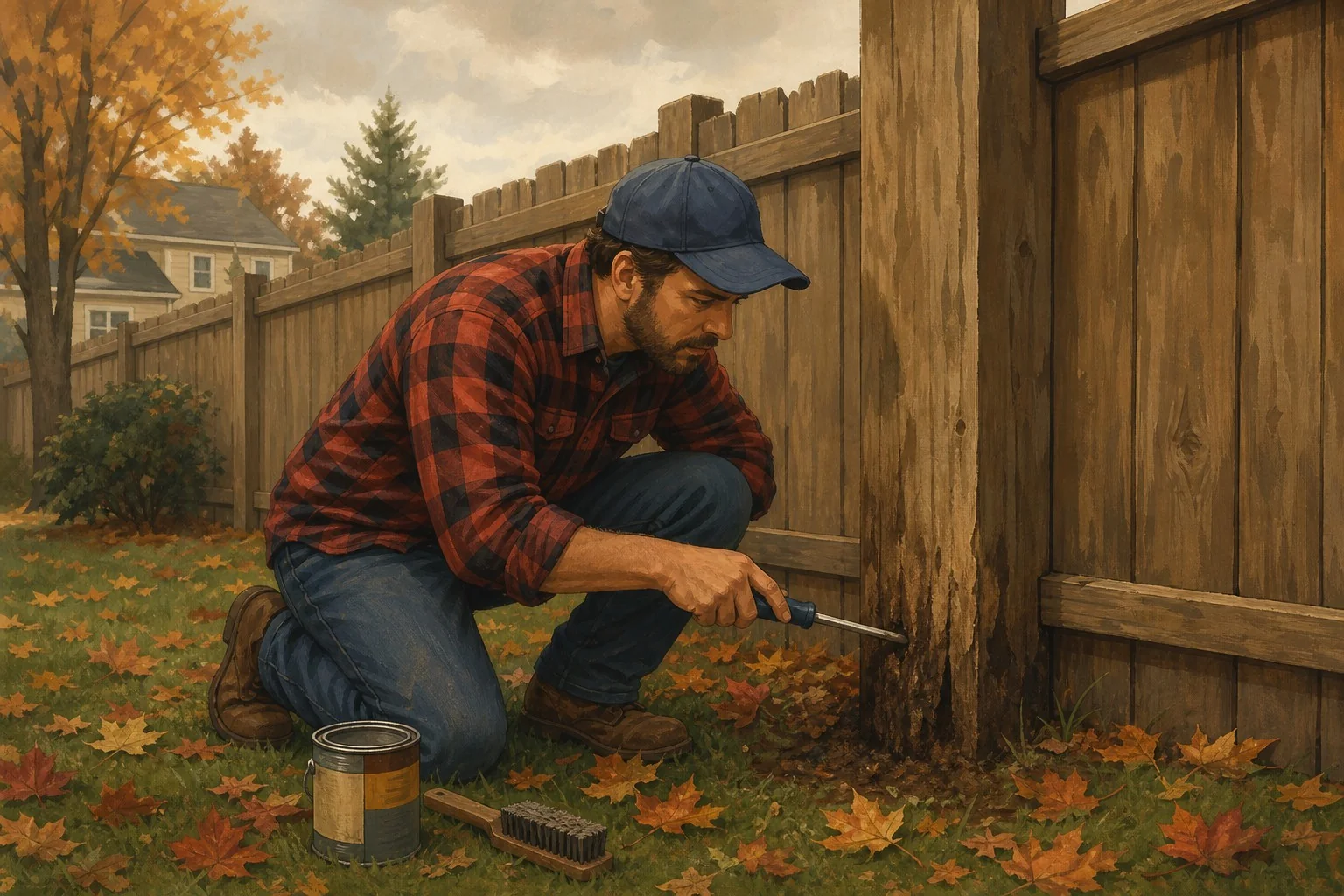
Grab a screwdriver — a regular flathead, nothing fancy. Walk to every post and push the tip into the wood at ground level. If it slides in like you’re stabbing a pumpkin, that post is done. If it goes in maybe a quarter inch and stops, you’re fine. In between, you’ve got early rot and you’ve got maybe a season to deal with it.
Check three spots on each post: right at the soil line, about six inches above, and where the rails attach. The soil line is where most of them go first because water sits there and the wood stays wet. The rail connections rot from the inside because water gets into the notch and doesn’t drain.
I had a job over in Roxborough a few years back — homeowner insisted his fence was fine because “the wood looks great.” The panels did look great. Then I put a boot against a post and the whole thing tipped over like a bad tooth. Every post at ground level had turned to mulch. He’d been staining the visible parts every two years and ignoring the four inches that mattered. Cost him a full replacement instead of the four posts he could’ve swapped two years earlier.
The fix: If one or two posts are gone, you can sister them or swap them. Dig out around the base, cut the bad post at grade, sink a new pressure-treated post next to it, and bolt them together with galvanized carriage bolts. If more than a third of your posts are soft, stop patching and plan a real replacement. You’re throwing good money after bad.
Check the rails and the panels — but check the hardware first.
Nails and screws holding a rotten fence together are a joke. Grab each rail and give it a good shake. If it moves independent of the post, the fasteners have pulled through soft wood. If you see rust bleeding down the boards in orange streaks, the nails are cooked and the wood around them is worse.
Look at the bottom of every picket. Water wicks up from the ground, and pickets rot from the bottom up. If the bottom two inches are dark, spongy, or crumbling, that picket’s got a year in it, tops. A whole row of soft pickets means the fence sat in wet mulch or leaf litter too long and needs airflow.
The fix: Trim back anything touching the fence — mulch, dirt piles, hostas, ivy, all of it. Wood needs to breathe. Replace individual pickets with cedar or pressure-treated stock. Swap rusted nails for exterior-rated screws so you’re not fighting the same battle in three years.
The gate is where you’ll find out how bad things really are.
The gate takes more abuse than any other part of the fence. It swings, it slams, it sags, it gets leaned on. If your gate is dragging, sticking, or the latch doesn’t line up anymore, something has moved. And on a fence, “something moved” almost always means a post is failing or the hinge screws are pulling out of soft wood.
Open and close it. Watch what flexes. If the hinge post leans toward the gate every time it opens, that post is losing its grip on the ground — either the concrete cracked or the wood at the base is gone. If the latch post moves, same problem, other side.
The fix: Small sag, tight hinges? Add a turnbuckle cable across the gate frame corner-to-corner and tighten it up. It’ll pull the gate square again. Post is leaning? That’s a dig-and-reset job, and it’s worth doing before winter because a leaning post will only get worse when the ground freezes and thaws.
Treat what’s left, then walk away.
Once you’ve patched what needs patching, seal it. A decent oil-based penetrating stain on dry wood — not paint, stain — will buy you two to three years of protection. Do it on a stretch of dry days when the wood’s not baking hot. Hit the end grain of every picket and every rail cut. End grain is where water goes in.
Don’t waste money on the fancy stuff at the big-box store that promises ten years. There’s no such thing. Any exterior wood finish in Pennsylvania weather is a two-to-three-year deal. Anyone who tells you different is selling you something.
When to stop patching and just replace it.
Here’s the truth nobody wants to hear: a wood fence in this climate lasts fifteen to twenty years if you take care of it, ten to twelve if you don’t. If yours is pushing twenty, you’re rearranging deck chairs. Save your weekends and your back and plan a real replacement in the spring.
But if your fence is eight, ten, twelve years old and just needs some love? Do the walk this weekend. Fix what you find. You’ll thank yourself in November when the wind is howling and your fence is still standing while your neighbor’s is in three pieces on the sidewalk.