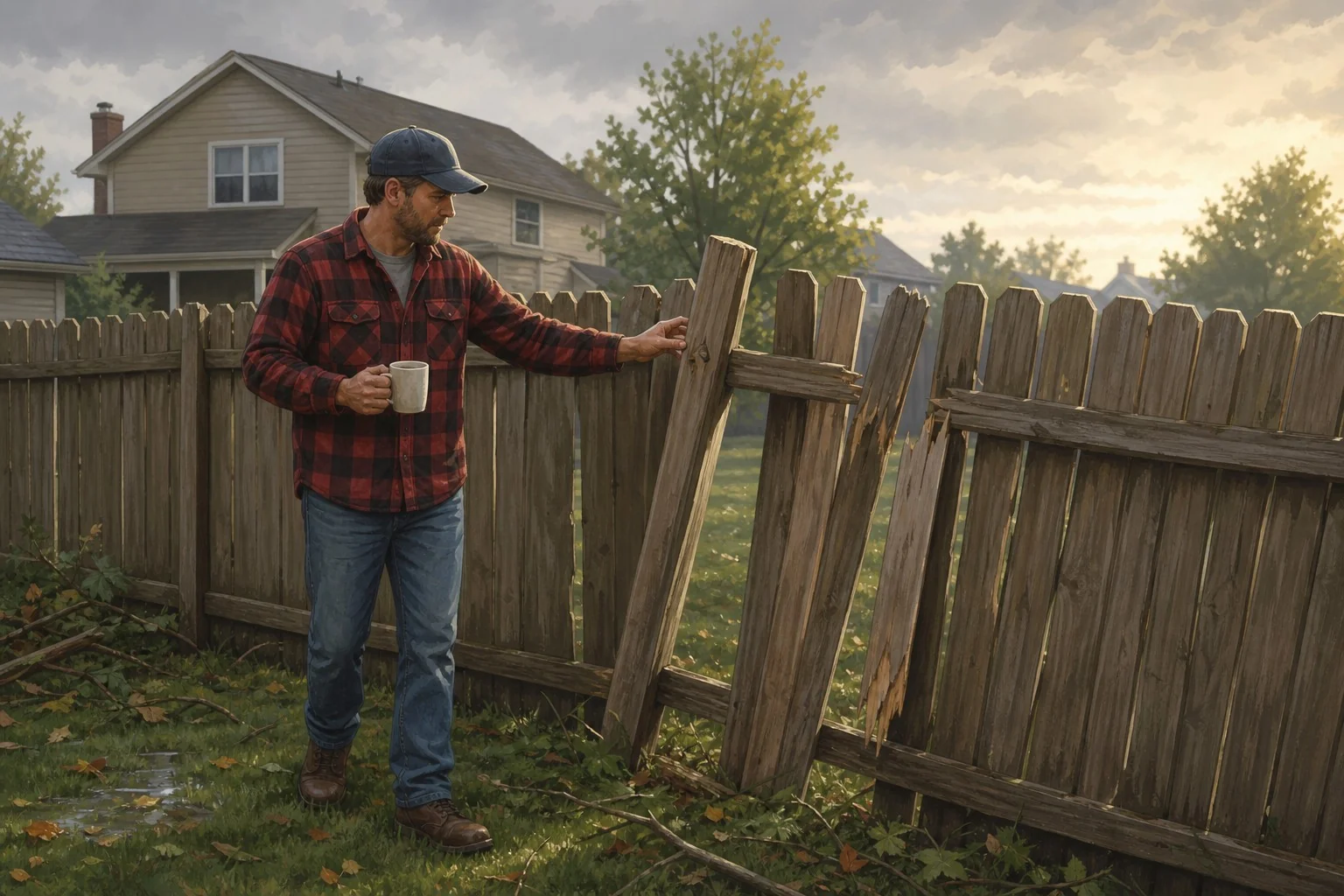
Pennsylvania summer storms don’t mess around. One minute it’s 92 and humid, the next there’s a wall of green sky coming over the Schuylkill and your patio umbrella is in the neighbor’s yard. By the time it’s done, your fence has taken a beating — and most people don’t bother looking at it until something falls over three weeks later.
Don’t be that homeowner. Walk the fence the day after the storm passes. You don’t need tools. You don’t need experience. You need eyes, a hand, and about twenty minutes.
Here’s what you’re looking for.
1. Lean on the posts. Literally.
The posts are the bones of the fence. If the bones are bad, nothing else matters. Forget how the boards look — go straight to the posts.
Grab each one and give it a firm push at about shoulder height. Not a love tap. A real push, like you’re trying to move a stuck shopping cart. A post set right shouldn’t budge. If it wobbles, leans back, or the base shifts in the dirt, you’ve got a problem.
Saturated ground is the killer here. Pennsylvania clay holds water like a sponge, and after a few inches of rain, a post that was fine in May can rock loose in June. If it’s leaning but the post itself is still solid, you can sometimes brace it and re-tamp the soil once the ground dries out. If the concrete footing came up with it, that’s a different conversation — that post is coming out and a new one is going in.
While you’re at it, check where the post meets the ground. If you see a black ring around the wood at soil level, push your thumbnail into it. If it sinks in like a sponge cake, the post is rotting from the inside out. Storm didn’t cause that — the storm just exposed it.
2. Walk the rails and the boards
After the posts, work the horizontal stuff. The top rail and the bottom rail are what hold your fence together. The boards or pickets are just dressing.
Look for:
- Split rails. A long crack running with the grain. Wind torques a fence harder than people realize. A rail can crack down its length and still look fine from ten feet away.
- Pulled nails or popped screws. If you see fasteners backing out of the wood, the connection is compromised. That board is the next one to come loose in the next storm.
- Boards that have shifted. Run your hand along the top of the fence. If one board is suddenly an inch higher or lower than its neighbors, the fastener at the top or bottom failed.
- Missing pickets. Obvious, but check the yard and the neighbor’s yard. A picket that flew off in the wind probably took a chunk of rail with it.
I had a job in Roxborough a few summers back where a homeowner told me his fence was “totally fine, just one board loose.” I pulled that one board and the whole bottom rail came with it — twelve feet of rotted, nail-shot pine that hadn’t been holding anything but appearances for two years. The storm didn’t break his fence. It just announced what was already true. That’s how this goes.
3. Check every piece of hardware
Gates take more abuse than any other part of a fence. They swing, they slam, they get yanked open by the wind. After a storm, they’re the first thing to misbehave.
Open and close every gate. It should swing smooth and latch clean. If it scrapes the ground, the hinge side has dropped — usually because the gate post moved or the hinge screws backed out. Tighten the screws first. If they spin in the holes, the wood is stripped and you need longer screws or new holes.
Look at every hinge, latch, and bracket. Rust streaks running down the wood from a fastener means water is getting in around it. That’s not the storm’s fault either, but the storm made it worse.
4. Know what’s DIY and what isn’t
Here’s the line, plain and simple.
Do it yourself:
- Tightening loose screws and hinges
- Replacing a single picket or board
- Re-tamping soil around a post that’s leaning but still solid
- Swapping out a latch or a small piece of hardware
- Cleaning debris out of the fence line so wood can dry
Call somebody:
- More than one post is loose or leaning
- A post snapped at the base or rotted through
- A whole section is down or pulling away
- The gate post moved and the gate won’t close
- You see damage you didn’t notice before the storm and now it’s structural
A fence is one of those things people convince themselves they can fix on a Saturday with a YouTube video and a bag of Quikrete. Sometimes you can. But pulling a rotten post and setting a new one properly — depth, gravel, plumb, concrete, cure time — is real work, and if you cut corners, you’re doing it again next summer.
One last thing
Take pictures. Before you fix anything, walk the fence with your phone and shoot the damage. If a tree from your neighbor’s yard came down on your fence, or a flying trash can did the job, that’s their problem to pay for, not yours. Homeowners insurance also wants to see what happened before you touched it.
The fence isn’t going anywhere in the next hour. Look at it before you swing a hammer at it. Half the bad fence repairs I’ve seen in thirty years happened because somebody rushed in and tried to fix what they hadn’t fully looked at yet.
Walk it. Push on it. Listen to it. Then decide what you’re doing.