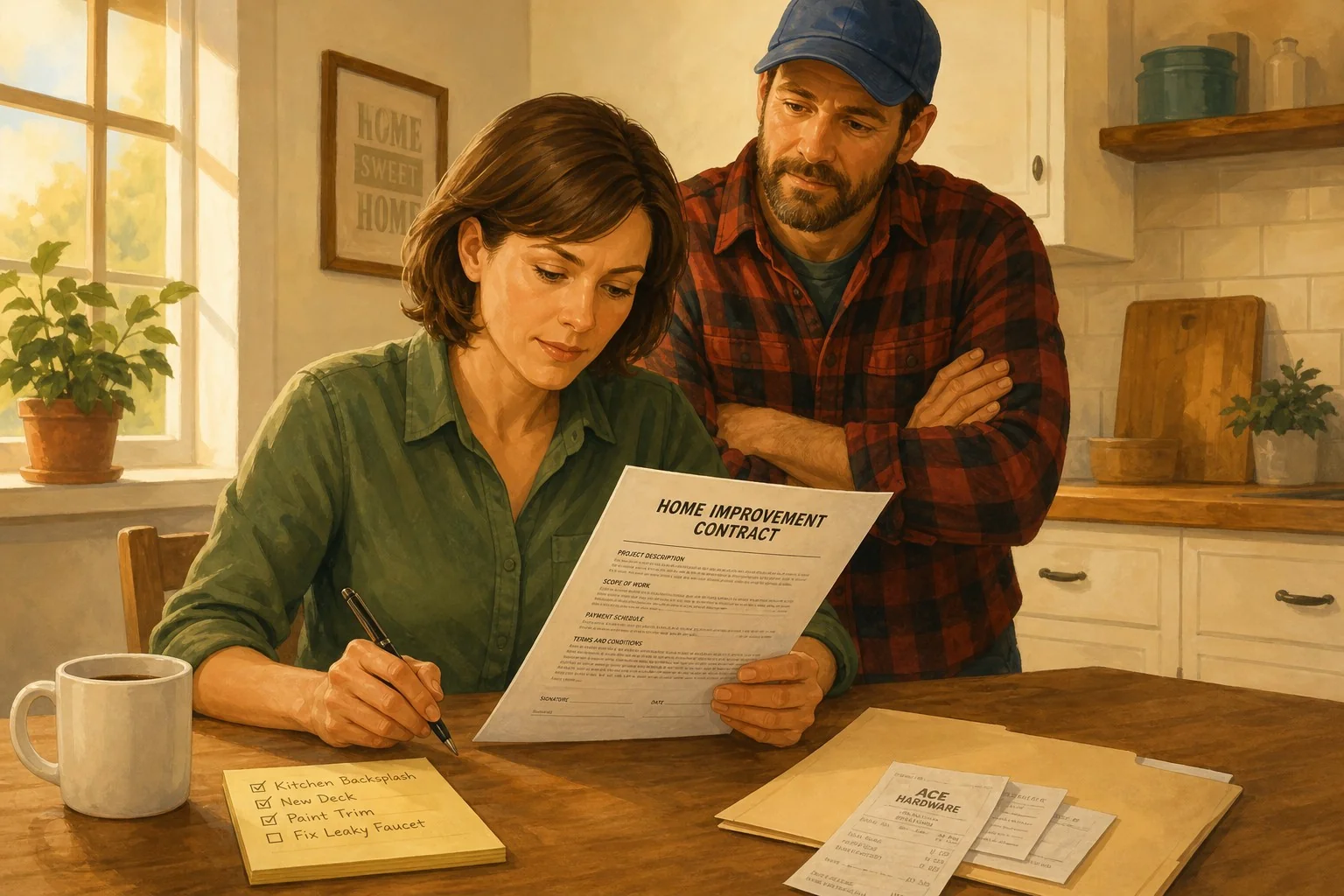
Homeowners get burned on this more than almost anything else. Contractor shows up, gives them a price, shakes hands, and everybody feels good. Work starts. Then something goes sideways — the wrong tile gets installed, the dumpster isn’t included, the painting was “assumed” to be one coat, not two — and now you’ve got a dispute on your hands. The homeowner says one thing, the contractor says another, and there’s no paper trail to settle it.
That’s not a misunderstanding. That’s what happens when you don’t have a written estimate.
Here’s the rule you need to tattoo somewhere: if it’s not written down, it’s not included. Not implied. Not assumed. Not “we talked about it.” If it isn’t in the document, your contractor has no obligation to do it, and you have no leverage to make them.
What a Real Estimate Looks Like
A real estimate isn’t a number on a napkin. It isn’t a one-line email that says “demo and tile work, $4,800.” That tells you nothing.
A proper written estimate should break down:
- Scope of work — exactly what is being done, room by room or phase by phase. “Install tile in master bath” isn’t enough. Is that floor tile, wall tile, or both? Backsplash? Shower surround? What size tile? How high up the wall?
- Materials — what brand, what product, what grade. If the estimate says “tile” without specifying, the contractor can legally install the cheapest stuff they can find. That’s on you for not pinning it down.
- Labor — what the labor cost is, separate from materials. You want to see these as separate line items, not lumped into one number. When something changes mid-job, you’ll need to know which part of the price is affected.
- Exclusions — what is explicitly not included. Good contractors will list this. If subfloor repair isn’t included, it should say so. If haul-away isn’t included, it should say so. Surprises mid-job almost always trace back to something that should’ve been listed as an exclusion.
- Timeline — start date, estimated completion, and any key milestones for bigger jobs. Not a guarantee, but something in writing gives you a baseline.
- Payment schedule — when payments are due and in what amounts. Never pay 100% upfront. That’s not even about trust; it’s just bad practice.
If a contractor hands you something that doesn’t have most of those things, ask for it before you sign anything. A contractor who’s done this for any real length of time won’t balk at that. Only the ones who are sloppy, inexperienced, or planning to bury you in change orders will push back.
The Change Order Problem
Even with a solid estimate, things change on jobs. That’s construction. You open a wall and find rot nobody expected. The homeowner decides they want a different fixture. Material gets backordered and you have to substitute.
Here’s the thing: every change to the original scope needs its own written change order, signed by both parties, before the work gets done.
A change order should include what’s changing, why, and what it costs. That’s it. Simple document. No change order means no agreement, which means when the final invoice is $3,000 more than the estimate, you’re in a verbal dispute with no documentation to back you up.
I had a client in Fishtown — nice couple, renovating a rowhouse kitchen — who let three or four small changes slide without paperwork because the contractor said, “Don’t worry about it, we’ll settle up at the end.” End of the job, there was an extra $6,200 on the invoice. Some of it was legitimate. Some of it was padding. They couldn’t tell the difference because nothing was written down. They paid most of it just to be done with the whole thing.
That’s money gone because they trusted a handshake over a piece of paper.
How to Read the Estimate Before You Sign
Don’t just look at the bottom-line number. Read the whole thing.
Look for vague language. Words like “allowance,” “as needed,” and “per owner’s selection” are flags. An allowance means they’ve budgeted a certain dollar amount for something — say, $500 for fixtures — and if you choose something that costs more, the difference comes out of your pocket. That’s fine as long as you know it going in. “As needed” can mean anything. Get it defined.
Check for what’s missing. If you’re doing a bathroom gut job, permits should be on there. Dumpster or debris removal should be on there. Caulking and finish work should be on there. If things you’ve discussed aren’t showing up in the estimate, ask why before you sign.
Get competing estimates for the same scope. If you’re getting three bids, make sure all three are bidding the same job. Contractors can quote wildly different scopes, and the cheapest number on paper can end up being the most expensive job in reality if it’s missing half the work.
The Verbal Promise Trap
Contractors aren’t always dishonest when they make verbal promises. Sometimes they mean it in the moment. Sometimes they forget. Sometimes personnel changes mid-job and the guy who made the promise isn’t the guy finishing your bathroom.
None of that matters to your bank account.
Get it in writing. Not because every contractor is out to get you — most of them aren’t — but because written documentation protects both sides. It protects you from scope creep and surprise charges. It protects the contractor from a homeowner who “remembers” the price being $2,000 less than it was. A good contractor should want this in writing as much as you do.
If they don’t, that tells you something.
The estimate is the document that defines the job. Treat it that way. Read it carefully, ask questions, push for specifics, and don’t let work start until you have something on paper that actually reflects what was agreed to. Everything else is just a conversation.