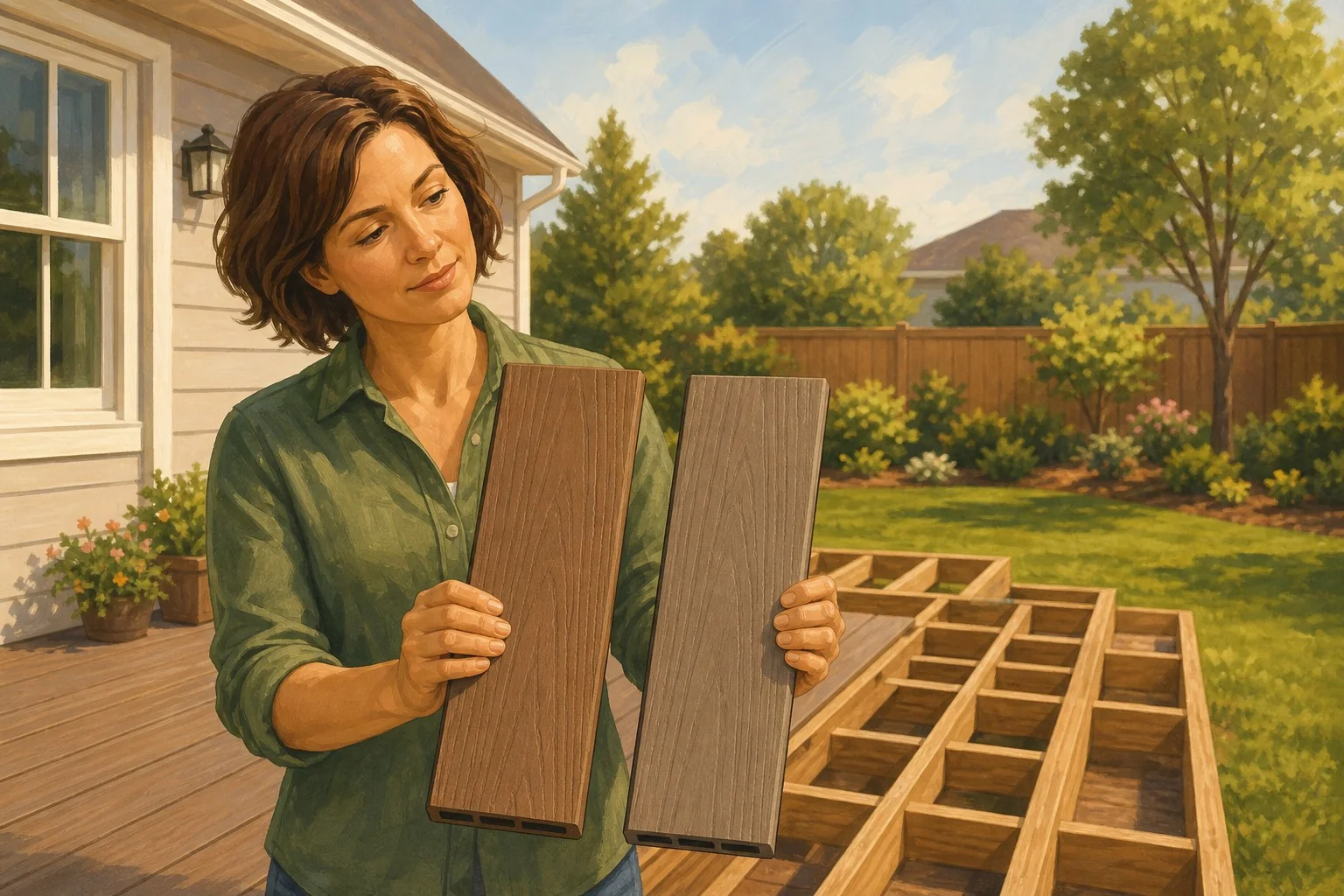
Short answer: Fiberon is a decent product. It’s not a scam, it won’t fall apart in two years, and for some homeowners it makes sense. But “as good as Trex” is not how I’d describe it — and I’ll tell you exactly why.
They’re Not the Same Product
Both are composite decking. Both mix wood fiber and plastic. Both are trying to sell you the same idea: a deck that looks good, holds up to weather, and doesn’t need to be stained every spring. But how well they pull that off is where the gap shows up.
Trex has been doing this since 1992. They essentially invented the residential composite decking market. They’ve had decades to work out the manufacturing problems, dial in the material formulations, and build a warranty program that holds up. Fiberon has been around since 1997 — not a new company — but they’ve always been playing catch-up in terms of market presence and distribution.
That matters because it affects everything downstream: who installs it, who stocks it, how easy it is to get replacement boards five years from now if something goes wrong.
Warranty: Read the Fine Print
This is where homeowners get fooled. Both companies advertise impressive numbers — 25 years, 30 years, “limited lifetime.” Sounds great until you actually read what’s covered.
Trex’s warranty on their mid-range and premium lines covers fade, stain, and structural defects. The fade warranty is real — they set measurable color-change thresholds, not just “we’ll look at it and decide.” Their warranty transferability to a new homeowner is also handled cleanly, which matters if you ever sell the house.
Fiberon’s warranty is comparable on paper but has more conditions and exclusions depending on which product line you’re in. Their Good-Better-Best tier structure means a lot of homeowners buying “Fiberon” are actually buying the entry-level line with the shorter, thinner warranty and don’t realize it until something goes wrong.
Both companies require proper installation per spec for the warranty to be valid. That’s standard. But Trex’s installation documentation is cleaner and their dealer network is bigger, which means you’re more likely to find an installer who’s actually done it before.
Durability in the Field
Composite decking fails in predictable ways: it fades, it scratches, it gets surface mold if water pools on it, and in some older formulations it got soft in direct sun. Both brands have improved substantially over the last ten years.
Trex’s capped composite — the Enhance and Select lines above entry level — uses a four-sided polymer shell around the board. That shell is what protects against staining, fading, and moisture absorption. The cap is the whole ballgame with composite. The better the cap, the longer the deck looks good.
Fiberon’s upper lines use the same approach and do it reasonably well. Their Promenade and Horizons lines hold up. The lower-tier Fiberon products use a partial or thinner cap, and that’s where I’ve seen people end up disappointed — not because it’s defective, but because they bought expecting Trex-level performance and got something a step down.
I’ve had clients come to me after installing entry-level Fiberon themselves. Saved money upfront, frustrated three years later when the boards are showing wear that a Trex deck at the same age wouldn’t show. Not catastrophic failure. Just a deck that looks older than it should.
Price: Fiberon Is Usually Cheaper
This is real and worth acknowledging. Fiberon often runs 10 to 20 percent cheaper than comparable Trex lines. On a big deck, that’s actual money — sometimes several thousand dollars.
If you’re on a tight budget and choosing between entry-level Fiberon and no deck, the Fiberon makes sense. If you’re comparing Fiberon’s top line to Trex’s top line, the gap closes and the calculus shifts.
Here’s how I tell clients to think about it: composite decking is not cheap no matter who makes it. You’re already spending serious money to not paint a deck. Spending another 15 percent to get the product with the better track record, the bigger dealer network, and the cleaner warranty isn’t a splurge — it’s the last 15 percent of a decision you’re going to live with for 25 years.
Aesthetics: Both Look Good, Trex Looks More Like Itself
Ten years ago, composite decking looked like composite decking. It looked fake. Both companies have made massive improvements in grain patterns, color variation, and surface texture. Neither one looks like a vinyl floor anymore.
Trex has more SKUs, more color options, and more design flexibility. If you have a specific aesthetic in mind — a particular wood tone, a board width, a specific fascia treatment — Trex is more likely to have exactly what you’re looking for. Fiberon’s color palette is solid but narrower.
If you want a natural wood look, both companies make products that get close. Neither one looks exactly like real hardwood. That’s the honest truth about composite decking in general. You’re buying maintenance savings, not a perfect wood replica.
So Which One Should You Buy?
If you’re comparing mid-range to mid-range, Trex wins on warranty clarity, installer availability, and long-term support. If you’re comparing Fiberon’s top line to Trex’s entry line, Fiberon might actually be the better call — product quality matters more than brand name at that point.
The real mistake homeowners make is buying based on price alone without checking which tier they’re actually in. Know what product line you’re buying, not just what brand. Read the warranty for that specific line. Ask your installer what they’ve seen hold up and what they’ve seen cause callbacks.
Fiberon isn’t a bad product. It’s a legitimate option. But if someone asked me what I’d put on my own deck in South Philly and money wasn’t the deciding factor, I’d go Trex. That’s based on twenty-plus years of watching what holds up and what people end up calling me to fix.