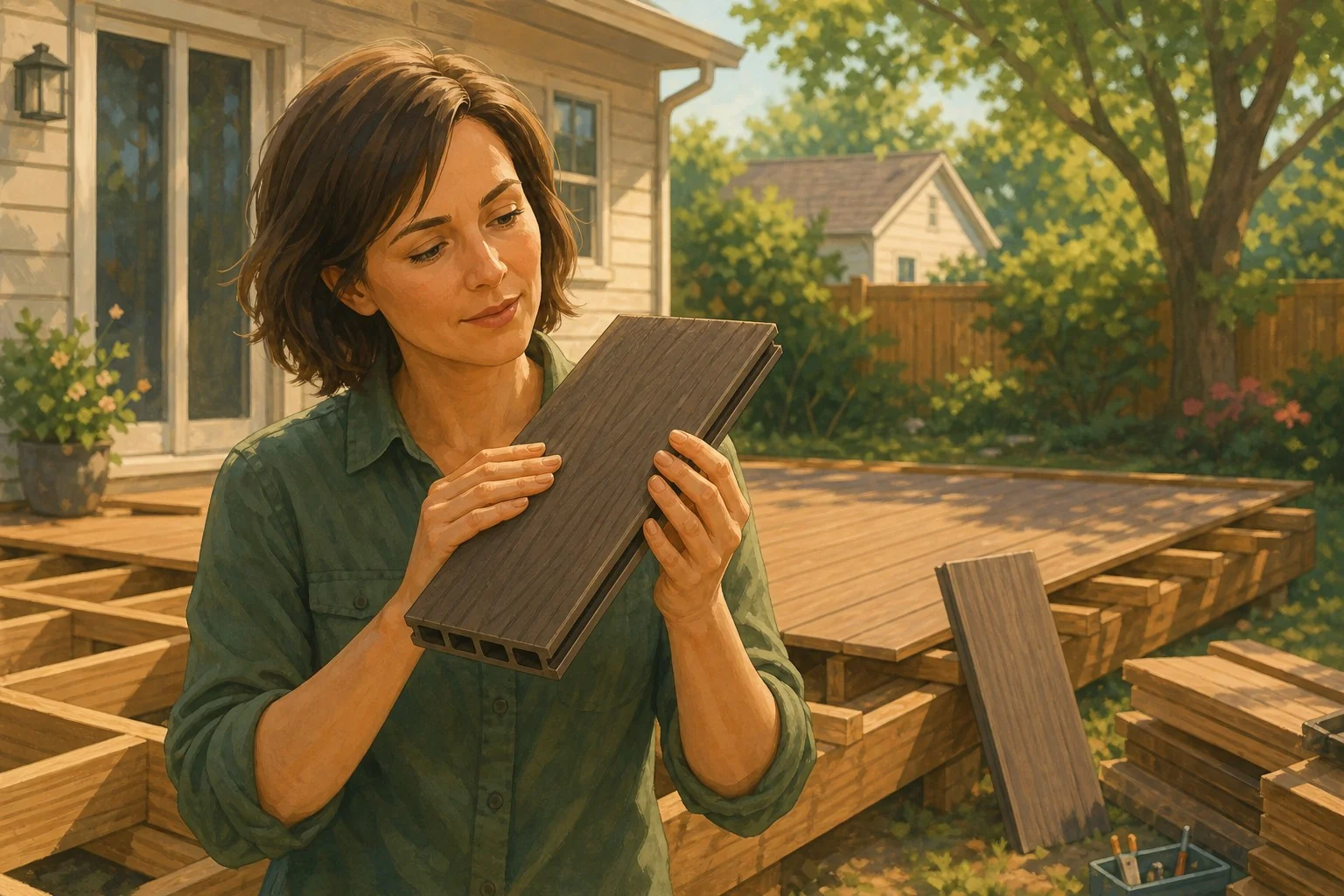
Short answer: Trex is composite. Not PVC. Never has been.
Long answer: Trex is what’s called a wood-plastic composite, or WPC. Roughly fifty percent reclaimed wood fibers, fifty percent recycled plastic — mostly polyethylene from things like grocery bags and stretch wrap. They grind it up, mix it, heat it, push it through a die, and a deck board comes out the other end. That’s the whole deal.
PVC decking is a different animal entirely. No wood in it. It’s all plastic — polyvinyl chloride, the same family as your plumbing pipe, just engineered to act like a deck board. Different material, different price, different performance.
People mix the two up constantly. Half the homeowners who call asking about “Trex PVC decking” have no idea they just said two contradictory things. Not their fault. The decking industry has spent twenty years muddying the water with marketing.
Why everyone gets this wrong
Here’s where the confusion comes from. Old-school Trex from the 90s and early 2000s was uncapped composite. Just the wood-plastic mix, exposed. It worked, sort of. But it faded, it stained, and if you spilled red wine on it in July you owned that stain for life.
So Trex did what every composite manufacturer eventually did — they wrapped it. Modern Trex boards have a PVC or polymer shell bonded to the composite core. That outer layer is what gives it the stain resistance and the color stability. The core is still wood-composite.
That’s where the mix-up starts. Cap is PVC-ish. Core is composite. People hear “PVC cap” and assume the whole board is PVC. It’s not. It’s a composite board wearing a plastic raincoat.
True PVC decking — brands like AZEK, TimberTech AZEK, Wolf — that stuff is plastic all the way through. No wood. Lighter board. Different feel underfoot. Usually more expensive.
The practical difference for your deck
If you’re a homeowner trying to figure out which one to buy, here’s what actually matters.
Weight and feel. Composite boards like Trex feel solid. Heavy. Substantial under your feet. PVC is lighter and can sound a little hollow when you walk on it, especially in the cheaper lines. Some people love that solid Trex feel. Some people don’t notice. Stand on a sample at the lumberyard before you commit to either.
Heat. Both get hot in direct sun. Anybody who tells you their composite or PVC stays cool in August is lying to your face. Lighter colors help. Darker colors will scorch your bare feet. Plan accordingly, or buy slippers.
Moisture and the woods question. Trex’s wood content used to scare people — wood plus water equals rot, right? In a capped composite, the wood is sealed inside the polymer shell. It’s not getting wet under normal conditions. I’ve pulled up ten-year-old capped Trex and the cores looked the same as the day they went down. Uncapped composite from the early 2000s is a different story — that stuff did soak up moisture and some of it grew mold along the edges. Don’t buy uncapped composite. Nobody should still be selling it.
Price. Composite is usually cheaper than PVC. Not always, but usually. The price gap has narrowed a lot in the last five years.
The Trex lines worth knowing
Trex sells in three main tiers, and the differences matter.
Trex Enhance is the entry-level. Capped composite, decent warranty, fewer colors. Fine for a budget build. I wouldn’t put it on a high-traffic deck that hosts barbecues every weekend, but for a quiet backyard? It’ll do the job.
Trex Select is the middle. Better cap, more colors, a step up in scratch resistance. Most homeowners end up here, and that’s usually the right call.
Trex Transcend is the top of the line. Premium cap, the richest color options, the longest warranty. If you want it to look like real hardwood from ten feet away, this is the one.
We stock all three. If you’re trying to figure out what’s right for your deck, bring a picture and the rough square footage and we’ll walk you through it.
One thing to watch out for
I had a homeowner up in Manayunk a few years back who insisted he wanted “PVC Trex” because his neighbor had it and loved it. We get over there, look at the neighbor’s deck — it was Transcend. Standard capped composite. The neighbor had been telling everyone for two years it was PVC because the salesman at the big-box store called it “PVC-protected.” That phrase has caused more confusion in this industry than just about anything.
So when somebody at the store says “PVC” — ask if they mean a PVC cap or a full PVC board. Two completely different products. Two completely different prices.
Bottom line
Trex is a wood-composite. The cap is plastic, the core is wood and recycled poly. If somebody hands you a brochure that says Trex is PVC, hand it back. They don’t know what they’re selling.
For most homeowners building a deck right now, capped composite is the sweet spot — looks good, holds up, doesn’t break the bank. Whether that’s Trex or one of the other composite brands is a separate conversation. But if you want Trex, you’re getting composite. That’s the answer.