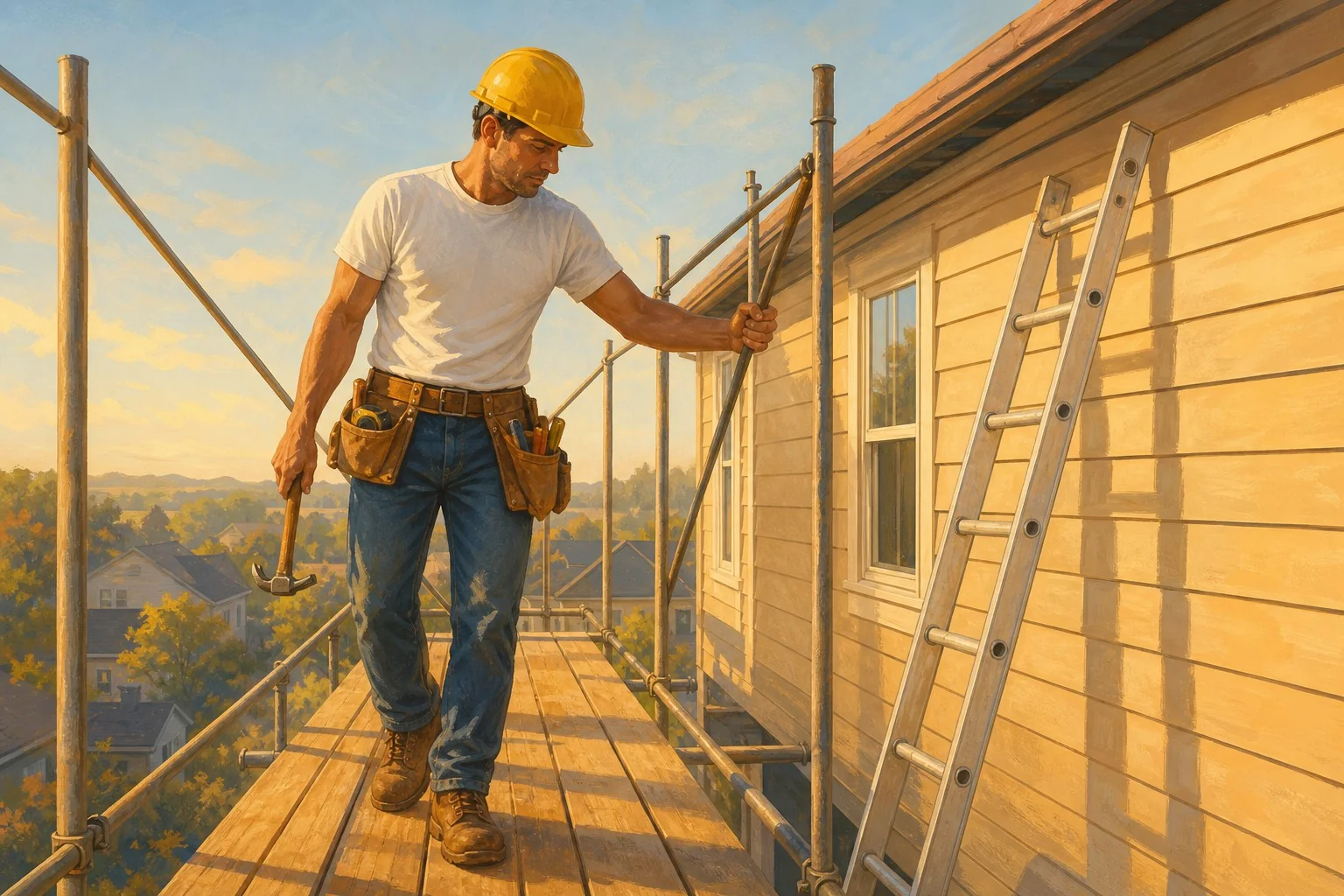
You Don’t Get Cited for Exotic Stuff—You Get Cited for the Same Three Things Every Week
Inspectors don’t show up looking for weird problems. They show up looking for the boring ones. And they find them, every single week, on the same handful of jobs — ladders leaning wrong, scaffolds thrown together sloppy, guys twenty feet in the air with no tie-off. The stuff that hurts people is the stuff nobody wants to slow down and do right.
If you’re a homeowner working on your own house — cleaning gutters, painting soffits, patching a roof — the physics don’t care that you’re not on a jobsite. Gravity doesn’t check your license. What wrecks a professional will wreck you the same way, and probably faster because you don’t do it every day.
Here’s what actually matters.
1. Set your ladder right or don’t get on it
Ninety percent of ladder problems come from the same handful of mistakes. Wrong angle. Feet on soft ground. Extending an extension ladder like it’s a step stool. Standing on the top two rungs. Reaching so far off to one side that your belt buckle passes the rail.
The rule I taught every apprentice: one foot out for every four feet up. Ladder going to the second-story gutter, roughly twenty feet? Base sits five feet away from the wall. Not close, not farther — five. If you can’t remember the math, stand at the bottom rung, toes on the ladder, arms straight out in front of you. If your palms hit the rung at shoulder height, the angle’s about right. If they don’t, fix it before you climb.
Feet need to sit flat on solid ground. Not grass. Not mulch. Not scrap plywood you found in the garage. If the ground isn’t level, either move the ladder to somewhere it is, or buy leg levelers — they’re forty bucks and they work.
Northeast Philly siding job, years back — one of my guys set his ladder in dirt and shimmed the low leg with a piece of scrap two-by. Looked fine standing there. Inspector came around, gave the base a boot, and the whole thing shifted about four inches sideways. That’s on flat ground with nobody on it. Now picture him twelve feet up with a bundle of J-channel on his shoulder. That was the end of that job for the day, and rightly so.
Tie the top off if you can. A ratchet strap through the ladder and around something solid takes ninety seconds. It’s the difference between a ladder that slides sideways and a ladder that doesn’t.
2. If your scaffold looks “good enough,” it’s probably not
Scaffolds don’t fail dramatically. They fail because one leg wasn’t plumb, one plank was cracked, one cross-brace was missing, and the whole thing shifted a quarter inch every time somebody stepped on it. Until it didn’t.
If you’re renting scaffold from the big box store to hit a stubborn spot on your house, do these things and don’t skip any of them:
- Base plates on solid, level ground. Same as ladders. If you’re on grass or soil, put a piece of two-by-twelve under each foot. Not scrap. Clean lumber.
- All cross-braces installed. Both sides. Every level. Scaffolds are engineered as complete assemblies. Miss one brace and the whole geometry changes.
- Guardrails if you’re over ten feet. That’s the number the code uses because that’s the number where people stop bouncing and start breaking.
- Full planks, tight together, no gaps. No half-boards, no plywood offcuts spanning the space. A proper plank rated for the load, sitting fully on the bearers.
- Don’t overload it. The rating on the tag is the rating. A pallet of shingles on a residential-grade scaffold is how people find out about ratings the hard way.
And check the wheels. Mobile scaffolds have to be locked before you climb them. Every time. A rolling tower can drift six feet across a driveway with a guy on it if nobody sets the casters. Sometimes he steps off fine. Sometimes he doesn’t.
Also — inspect the frames before you assemble. Bent tubes, cracked welds, missing pins. Rental gear takes a beating. If a piece looks tired, swap it. The rental yard doesn’t care and neither should you.
3. Wear the harness. And actually clip it to something.
Fall protection is the third thing pros get written up for constantly, and it’s the one homeowners skip the most because it feels like overkill for a two-hour job.
Here’s the truth: a fifteen-foot fall onto concrete kills you or breaks you badly enough that you’ll wish it had. Roofing, gutter work, chimney work — anything above about six feet where you don’t have guardrails — deserves a harness and a rope. A basic roofer’s kit runs about eighty bucks. That’s less than one urgent-care copay and roughly one-thousandth of what a spinal injury costs.
Two things matter more than owning the harness:
One, anchor to something that will actually hold you. A ridge anchor screwed through the sheathing into rafters. Not a vent stack. Not a chimney cap. Not a length of rope tied around your bumper. If the anchor pulls out, the harness is jewelry.
Two, keep the rope short enough that it stops you before the ground does. A twenty-foot lanyard on a fifteen-foot roof is a decoration, not a safety device. Adjust the rope so that if you slip, you stop above the eaves — not swinging past them.
The pattern
The same three things get pros written up week after week. The same three things send homeowners to the ER every summer. Ladders, scaffolds, tie-offs. Nothing exotic. Nothing you didn’t already know was important.
The reason it keeps happening is that everybody thinks they’ll skip the setup this one time because the job’s only going to take twenty minutes. And then the ladder shifts, or the plank flexes, or a boot slips on a wet shingle, and twenty minutes turns into six months of physical therapy — if you’re lucky.
Do the boring stuff. Set it up right. If it takes an extra fifteen minutes, take the fifteen minutes. The ground doesn’t negotiate.