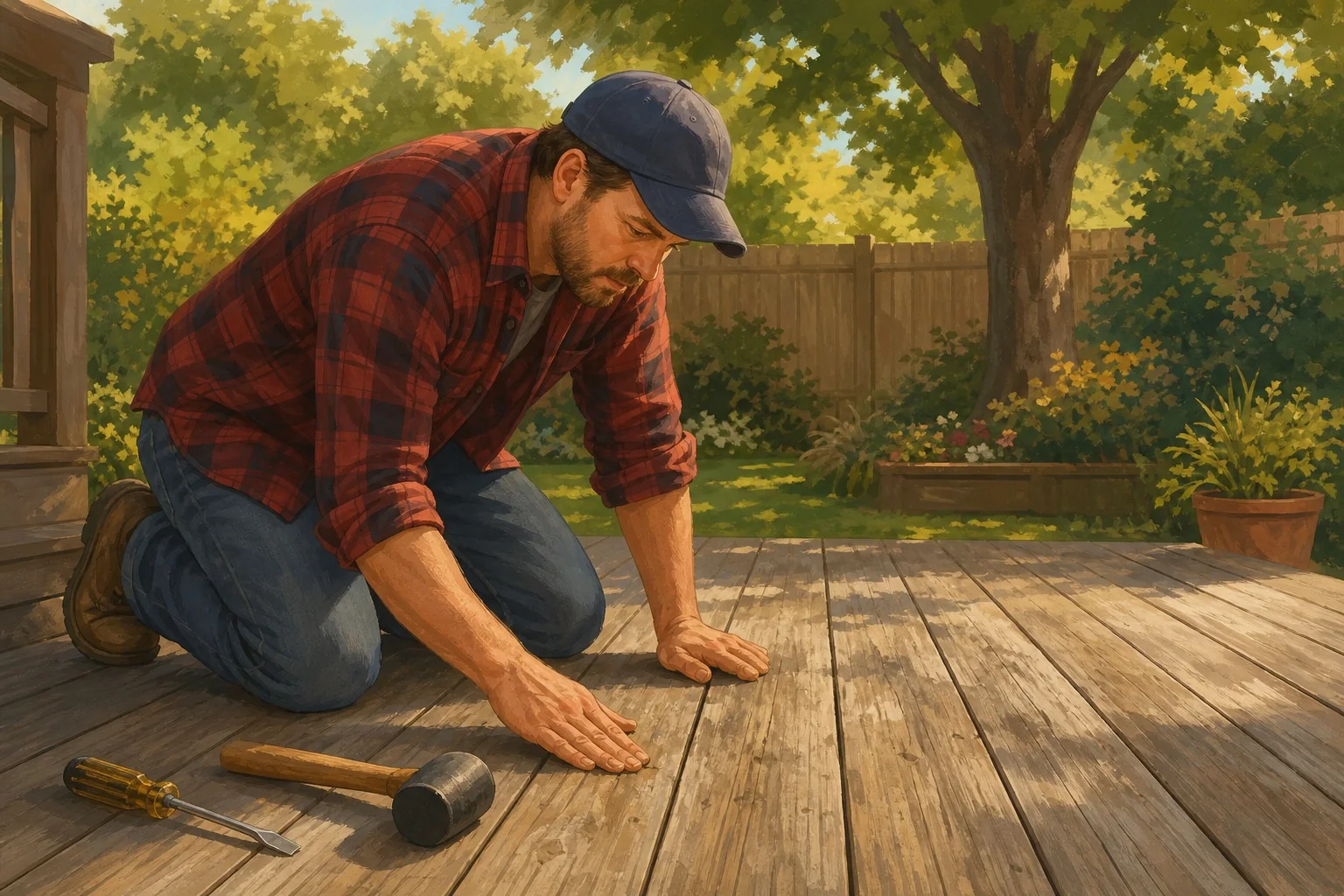
Seasonal deck inspection
August is the meanest month for a deck. After months of UV, humidity, and temperature swings, this is the time to catch problems—before fall turns them into expensive repairs.
Start with the ledger board
The ledger is the board bolted to your house that the whole deck hangs off of. If it fails, the deck comes down. Not “sags a little.” Comes down.
Deck collapses land homeowners in the hospital every summer, and nine times out of ten the failure starts at the ledger.
Stop-and-check condition
Go under the deck with a flashlight. You want to see lag bolts or through-bolts—big, substantial fasteners—not nails. If you see nails, stop and call somebody who knows deck construction.
You also want to see flashing tucked up behind your siding and over the top of the ledger. If water is running down your siding and getting trapped behind that board, it may be rotting from the back where you cannot see it.
Push a screwdriver into the ledger in a few spots. It should feel like wood. If it feels like a wet sponge or the tip sinks in, you have rot.
Check the bolts with a wrench. If they spin freely, the wood behind them is shot.
Walk every board and look for three problems
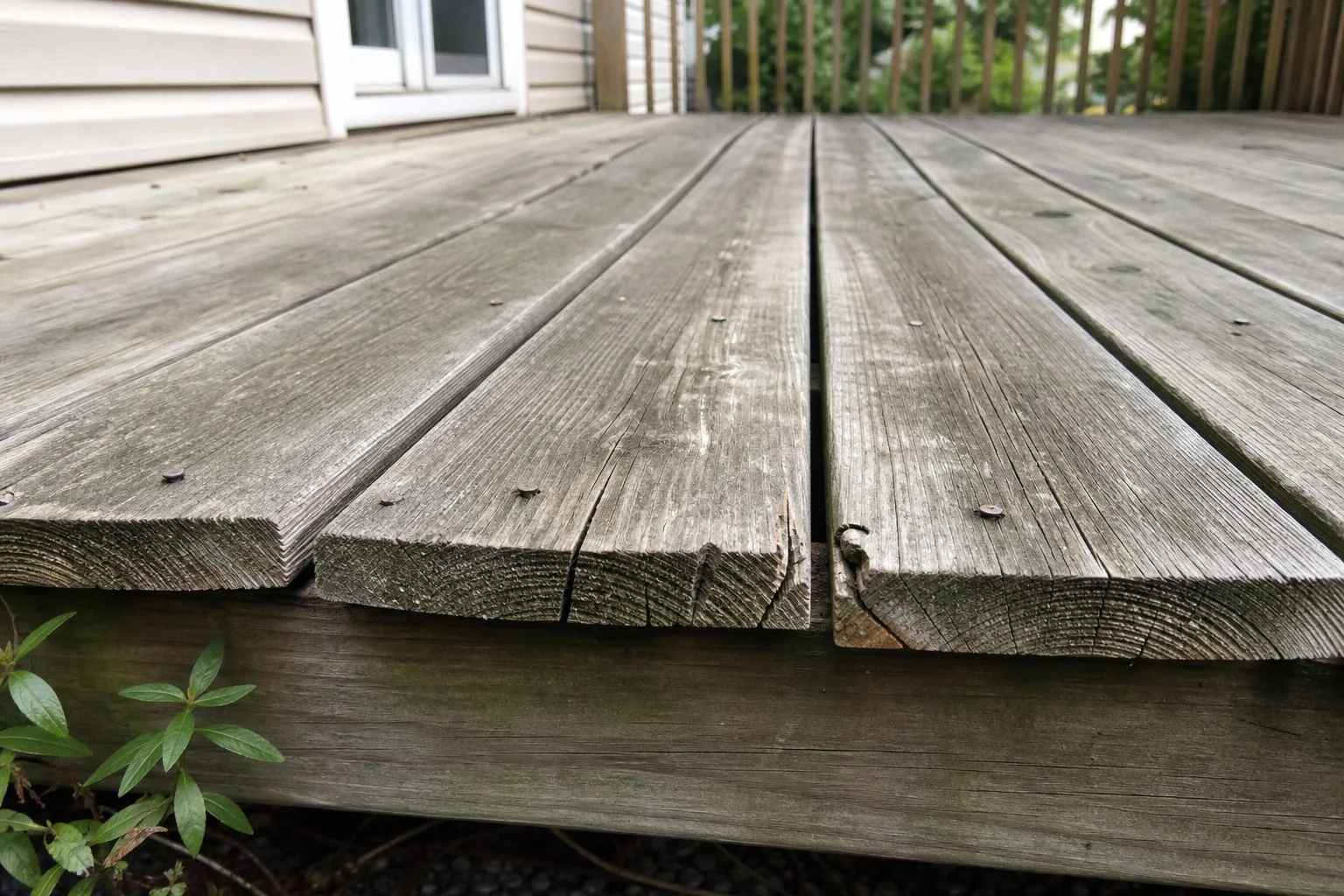
Get on your hands and knees if you have to. You are looking for three things:
- Cupping
- When the edges of a board curl up and the middle dips down, or vice versa. A little bit is normal after a wet summer. A lot means the board is drying unevenly, usually because it was installed bark-side down or is not getting airflow underneath. Cupped boards hold water, and water is what kills decks.
- Fasteners backing out
- Nails pop and screws work their way up. Run your hand across the deck carefully because a raised nail head can open your palm. Anything sticking up gets driven back down or replaced. Do not just hammer a popped nail back in and call it done. Pull it and put a screw in.
- Splits and checking
- End grain sucks up water like a straw. If you see splits running down from the ends of your boards, that is where rot starts. Seal small splits. Replace boards with big splits.
Clean out the gaps between boards
This is the job everyone skips and everyone regrets.
Leaves, pine needles, seed pods, and whatever else the trees dumped on you in July pack down into the gaps between your deck boards and hold moisture against the wood. That is a rot factory. It does not matter how good your stain is if the boards are wet 24 hours a day from the crud packed underneath.
-
Clear each gap
Take a putty knife or an inexpensive deck-cleaning tool and drag it through every gap. You will be shocked by what comes out.
-
Blow or rinse away the debris
Hit the gaps with a hose or a leaf blower to clear the remaining material.
-
Inspect the joist tops
Look through the gaps while you are cleaning. Black staining or spongy wood on top of the joists means water is sitting there and the joists are rotting from above. That is a bigger conversation, but you need to know about it.
Check the railings like your kid’s life depends on it
Because it might.
Shake every post
Grab every railing post and shake it hard. Lean on it. A properly built railing does not move.
Find the weak connection
If a post wiggles, the connection at the base is compromised. The bolts may be loose, the wood may be rotted, or it may never have been built right in the first place.
Test the top rail
Apply the same test to the top rail. If you can flex it more than an inch or two, the balusters or top-rail connections need attention.
Fix a loose railing before someone leans on it during a party and goes over the edge.
Look at your stain honestly
Start with a water test. Splash some water on the deck. If it beads up, your finish is still doing its job. If it soaks in and darkens the wood, the finish is done.
A dead finish does not mean you need to strip and refinish tomorrow—but it means the wood is now drinking every rainstorm, and you are on the clock. Get a fresh coat on before the fall rains come. September, when the humidity finally breaks, is your window.
Do not seal in a problem
Do not stain over dirt, mildew, or old flaking finish. You are just gluing the mess in place. Clean it, let it dry a full 48 hours, then coat it.
Know what you can handle
Small maintenance
A few popped nails, debris in the gaps, or a tired finish is a Saturday project. Handle it yourself.
Structural problems
Soft spots in the ledger, joists rotting from above, railings that wiggle, or bolts spinning in their holes are not a DIY afternoon. Get somebody out there who knows what they are looking at.
Catch it now
A deck inspection from a decent contractor runs a couple hundred bucks. A deck collapse runs into six figures and possibly a funeral.
Catch it in August. Fix it in September. Enjoy your deck in October instead of staring at a pile of lumber and a repair bill.