August in Pennsylvania is brutal on a fence. You’ve got a sun that’s been baking the same boards since May, humidity that won’t quit, and thunderstorms that roll through and shove your posts around like they owe them money. By the time Labor Day hits, your fence has taken a beating whether you noticed or not.
Now is when you fix it. Not November. Not when the ground is frozen and you’re trying to pull a rotted 4x4 out with a chain and a prayer. Now.
Here’s the walk-through I’d do if it was my house.
Walk the whole line first. Don’t skip the back corner.
Grab a screwdriver and a hammer and just walk it. Every panel, every post, every gate. The back corner behind the shed where nobody looks — that’s where the problems live. That’s where the vines grew all summer, that’s where the runoff pooled, that’s where the neighbor’s kid launched a soccer ball into the same picket eighteen times.
You’re looking for four things: leaning posts, loose fasteners, cracked or warped boards, and any spot where the wood has gone soft. The screwdriver is your probe. Poke it into the base of every post, right at grade where the wood meets the dirt. If it sinks in like you’re stabbing a banana, that post is done. Doesn’t matter what the top half looks like.
Sun damage on wood is worse than people think.
UV breaks down the lignin in wood. In English: the sun literally cooks the glue that holds the fibers together. You get that silver-gray color everyone thinks looks “rustic,” but underneath the surface it’s chalky, dry, and thirsty. Splash some water on a board. If it soaks in flat and dark instead of beading up, your sealer is gone and the wood is drinking.
Fix: give it a light wash with a deck cleaner, let it dry a full two or three days, then put a semi-transparent oil-based stain or a decent sealer on it. Do it in September when the temps drop into the 70s. Not now, when it’s 92 and the stain flashes off before it can soak in. Not October, when the wood is too cold to accept it. Late September, early October — that’s the window.
Skip the cheap water-based sealers from the big box. They look great for a summer and peel off in sheets by the next one. Spend the extra fifteen bucks a gallon.
Vinyl doesn’t rot, but it does everything else.
People buy vinyl thinking it’s zero maintenance. It isn’t. It’s low maintenance, and there’s a difference.
What UV does to vinyl: it makes it brittle. A five-year-old vinyl panel that took a whiffle-ball hit in June will crack cleanly in October when the temperature drops. Look for hairline stress cracks around the routed slots where the rails meet the posts. That’s where it always goes first.
What storms do to vinyl: they pop the rails out of the posts. Vinyl panels aren’t screwed together — they float in slots so they can expand and contract. A hard wind lifts them just enough to unseat the rail, and now the panel is doing the wave every time the wind blows. Push down on the top rail of each section. If it moves more than a hair, the panel needs to be reseated and the post cap glued back on with the right vinyl adhesive. Not silicone. Not Gorilla Glue. Vinyl cement, made for PVC.
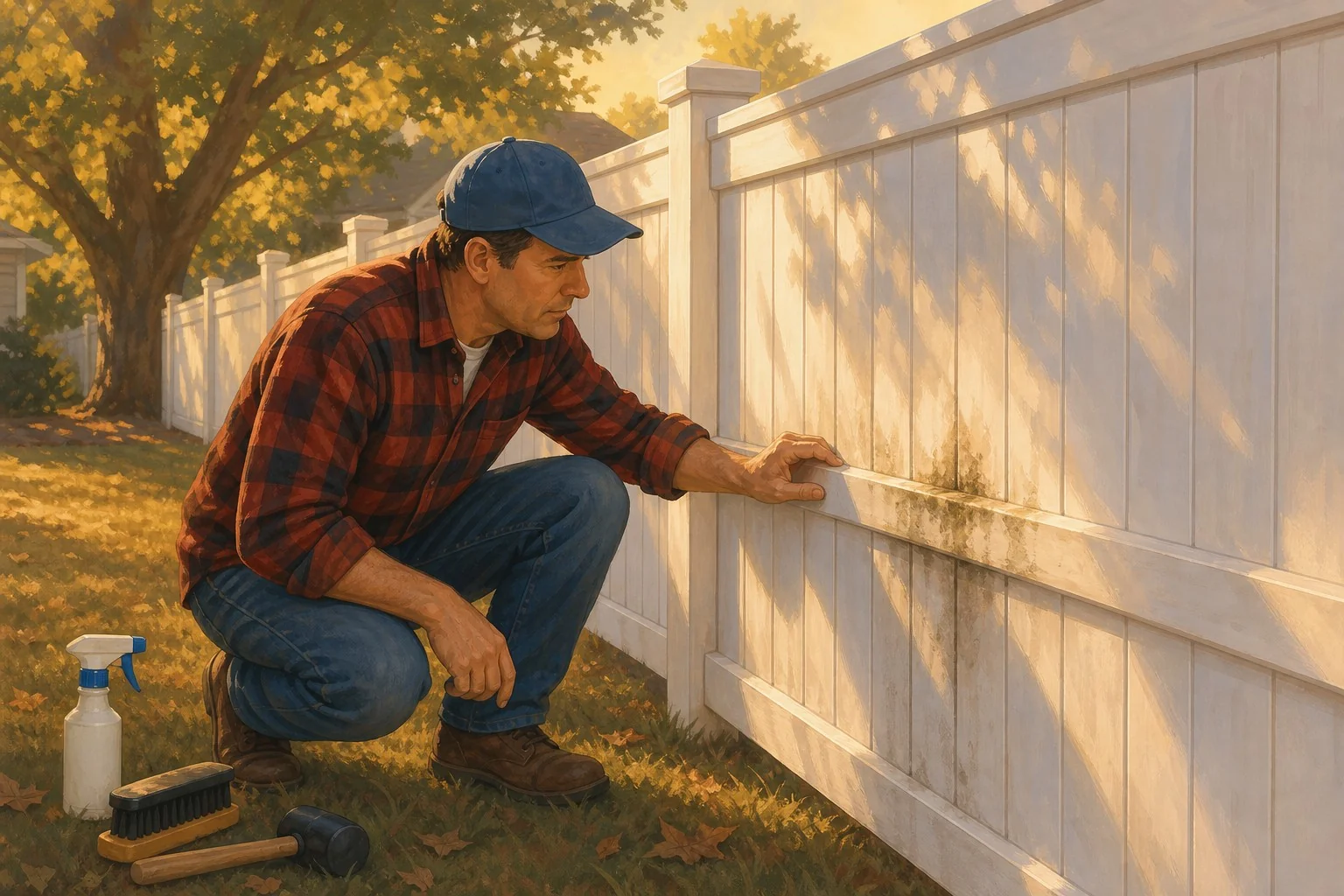
Wash the whole thing with a bucket of warm water, a little dish soap, and a soft brush. That green algae on the north-facing side isn’t just ugly — it holds moisture against the vinyl and speeds up the UV breakdown. Ten minutes with a brush now saves you a panel replacement in two years.
Posts are the whole ballgame.
Ninety percent of fence problems are post problems. If the post is solid and plumb, the fence stands. If the post is soft or leaning, nothing else matters.
Grab the top of each post and give it a good shove — front to back, then side to side. A little flex in a tall privacy panel is normal because the wind loads it. But if the post itself rocks in the ground, you’ve got a problem. Could be rot at the base, could be the concrete footing cracked, could be the ground swelled and shrank all summer and loosened everything up.
I had a homeowner up in Roxborough call me two Novembers ago. She’d noticed her back fence leaning about ten degrees in August, figured she’d deal with it in spring. First real windstorm in October took the whole run down — sixty feet of six-foot privacy fence, laying flat on her neighbor’s hostas. The neighbor was not gracious about it. Every single post had rotted through at grade and she never checked because they looked fine from three feet away. That whole job cost her four times what a couple of post replacements in September would have.
If a post is soft at the base but the fence panels are still good, you can sister a new post next to the old one, bolt the panels to the new post, and cut the old one off at grade. That’s a Saturday job with a bag of concrete and a post-hole digger. If three or more posts in a row are shot, you’re better off pulling the whole run and starting over. Half-measures on a bad fence just cost you the labor twice.
Gates. Always the gates.
Gates sag. That’s what they do. The hinge side takes all the weight, the latch side droops, and by the end of summer the gate is dragging on the ground or the latch won’t close.
Two fixes, both easy. One: throw an anti-sag turnbuckle kit on the gate, run the cable from the top of the hinge side to the bottom of the latch side, and crank it until the gate squares up. Twenty bucks, twenty minutes. Two: if the hinge screws are stripped out of the post, pull them, jam a couple of glued dowels or golf tees into the holes, let them set overnight, and drive the screws back in. Fresh bite, solid gate.
If the gate post itself is leaning, none of that helps. Fix the post first.
Do it now. Not in six weeks.
The ground is still workable. The wood will still accept stain. You can see what you’re doing without a headlamp at 5 p.m. Every problem you find in August is a problem you can fix on a Saturday. Every problem you find in December is a problem you’re paying somebody like me to fix in February when we’re not cheap and we’re not happy about it.
Walk the fence. Poke the posts. Fix what needs fixing. Then enjoy the fall.