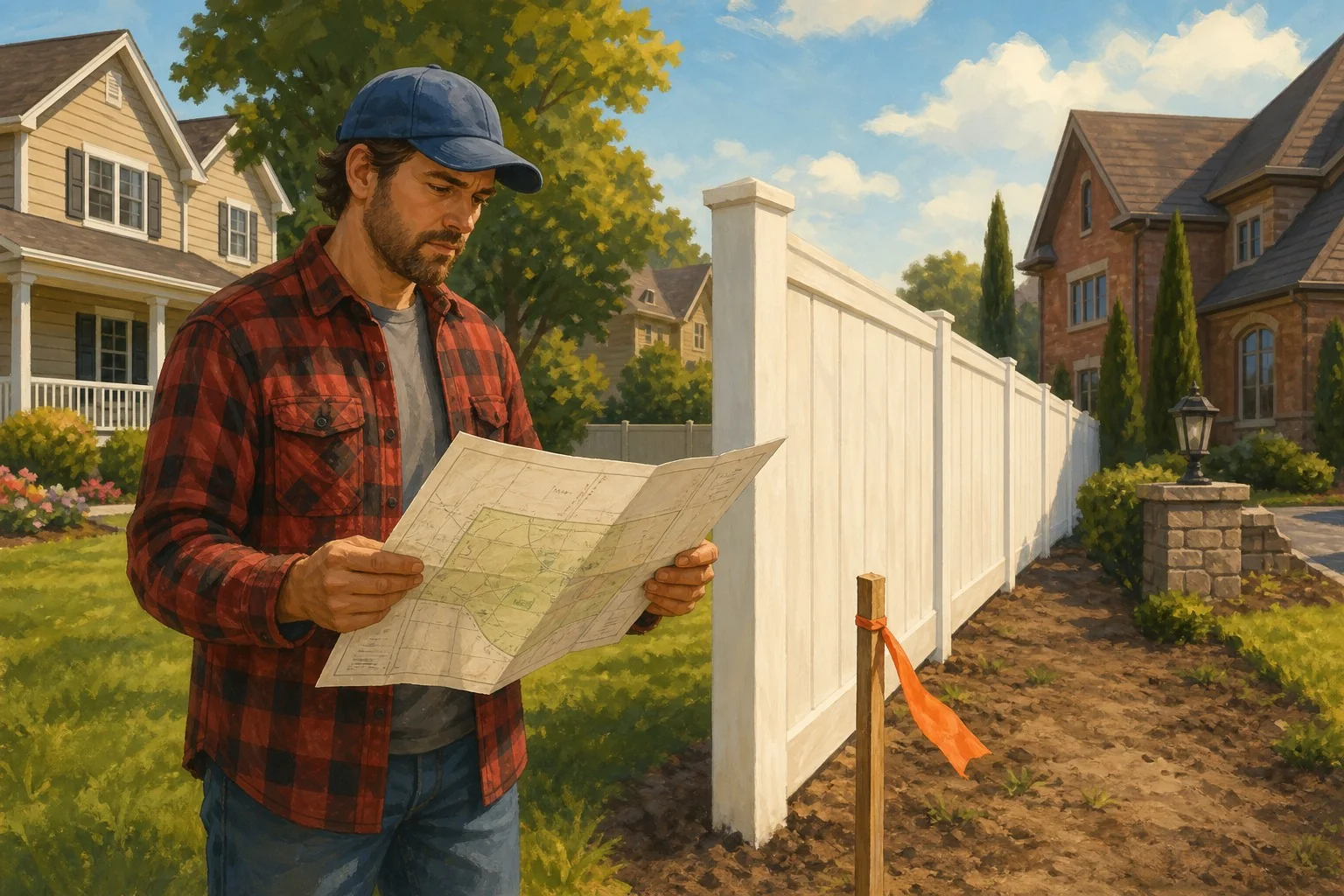
Every so often I get a call from somebody who just bought a house and found out their backyard is split by an invisible line nobody told them about at closing. Not the property line. The township line. Their house sits in one town, half the yard sits in another, and they want to put up a fence.
Then they call the permit office and get told two different things by two different clerks. Welcome to the club.
This happens more than people think, especially out around the edges of any built-up area. The Philly suburbs are lousy with it. Two towns share a border, some old subdivision got platted before anybody cared, and now your lot line runs right through the seam. Your fence is going in two municipalities whether you like it or not.
Here’s how to handle it without wasting a bunch of money and time.
First, find out where the line actually is
Before you pull a permit anywhere, you need to know two lines: your property line, and the municipal line. They are not the same thing and one of them is invisible.
Your property line lives on your deed and on the plot survey. If you don’t have a current survey, get one. I don’t care what the neighbor says the line is. I don’t care what the old fence used to follow. Fences get moved, hedges grow crooked, and memory is garbage. A licensed surveyor puts pins in the ground and hands you a drawing. That drawing is what everybody argues from.
The municipal line is a separate question. Your county GIS website usually shows it, and it’s often free to look at. Cross-reference the municipal boundary against your survey. If the boundary crosses your lot, mark exactly where — and how much of the fence run falls in each town. You need real numbers, not “most of it is in Whitemarsh.”
Yes, you probably need two permits
This is the part nobody wants to hear. If your fence sits in two municipalities, each municipality has authority over its own piece. That usually means two separate permit applications, two fees, two inspections, and two sets of paperwork.
Some towns will accept a joint filing if you tell them upfront what’s going on. Most won’t. They don’t coordinate with each other and they’re not going to start for your fence. You file with both, you pay both, you deal with both.
Call the zoning officer in each town before you file anything. Not the general permit clerk — the zoning officer. Tell them the situation, ask what they need, and ask if they’ve handled a split-lot fence before. Half the time you’ll get a helpful answer and a heads-up on the local quirks. The other half you’ll get a shrug, but at least you tried.
One more thing: keep every email, every receipt, every stamped drawing. When one township’s inspector shows up and questions what the other township approved, you want the paper in your hand.
When the two towns’ rules disagree
They will. Count on it.
Township A allows a six-foot solid wood fence on the side yard. Township B caps side-yard fences at four feet and requires 50% open construction. Now what?
Simple answer: each section of fence has to obey the rules of the township it’s sitting in. If ten feet of your run is in Township B, that ten feet has to meet Township B’s rules. Doesn’t matter that the rest is six-foot solid. The piece in B either drops to four feet or switches to a spaced-picket style — or both. Yes, it looks stupid. Yes, that’s the law.
If the difference is going to make the finished fence look like a Frankenstein job, you have three real options:
Option one: Build the whole thing to the stricter town’s rules. Ugly compromise, but the fence looks uniform. This is usually what I tell clients to do if they care how it looks from the yard.
Option two: Design the transition on purpose. A stepped fence, or a change in style at the municipal line, planned instead of accidental. Put a post or a gate at the transition so it reads as intentional. This works if you’ve got a decent eye and a carpenter who gives a damn.
Option three: Apply for a variance in the stricter town. This is a longer road — hearings, notices to neighbors, sometimes a lawyer. Only worth it if the fence really matters and you’ve got a real hardship argument. “It’ll look weird otherwise” is not a hardship. Sight-line safety, a documented nuisance, a topography issue — those might fly.
Setbacks, materials, and the sneaky stuff
Height isn’t the only thing that varies. Watch for:
- Setback from the property line. Some towns want the fence right on the line, some want it six inches back, some want a foot. If your two towns disagree, you either meet the stricter setback on that section or you end up with a fence that jogs. Neither is fun.
- Material rules. A lot of townships have quietly banned vinyl on street-facing sides, or require the “finished” side to face out. Read both codes.
- Corner-lot sight triangles. If any part of your fence is near an intersection, both towns will have visibility rules and they won’t match.
- HOA rules on top of all this. If you’re in an HOA, that’s a third rulebook, and it wins whenever it’s stricter than either town.
I had a homeowner in Springfield last spring who put up 180 feet of six-foot board-on-board without checking the split. About 40 feet of it sat in the next township over, which caps rear fences at four feet. He got a notice, ignored it, got fined, then had to hire a crew to cut down and re-cap 40 feet. Cost him more to fix than the whole fence cost to build. Don’t be that guy. Check first.
When to just hire it out
If any of this is making your eyes glaze over, hire a fence contractor who’s worked in both townships and let them run the permits. It costs more up front. It saves you real money if you’d otherwise miss something and have to redo the work.
Ask the contractor directly: “Have you pulled a permit in both of these towns in the last two years?” If the answer is no, keep calling. You want somebody who already knows which zoning officer to talk to and what forms they use. That knowledge saves weeks.
Property lines are what they are. You don’t get to move the township border. You do get to plan around it and not get burned. Do the survey, pull both permits, respect both codes, and build the fence once.