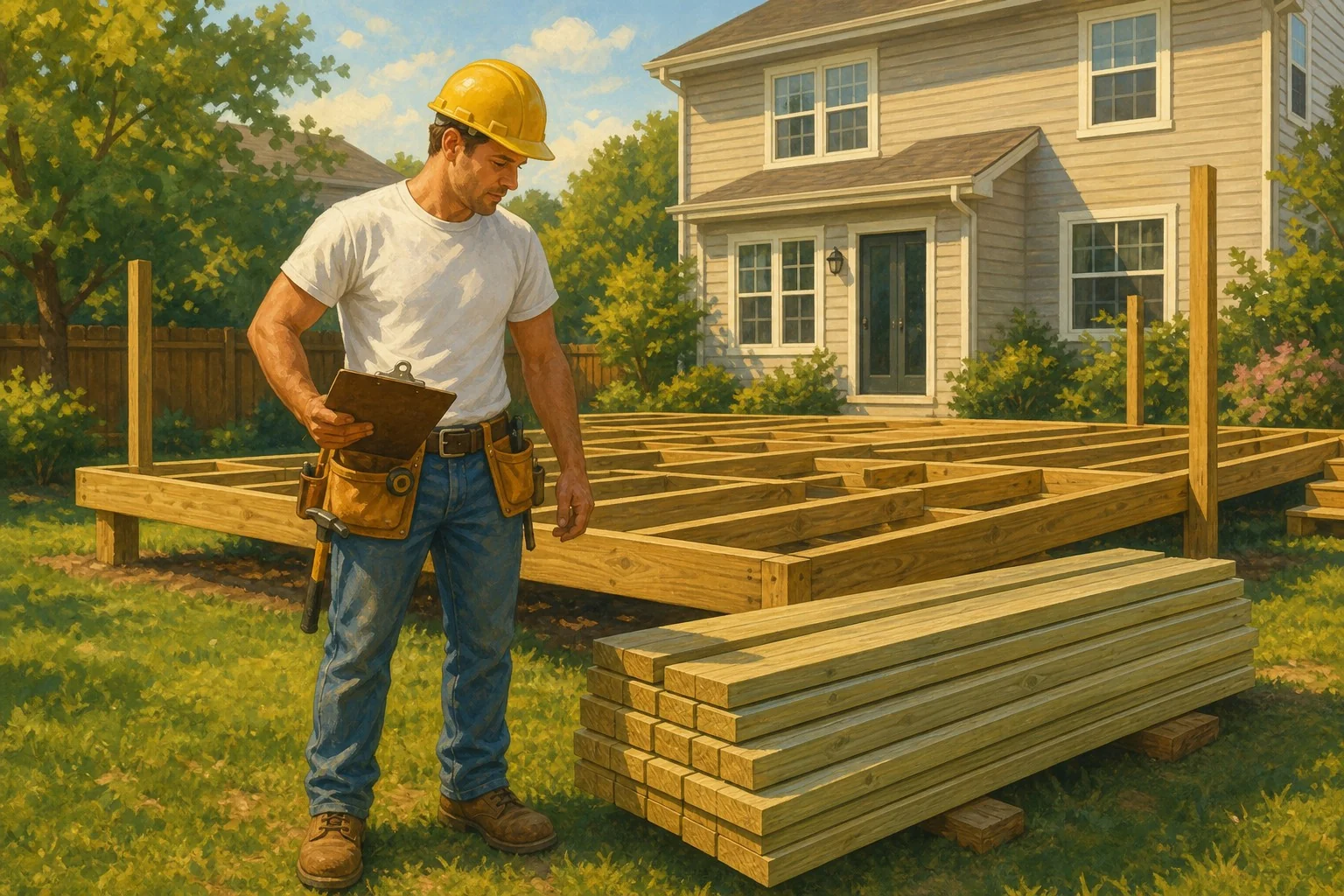
You’re building a deck. You’ve got your design, you’ve got your budget, and you’ve priced out your lumber. You know exactly how many boards you need. So you order exactly that many boards.
And then you call me two weeks later wondering why the job is stalled and your backyard looks like a construction site that somebody abandoned.
I’ve watched this play out more times than I can count. Homeowners order to the inch. No cushion. No margin for error. And then reality shows up — a warped board here, a bad cut there, a handful of fasteners short — and suddenly a two-week job turns into a month because you’re waiting on a reorder that’s backordered at the supplier.
Here’s what you do instead.
Add 10% to Your Decking Boards
Ten percent. Not five, not “a couple extras.” Ten.
This isn’t paranoia. It’s math. When you’re cutting boards to fit around posts, angles, or stairs, you’re going to waste material. Some of it’s planned waste, some of it’s a bad cut you didn’t see coming, and some of it is a board you open the wrapper on and it’s got a knot right where you need solid wood. Composite decking can have surface defects. Pressure-treated lumber warps in your truck on the way home.
On a 400 square foot deck, 10% is about 40 square feet of boards. That feels like a lot until you’re on board 187 of 200 and you realize you’re three boards short and your supplier wants five days to restock.
Order the extra boards. If you finish without needing them, stack them in the garage. They’re worth keeping for repairs down the road. Decking materials change; colors get discontinued; the batch you buy next year might not match what you put down this year. Having spares isn’t waste — it’s insurance.
Fasteners: Double What You Think You Need
I know what you’re thinking. You’ve got the fastener count from the manufacturer’s spec sheet, you’re going to buy that number, maybe add ten percent.
Don’t.
Fasteners are cheap. Losing two days because you ran out of hidden deck clips forty screws from the finish line is not cheap. Buy double. Seriously. The price difference between the amount you think you need and double that amount is a rounding error compared to the cost of your time and your lumber sitting exposed to the weather while you wait for a reorder.
This goes for everything: deck screws, structural screws for the framing, joist hanger nails, lag bolts for the ledger. If you’re using hidden clip fasteners for composite decking, those things disappear into the gaps and get lost easier than you’d expect. Buy more.
The leftover box of screws goes in your hardware bin. You will use them. I promise.
Railing Parts: The Part Nobody Thinks About Until They’re Missing One
Railings are where the nickel-and-dime planning really bites people. You need a specific number of balusters, two post caps, a handful of rail brackets, maybe some angle connectors if you’ve got stairs. You calculate it all out, order exactly what the plan says, and then one baluster arrives cracked, or you miscounted a run, or you realize the stair railing needs a different bracket than the field railing.
Now you’re calling the supplier for one part. And they want to ship it ground because it doesn’t qualify for free freight. And it takes a week. And your deck is sitting there with an open railing section because you can’t use it until it’s done.
I had a job in Fishtown — nice couple, brand new composite deck, whole thing done except for six balusters on the stair section. The style had been discontinued. We spent two weeks tracking down a match. They got lucky, but it was close. Order extra balusters. Keep the receipts, keep the packaging, and return what you don’t use if the supplier allows it.
At minimum, order five to ten percent more balusters than your count requires. Post caps are cheap — buy one or two extra. Rail connectors, same thing.
One More Thing on Timing
If any part of your project uses special-order materials — custom-length boards, specific composite colors, particular railing profiles — order everything before you start demo or framing. Everything. Not “most of it” and then the rest when you need it.
Supply chains are not predictable. What’s in stock today might be backordered by next Tuesday. I’ve seen decks sit framed and exposed through two weeks of rain because the decking boards were stuck in a distribution center somewhere. The framing holds up. The homeowner’s patience doesn’t.
Get all your materials on-site before you pull a single board off the old deck. Order extra. Keep what you don’t use. Return what the supplier will take back.
Or don’t, and order twice. Your choice.