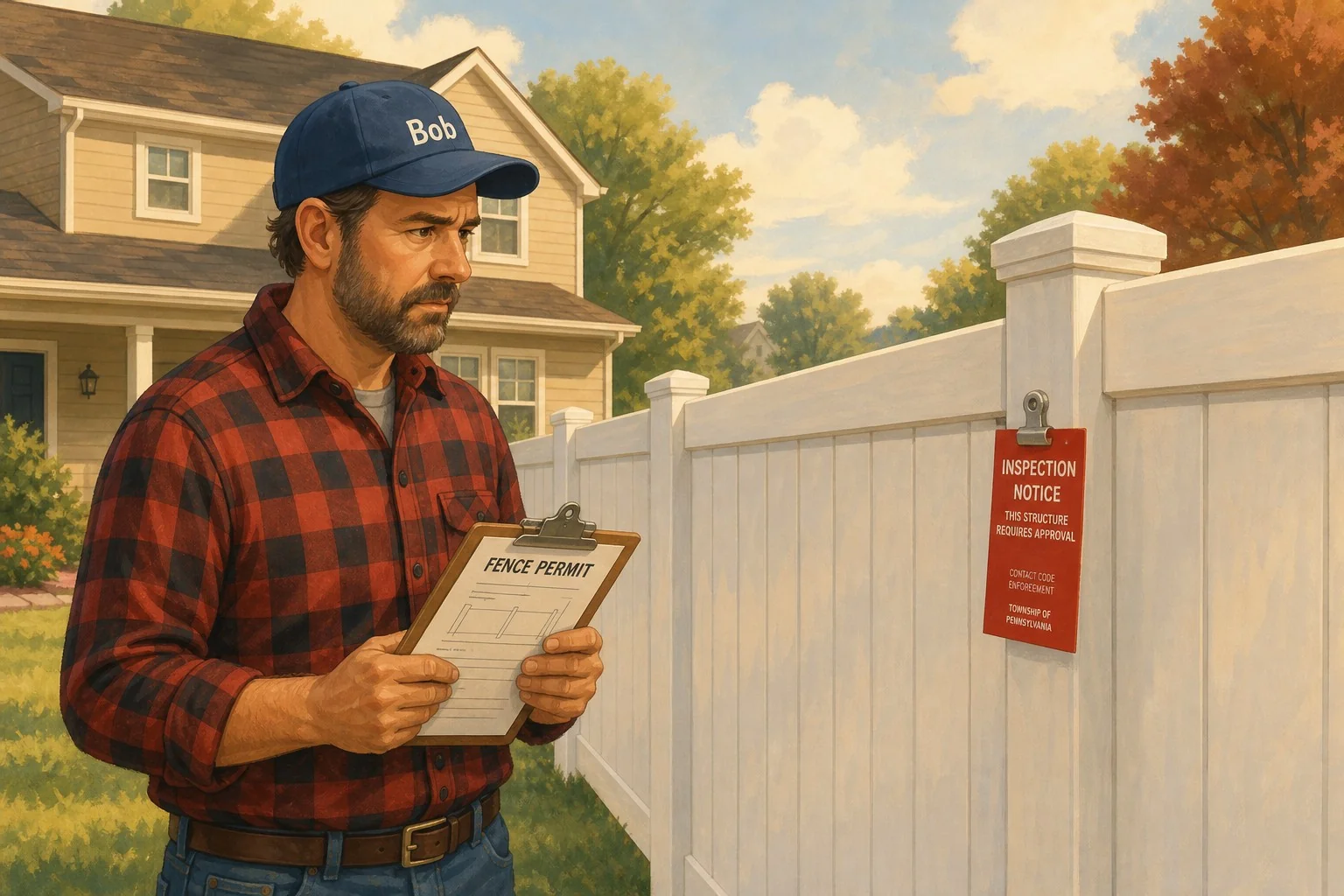
Most fences don’t fail inspection because the homeowner is dumb. They fail because nobody told them the rules, and the guy they hired either didn’t know or didn’t care. Either way, the inspector shows up, red-tags the job, and now you’re paying twice — once for the fence, once to fix it.
Pennsylvania doesn’t have one fence code. Every township, borough, and city writes its own. That’s the first thing you need to get through your head. What flew in Cheltenham won’t fly in Lower Merion. Bucks County is not Philadelphia. Call your local zoning office before you dig a single hole. That one phone call saves more jobs than anything else I can tell you.
With that out of the way, here are the three things that trip people up over and over.
1. Footing depth — the frost line is not a suggestion
In most of PA, the frost line sits somewhere between 36 and 42 inches. That means your fence post footings — the concrete under your posts — need to go that deep. Not 24 inches because it was easier to dig. Not “close enough.” Deep enough to sit below where the ground freezes.
Why does the inspector care? Because when the ground freezes and thaws, anything sitting above the frost line moves. Your fence heaves in the winter, sags in the spring, and in three years the whole run looks like a drunk built it. And on a permitted job, the inspector is going to want proof.
Some townships want you to leave the holes open so they can measure before you pour. Some want photos with a tape in the hole. Some send a guy out. Ask before you start. If you pour concrete before the inspection and they wanted to see the holes, you’re digging it back out. I watched a homeowner in Roxborough do exactly that on a 180-foot run because his installer didn’t call for the pre-pour inspection. Weekend gone. Cost doubled. Wife not thrilled.
How to avoid it:
- Confirm your local frost depth in writing from the zoning office
- Ask specifically whether they want a pre-pour hole inspection
- Dig every hole to the required depth — not just the corners
- Take photos with a tape measure in the hole before you pour, every post
2. Setback errors — that fence is not where you think it is
Setback rules say how far your fence has to sit from the property line, the sidewalk, the curb, the neighbor’s driveway, the street, and sometimes an easement you didn’t know existed. These rules vary wildly. Some places let you build right on the line. Some make you pull back six inches, a foot, three feet, whatever the code says.
Here’s where homeowners get burned: they measure from the sidewalk, or from a hedge, or from where they think the line is. Then the inspector shows up with the plot plan and the fence is eight inches into the neighbor’s yard, or two feet into a public right-of-way. Now the fence comes down.
The property line is not always where the grass changes color. The sidewalk is often not on your property at all — the strip between the sidewalk and the curb usually belongs to the township, and there’s an easement running under your front yard for utilities. If you don’t know where your real lines are, you don’t know where your fence can go.
How to avoid it:
- Pull your plot plan or survey before you start. If you don’t have one, get one. It costs less than tearing down a fence
- Look up your zoning district’s front, side, and rear setback rules for fences specifically — they’re different from house setbacks
- Check for easements on your deed. Utility easements can kill a fence run
- If you share a line with a neighbor, talk to them and agree in writing before you dig. That conversation saves lawsuits
3. Corner clearance and sight triangles — the one that surprises everybody
If your property sits on a corner, or your fence goes near a driveway or intersection, there’s a rule called the sight triangle. It’s the area a driver has to be able to see through so they don’t T-bone somebody pulling out. In most PA municipalities, nothing over 30 inches tall — no fence, no hedge, no landscaping wall — can sit inside that triangle.
The triangle is usually measured from the corner of the intersection, back some number of feet along each street. The exact numbers depend on your town, the road classification, and the speed limit. Twenty-five feet is common. Some places want more.
This one catches people because a fence that’s perfectly legal in your backyard becomes illegal the second it crosses into the front-corner zone. Six-foot privacy fence in the back, drops to 30 inches once it hits the triangle. Or it just stops short. Either way, you need to know the line before you build up to it.
How to avoid it:
- If you’re on a corner lot or near any driveway, ask specifically about sight triangle requirements
- Get the measurement in writing — feet along each road, and max height inside the zone
- Plan the fence in two heights if you have to. Full privacy in the back, cut down or stopped short in the corner zone
- Don’t try to sneak a tall fence in and hope nobody notices. Somebody notices, usually a neighbor, and you’re back at square one
A few more things that get people red-tagged
Wrong side facing out. In a lot of PA townships the “finished side” — the side without the rails and posts showing — has to face your neighbor and the street. Build it backwards and you fail.
Height violations at the property line. Six feet in the back is standard most places. Four feet in the front is common. Some townships measure from grade, some from the sidewalk, some from the crown of the road. Ask.
Building over utilities. Call 811 before you dig. If you put a post through a gas line you’ve got bigger problems than a failed inspection.
No permit at all. Yeah, people still try this. The inspector drives by, sees a new fence, pulls the address, and there’s no permit on file. Now you’re paying penalty fees on top of the permit cost, and you’re still getting inspected.
The short version
Fence inspections in PA fail for the same three reasons over and over: the posts aren’t deep enough, the fence isn’t where it’s supposed to be, or it’s blocking somebody’s view of the road. Call your zoning office. Get your plot plan. Ask about sight triangles if you’re on a corner. Dig your holes to the frost line. Take pictures of everything.
Do those five things and you’ll pass. Skip them and you’ll pay for the fence twice. Your call.