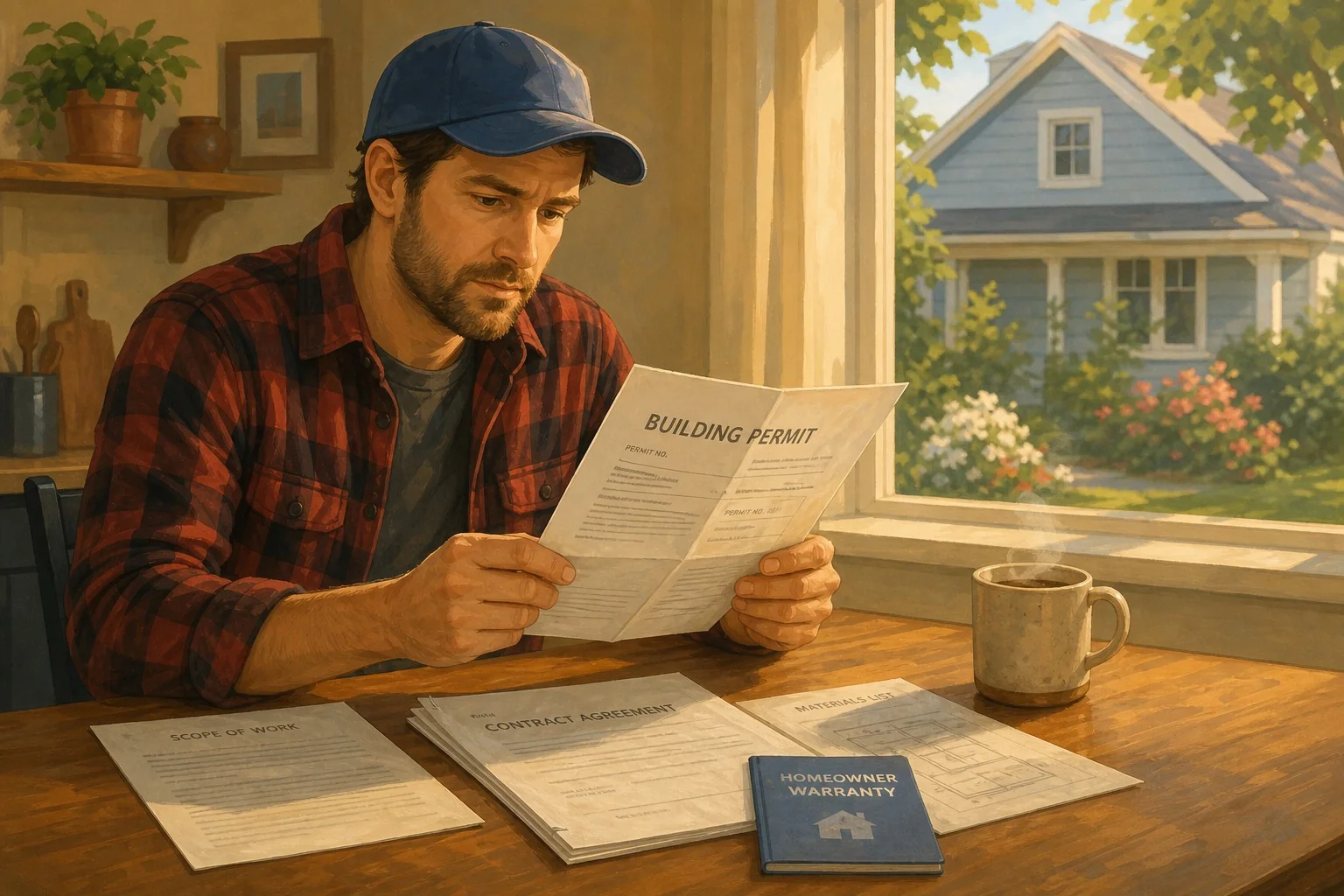
Nobody gets excited about paperwork. I get it. You want the kitchen done, not a filing system. But I have watched homeowners lose thousands of dollars — sometimes tens of thousands — because they had nothing in writing when things went sideways. And when things go sideways, they go fast.
You can do everything right and still get nailed if you can’t prove it. That goes for contractors, and it goes double for homeowners who hired the wrong one.
The Paper Trail Protects You — Not the Contractor
Here’s the thing most people get backwards: they think documentation is the contractor’s problem. It’s not. It’s yours.
When a contractor doesn’t pull a permit, the liability sits on the property. That means you. When a worker gets hurt on your job and there’s no record of proper insurance, guess whose homeowner policy takes the hit? Yours. When the roof leaks two years after a “professional” replaced it and you have nothing in writing about the scope of work or the materials used, you have no leg to stand on in small claims court. You just have a leaky roof and a bad story.
The paper isn’t bureaucracy. The paper is your leverage.
What You Need Before Anybody Touches Your House
Three things. Don’t let a job start without them.
1. A written contract that actually says something.
Not an email that says “gut the bathroom, $8,500, start Monday.” A real contract: scope of work, materials specified by brand and grade where it matters, payment schedule tied to milestones, start date, completion target, what happens if it goes over. Change orders in writing — every single one. If something changes and it’s not written down, you’ll be arguing about it at the end when everyone’s tired and nobody agrees on what was said four weeks ago.
The payment schedule is where I see homeowners get burned most often. Paying 50% upfront to someone you just met is not normal. Ten to fifteen percent is reasonable for mobilization on a bigger job. After that, payments should follow completed work you can see and verify.
2. Proof of insurance — current, not expired.
Ask for a certificate of insurance. Not a verbal “yeah, we’re covered.” A certificate. It should show general liability and workers’ compensation, and it should be current. Call the insurer if you want to be sure — the number’s on the certificate. Takes five minutes.
If a worker gets hurt on your property and the contractor doesn’t have workers’ comp, that worker’s medical bills can end up on your doorstep. I’ve seen it. Homeowners are stunned every time because they assumed someone else’s insurance would cover it. That’s not how it works.
3. Permits pulled before work starts.
If your contractor tells you permits aren’t necessary for the work you’re doing — electrical panel upgrade, addition, structural changes, new HVAC system — get a second opinion before you believe it. Unpermitted work can block a sale, fail an inspection, void your homeowner’s insurance, or require you to tear out finished work so an inspector can see what’s behind the wall.
Permits are not an inconvenience. They’re a record that the work was inspected and done to code. When you sell the house someday, that record matters.
No Documentation Means It Never Happened
I ran commercial jobs for years, and here’s what I learned from the regulatory side of things: OSHA doesn’t care what you meant to do. They care what’s written down.
Had a crew over in Port Richmond once — solid guys, clean site, nobody cutting corners. But safety meeting logs hadn’t been kept. Inspector came through, asked to see the documentation. Got blank stares. Didn’t matter that we’d been running tailgate meetings every Monday. Didn’t matter that nobody had gotten hurt. No paper, no proof. Citation issued.
That lesson applies directly to homeowners hiring for residential work. The absence of documentation isn’t neutral. In the eyes of an inspector, a court, or an insurance adjuster, if it isn’t written down, it didn’t happen. The contractor who told you verbally that they’d handle the permit? In their eyes, that conversation didn’t happen. The agreed-upon scope that changed twice during the job? Nobody remembers it the same way. The warranty on materials? Good luck enforcing a verbal promise eighteen months later.
What to Keep After the Job Is Done
Don’t toss the paperwork when the crew packs up. Keep it.
Hold on to the signed contract, all change orders, the final invoice, and proof of payment. Keep copies of any permits and the final inspection sign-off. If you bought materials yourself or the contractor specified brand names in writing, keep those records too. Manufacturer warranties often require documentation of who installed the product and when.
Store it somewhere you can find it. A folder in a drawer is fine. A photo on your phone works too. The point is to have it when you need it — which is usually when something’s going wrong fast and you don’t have time to dig.
The Bottom Line
Paperwork is not the exciting part of a renovation. Nobody frames their building permit. But no paperwork means no proof, and no proof means you’re at the mercy of whoever tells the most convincing story. In a dispute, that’s usually not the homeowner.
Get it in writing before the job starts. Keep it when the job’s done. It costs you nothing and it’s the only thing standing between you and a very expensive lesson.
I’ve seen good projects turn into nightmares because nobody wanted to slow down long enough to document anything. Don’t be that story.