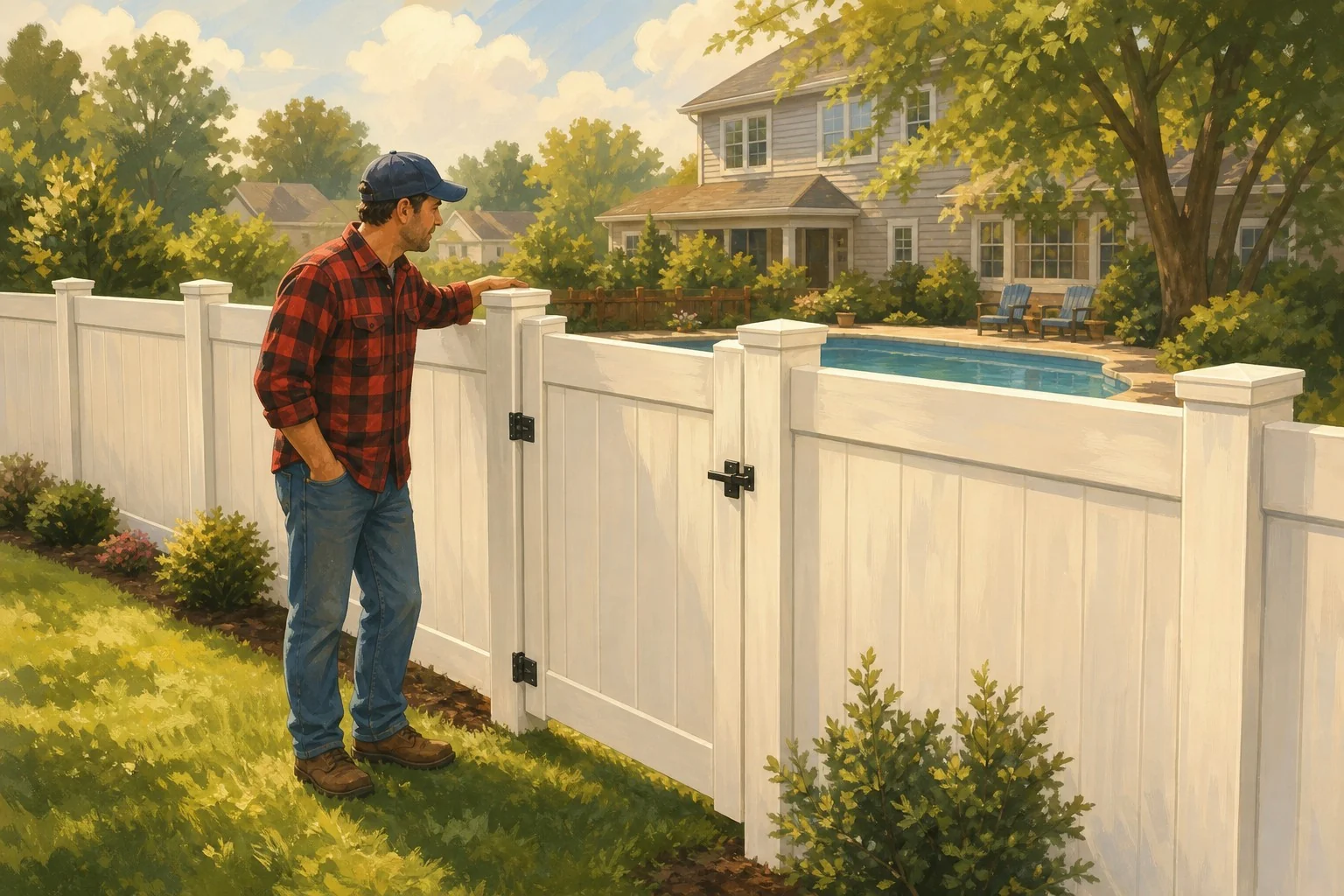
Nobody wants to think about a kid drowning in their backyard. So most homeowners don’t. They put in the pool, throw up whatever fence the pool company sells them, and move on with their summer.
Then a neighbor’s kid wanders in through a gate that never quite latched, and everyone finds out the hard way what the law actually says.
Pennsylvania has real, enforceable pool fence rules. Not suggestions. Not “best practices.” Rules that inspectors will fail you on and insurance companies will drop you over. Here’s what you actually need to know as a homeowner.
The Law Starts With the ISPSC
Pennsylvania adopted the International Swimming Pool and Spa Code under the state’s Uniform Construction Code. Every township, borough, and city in PA either enforces it straight or has amended it to be stricter — never looser. So if your buddy tells you his cousin in some township got away with a 3-foot fence, either the cousin is lying or somebody didn’t do their job.
Any pool that holds more than 24 inches of water needs a barrier. That includes most inflatable pools, all above-ground pools, in-ground pools, and hot tubs without a locking cover. Yes, the Costco blow-up pool counts. Sorry.
Fence Height: 4 Feet Is the Floor, Not the Goal
The code minimum is 48 inches, measured from the outside. Not from inside the pool area. Not from the top of some berm you built up to make it look taller. From the actual ground where a kid would be standing.
Four feet clears code. It does not clear common sense. A determined eight-year-old can climb a 4-foot fence in about six seconds. Most townships around Philly — Montco, Delco, Chester County, Bucks — are fine with 48 inches. But if you want the fence to actually do its job, put in six feet. Your insurance company will thank you, your future self will thank you, and no drunk uncle at a Fourth of July party is climbing over a 6-footer without a ladder.
Gate Hardware Is Where People Get Cocky
This is the part homeowners screw up the most, and it’s the part inspectors look at first.
- Self-closing. The gate has to close on its own. Every time. No exceptions. No “we usually remember to shut it.” A spring hinge that costs thirty bucks at the hardware store does the job.
- Self-latching. It has to latch on its own once it closes. Not “if you slam it hard.” Automatically.
- Latch height. The release has to be at least 54 inches above the ground on the outside of the fence. Or, if the latch is on the pool side, it needs a shield so a small hand can’t reach through and pop it.
- Opens outward. Away from the pool. So a kid pushing on it can’t just push their way in.
I had a client up in Roxborough — nice couple, new in-ground pool, big housewarming planned for that Saturday. Inspector came out Wednesday, walked straight to the gate, pushed it with one finger, and watched it drift open and stay open. Failed on the spot. They had to cancel the party and eat a re-inspection fee. The fix was a $28 spring hinge and a $15 gravity latch. Ten minutes of work. That’s how close people cut it.
Gaps, Spacing, and the 4-Inch Rule
The fence itself has rules about what can pass through it. Nothing on the barrier can allow a 4-inch sphere to pass. That’s basically the fist test — if a small kid’s head can fit, it’s not compliant.
Vertical pickets need to be spaced no more than 1¾ inches apart if there’s a horizontal rail below 45 inches on the outside. Why? Because horizontal rails become ladder rungs. If you’ve got a horizontal-rail fence — the kind that looks like a farm fence — and the rails are within reach of the ground, code tightens the vertical spacing so kids can’t climb it like a jungle gym.
Chain link needs mesh openings no larger than 1¼ inches, or it needs slats woven through to close the gaps. That old chain-link fence from 1978 you were hoping to reuse? Probably doesn’t pass. Measure it before you assume.
Ground clearance under the fence: no more than 2 inches. If your yard slopes and there’s a 4-inch gap under the gate, that’s a fail. Doesn’t matter how pretty the fence is.
Above-Ground Pools Get No Free Pass
Homeowners think above-ground pools are exempt because the pool itself is 4 feet tall. Wrong.
If the pool wall is at least 48 inches high and there’s no permanent ladder, the pool wall can serve as the barrier — but only if the ladder is removable or has a lockable, code-compliant cover. If you’ve got a deck attached to the pool, that deck needs its own fenced or gated enclosure. Otherwise the deck is just a launching pad straight into the water. That’s not me being dramatic. That’s how kids drown.
What Your Insurance Company Wants (This Is Where It Gets Expensive)
Code is the minimum. Insurance is where it actually hurts if you get it wrong.
Most homeowner policies in PA classify pools as an “attractive nuisance.” Translation: you can be liable even if a trespasser gets hurt. Carriers manage that risk by demanding more than code:
- 6-foot fences are standard for underwriting on a lot of in-ground pool policies now
- Locked gates — not just latched, actually locked with a key or combo when unattended
- Pool alarms or safety covers required by some carriers, especially for diving pools
- No diving board on a lot of residential policies now, or a big premium hike if you keep one
- Photos at renewal. Yes, they’ll ask. Yes, they’ll drop you if the fence looks like it lost a fight with a windstorm
Every carrier is different. State Farm doesn’t want what Erie wants. Erie doesn’t want what USAA wants. Call yours before you build and get the requirements in writing. Otherwise you find out at claim time, which is the worst possible moment to learn anything.
Get the Permit. Get the Inspection.
You need a permit for the pool. In most PA townships that same permit covers the barrier. Some require a separate fence permit. Either way, an inspector comes out before you can fill the pool or use it.
Don’t try to sneak around this. If someone gets hurt at an unpermitted pool, your homeowner policy will find out fast, and they will deny the claim. And if it’s a kid, you’re not just fighting an insurance company — you’re facing the county too.
Bottom Line
The rules aren’t complicated:
- 48 inches minimum, six feet if you’re smart
- Self-closing, self-latching, opens outward, latch 54 inches up
- No gaps a 4-inch sphere can pass through, no climbable horizontal rails within kid reach
- Above-ground pools need a locked or removable ladder — the pool wall alone is not enough if the ladder stays up
- Call your insurance carrier before you dig
- Pull the permit, pass the inspection, keep the paperwork
A pool is fun. Nobody’s arguing that. But it’s also a large tank of water in your yard that children are magnetically drawn to. Build the barrier like it matters. Because it does.